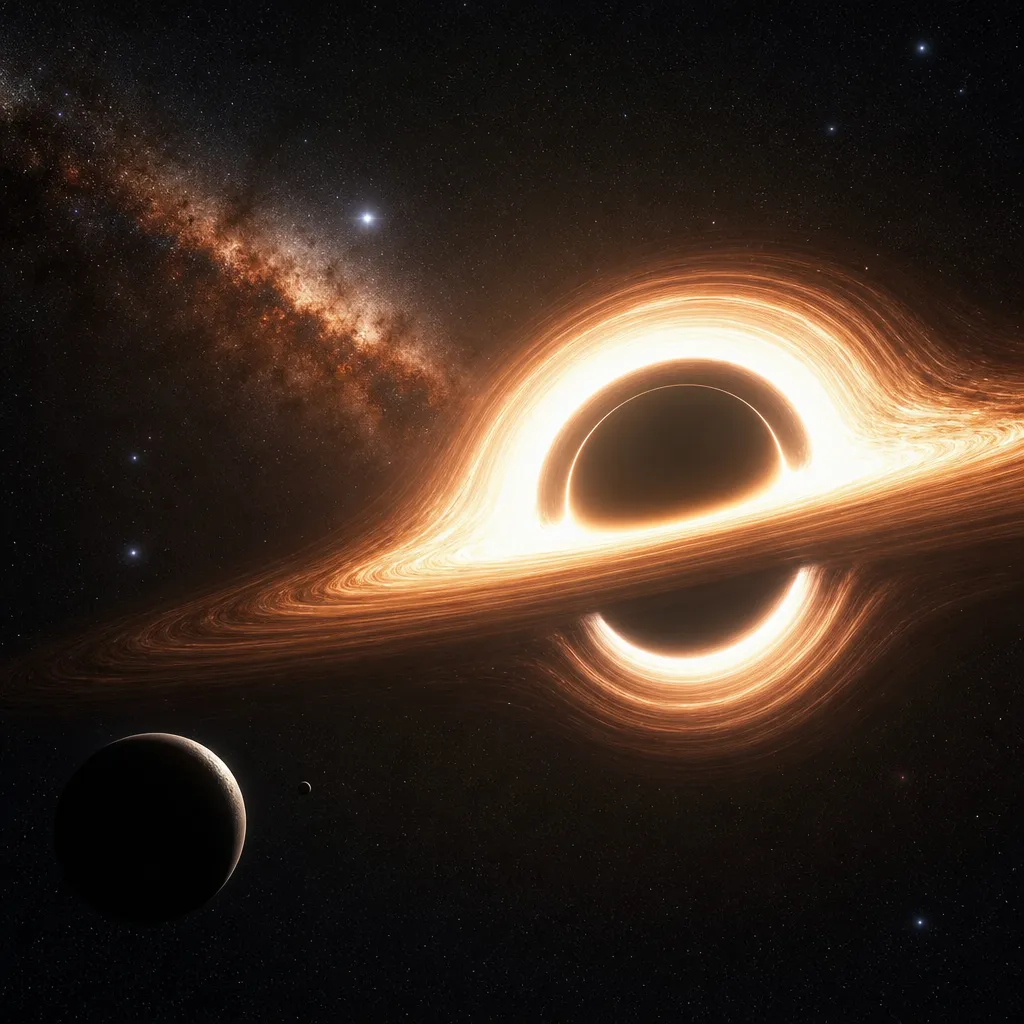


Gravitational lensing arises when massive objects cause a curvature in spacetime, deflecting light from distant sources. This phenomenon, predicted by Einstein’s theory of General Relativity, has become one of the most powerful tools in cosmology and astrophysics. By studying these cosmic distortions, astronomers can map the distribution of dark matter, magnify faint galaxies, and probe the large-scale structure of the universe. This article examines the physical principles, observational techniques, and key applications that underpin gravitational lensing.
Fundamentals of Gravitational Lensing
At its core, gravitational lensing occurs because mass tells space how to curve, and curved space tells light how to move. When a massive object—such as a galaxy or cluster of galaxies—lies between a distant light source and an observer, it acts like a lens, bending the path of photons. The amount of deflection depends on the mass distribution of the lens and the alignment between the source, lens, and observer.
General Relativity describes the geometry of spacetime around a mass. A simple way to visualize this is with the two-dimensional “rubber sheet” analogy: a bowling ball placed on a stretched sheet creates a depression, and marbles roll toward it. In the cosmic stage, the sheet is four-dimensional spacetime, the bowling ball is a massive object, and the marbles are packets of light energy.
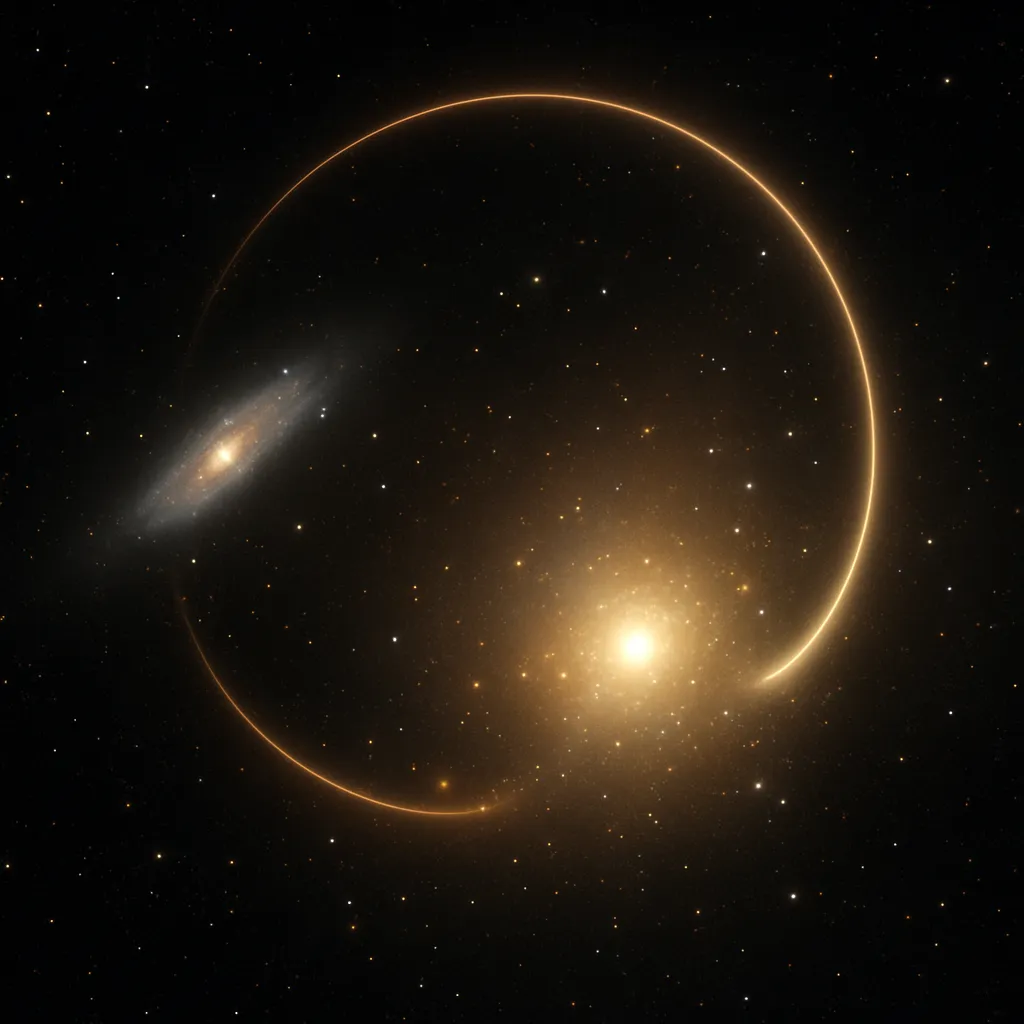
Mathematically, the lens equation relates the angular position of the source (β), the image (θ), and the lens potential (ψ). This relationship can produce multiple images, arcs, or even rings of the background source, depending on the precise geometry. The so-called Einstein ring appears when source, lens, and observer are perfectly aligned, generating a circular image whose radius is the Einstein angle θE:
- θE = √(4G M / (c²) × DLS / (DL DS))
Here, G is the gravitational constant, c is the speed of light, M is the lens mass, and DL, DS, and DLS are the angular diameter distances to the lens, to the source, and between lens and source.
Types of Lensing Effects
Strong Lensing
When a foreground object is extremely massive and closely aligned with a background source, it can produce highly distorted, multiple images or giant arcs. These striking visuals often occur around massive galaxy clusters, whose combined gravitational field can act as a powerful cosmic magnifier. Strong lensing enables astronomers to study galaxies that would otherwise be too faint or too distant to detect.
Weak Lensing
Weak lensing produces subtler, statistical distortions of galaxy shapes. Individual galaxies are only slightly sheared, but by averaging over millions of sources, researchers can map the projected mass density of the universe. This technique has become a cornerstone for measuring the large-scale distribution of dark matter and constraining cosmological parameters such as the matter density parameter Ωm and the dark energy equation of state.
Microlensing
Microlensing occurs when a stellar-mass object—like a star, black hole, or rogue planet—briefly aligns with a background source. The lens is too small to produce resolvable multiple images, but the total brightness of the source temporarily increases. Microlensing surveys have discovered exoplanets, probed the mass function of compact objects, and set limits on MACHOs (Massive Compact Halo Objects) as dark matter candidates.
Observational Techniques and Instruments
Detecting gravitational lensing signatures requires high-resolution imaging, precise photometry, and accurate modeling. Modern surveys employ a combination of space-based and ground-based facilities.
- Hubble Space Telescope: Its unparalleled angular resolution has revealed detailed arcs and Einstein rings, crucial for reconstructing mass distributions.
- James Webb Space Telescope: Equipped with infrared sensitivity, JWST can peer through dust and observe high-redshift galaxies magnified by foreground lenses.
- Large Synoptic Survey Telescope (Vera C. Rubin Observatory): Expected to image billions of galaxies, enabling high-precision weak lensing studies across vast sky areas.
- Atacama Large Millimeter/submillimeter Array (ALMA): Provides milliarcsecond resolution to probe molecular gas in lensed galaxies, revealing star formation at early epochs.
Survey strategies often involve deep, wide-field imaging combined with spectroscopy to determine redshifts of lenses and sources. Data pipelines use sophisticated shape-measurement algorithms and machine learning to extract shear maps and detect rare strong-lens configurations.
Applications in Modern Cosmology
Gravitational lensing has revolutionized our understanding of the universe. Among its key applications are:
- Mapping Dark Matter: Since lensing is sensitive to total mass—visible and invisible—it directly reveals the distribution of dark matter in galaxy clusters and the cosmic web.
- Measuring the Hubble Constant: Time delays between multiple images of strongly lensed quasars provide an independent route to H0, helping to address the current tension between local and early-universe measurements.
- Studying Galaxy Evolution: Lensed galaxies at high redshift appear brighter and larger, enabling detailed spectroscopic studies of their stellar populations, kinematics, and interstellar medium.
- Probing Dark Energy: Weak lensing tomography, which slices the universe into redshift bins, constrains the growth of structure over cosmic time, placing limits on dark energy properties.
Challenges and Future Prospects
While gravitational lensing is a powerful probe, it faces several challenges. Intrinsic alignments of galaxies can bias weak lensing signals, and accurate photometric redshifts are essential to avoid systematic errors. The complex modeling of cluster lenses requires large computational resources and improved mass reconstruction techniques.
Looking ahead, upcoming missions like the Euclid satellite and the Nancy Grace Roman Space Telescope will dramatically expand lensing datasets, offering sub-percent precision on cosmological parameters. Combined with multi-messenger astrophysics—linking lensing observations to gravitational waves and neutrino signals—the next decade promises transformative insights into the invisible scaffolding of our universe.