

Black holes form when enough mass is compressed into a small enough region that gravity overwhelms every known force that could otherwise support the object. In today’s universe, the best-established route is the collapse of the core of a very massive star after it runs out of nuclear fuel. Black holes can also grow by swallowing gas, merging with other compact objects, and possibly by forming through other channels in unusual environments. Although black holes themselves do not emit light, astronomy has built strong evidence for how they form by observing the stars, gas, radiation, and gravitational waves around them.
A black hole is not simply a “cosmic vacuum cleaner.” It is a region of spacetime bounded by an event horizon, a surface beyond which not even light can escape. Outside that boundary, however, gravity behaves in ordinary ways: if the Sun were somehow replaced by a black hole of the same mass, Earth would continue orbiting much as it does now. What makes black holes special is not that they pull harder at a distance than other objects of equal mass, but that matter can collapse to extraordinary density and trap escape paths entirely.
What a black hole is
According to Einstein’s general theory of relativity, mass and energy curve spacetime, and gravity is the result of objects moving through that curved geometry. A black hole forms when matter becomes so compact that all future paths inside a certain boundary lead inward. That boundary is the event horizon.
For a non-rotating, uncharged black hole, the event horizon’s size depends only on mass. Real black holes in nature are expected to rotate, often rapidly, because the matter that formed them almost always carried angular momentum. Rotation changes the surrounding spacetime and affects how gas falls in, how jets may be launched, and how two black holes merge.
The center of a black hole is often described using the term singularity, where current equations predict extreme curvature. But this is a sign that known physics is incomplete under such conditions. General relativity describes black holes extremely well outside the horizon, yet the true nature of the innermost region remains uncertain and likely requires quantum gravity to understand fully.
The main way black holes form: stellar core collapse
The clearest formation pathway produces stellar-mass black holes. These begin as very massive stars, much heavier than the Sun. During most of a massive star’s life, gravity tries to squeeze it inward while pressure from hot gas and energy released by nuclear fusion push outward. As long as fusion continues, the star can remain stable.
That balance eventually fails. In the core of a massive star, fusion builds heavier elements in stages. But fusion of iron-group elements does not provide the same outward energy support. Once the core becomes dominated by iron and grows too massive to be supported, it collapses in a fraction of a second.
What happens next depends on the mass of the collapsing core and on details such as rotation, magnetic fields, and how much mass the star lost earlier in its life. In many cases, the collapsing core rebounds and drives a supernova explosion, leaving behind a neutron star. In other cases, the core is too massive, and no known pressure can halt the collapse. Then a black hole forms.
Some black holes may form after a failed or weak supernova, where much of the star falls inward. In some scenarios, the outer layers are ejected only partly, and in others the star may collapse with little visible explosion at all. Astronomers call this kind of event a direct collapse or a failed supernova candidate, depending on the evidence and model.
The physics of collapse
Core collapse is a battle between gravity and pressure. Pressure inside stars comes from particle motion, radiation, and, in compact remnants, quantum effects. White dwarfs are supported by electron degeneracy pressure. Neutron stars are supported mainly by neutron degeneracy pressure and strong-interaction physics. But these supports have limits.
If the remnant core is too massive, gravity wins. The collapse continues inward, and once enough mass lies within its Schwarzschild radius for a non-rotating case, an event horizon forms. From that point on, the object is a black hole.
Rotation can delay collapse or shape the infalling material into disks, but it cannot indefinitely save an overmassive core. Magnetic fields may channel flows and help power jets in some explosions, especially in rare high-energy events such as some long gamma-ray bursts. Still, the basic requirement remains the same: enough mass concentrated into a sufficiently small volume.
| Stage | What happens | Likely outcome |
|---|---|---|
| Massive star burns nuclear fuel | Fusion supports the star against gravity for millions of years | Stable star during most of its life |
| Iron-rich core develops | Fusion can no longer provide enough outward pressure | Rapid core collapse begins |
| Collapse of the core | Density rises enormously; shock waves, neutrinos, and fallback may shape the event | Neutron star or black hole |
| If the remnant is too massive | No known force can stop collapse | Black hole forms |
Other possible formation channels
Not all black holes need to form from single stars. Some arise in binary systems, where one star evolves faster, collapses, and later gains more mass from its companion. Binary evolution can strongly affect final masses and spins. It can also produce pairs of black holes that eventually spiral together and merge.
When two black holes merge, they create a larger black hole. This is growth rather than first-time creation of a black hole from ordinary matter, but it is an important formation route for the black holes detected through gravitational waves. Repeated mergers in dense stellar environments, such as globular clusters or galactic centers, may build heavier black holes over time, though the efficiency of this process is still under study.
There is also strong evidence that supermassive black holes live in the centers of most large galaxies. How the first ones formed remains one of the major open questions in astrophysics. Several ideas are actively studied:
- Growth from stellar remnants: an early stellar-mass black hole forms, then accretes gas and merges repeatedly.
- Direct collapse of enormous gas clouds: under special conditions, a dense gas cloud may avoid fragmenting into many stars and instead collapse into a massive seed black hole.
- Dense star-cluster pathways: frequent collisions and mergers among stars in a crowded cluster may produce a massive central object that later collapses.
These are plausible mechanisms, not settled fact in every detail. Observations of very massive black holes in the early universe show that some of them grew quickly, but the exact mix of seed formation and later growth remains uncertain.
Supermassive black holes and galaxy evolution
Supermassive black holes are millions to billions of times the Sun’s mass and sit in galactic centers. The Milky Way hosts one called Sagittarius A*. These giant black holes are thought to grow through accretion of gas and through mergers during galaxy collisions.
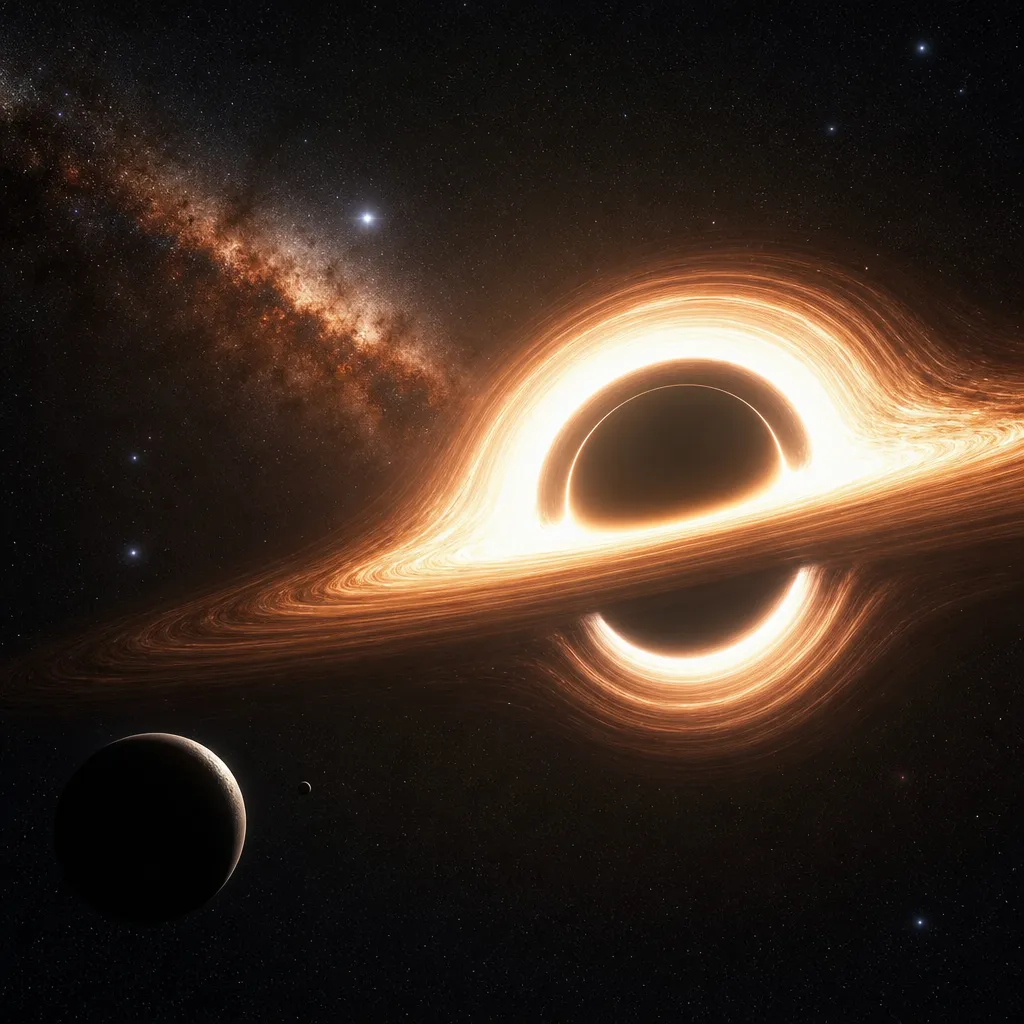
When gas falls toward a supermassive black hole, it often forms a hot, glowing accretion disk. Friction and magnetic effects in the disk convert gravitational energy into heat and radiation, making active galactic nuclei and quasars among the brightest long-lived objects in the universe. The black hole itself remains dark; the light comes from matter just outside the event horizon.
These objects matter far beyond their immediate surroundings. Energy released near growing supermassive black holes can heat or expel gas from galaxies, influencing future star formation. This “feedback” is now a central idea in galaxy evolution, supported by many observations, though the detailed coupling between black-hole activity and galaxy gas is complex and still being refined.
| Black hole type | Likely formation route | How astronomers detect it |
|---|---|---|
| Stellar-mass | Collapse of a massive star’s core | X-rays from accretion, orbital motion of companion stars, gravitational waves from mergers |
| Intermediate-mass | Possibly repeated mergers, dense-cluster collapse, or unusual stellar evolution | Dynamical effects, accretion signatures, some gravitational-wave events |
| Supermassive | Early seed formation plus long-term accretion and mergers | Stellar and gas orbits in galactic centers, active nuclei, radio imaging of event-horizon-scale emission |
How scientists know black holes form this way
No telescope watches an event horizon “switch on” in direct real time with a clear label saying a black hole has formed. Instead, the case comes from multiple lines of evidence that fit together.
One line comes from the lives and deaths of massive stars. Astronomers observe supernovae, measure the masses of stars in binary systems, and identify compact objects too massive to be neutron stars. In X-ray binaries, a dark object pulls gas from a companion star; by tracking the companion’s orbit, scientists can infer the unseen object’s mass. If that mass exceeds the plausible upper limit for a neutron star, the strongest explanation is a black hole.
Another line comes from gravitational-wave observatories such as LIGO and Virgo, which have detected mergers of black holes. The waveforms match general relativity’s predictions for spiraling and merging black holes with remarkable precision. These detections prove that black holes exist in binaries and can be born, paired, and later merged in nature.
At galactic centers, astronomers track the orbits of stars around invisible massive objects. In the Milky Way, stars near Sagittarius A* move under the influence of a compact object containing millions of solar masses within a tiny region. That is compelling evidence for a supermassive black hole. The Event Horizon Telescope has also imaged bright emission from hot plasma near the shadows of the black holes in M87 and Sagittarius A*, adding direct horizon-scale evidence.
What remains uncertain
Many details are still open questions. One uncertainty is the exact mass boundary separating neutron-star and black-hole formation. That boundary depends on the poorly known behavior of matter at extreme density, on rotation, and on the messy physics of supernova explosions.
Another unresolved issue is how common direct collapse is. Some very massive stars may vanish with little visible fireworks, but such events are difficult to confirm observationally. Astronomers continue searching for stars that disappear and for transients that may signal failed supernovae.
The origin of intermediate-mass black holes is also not fully established. They may bridge the gap between stellar-mass and supermassive black holes, but clear examples remain harder to confirm than the better-studied extremes.
Perhaps the biggest mystery is the birth of the first supermassive black holes. Quasars seen in the early universe show that some black holes became enormous quickly. Whether they began as relatively small seeds growing at high rates, or as already-massive seeds from direct collapse, is still an active area of research.
Why black-hole formation matters
Understanding black-hole formation is about more than black holes themselves. It connects stellar evolution, nuclear physics, supernovae, galaxy growth, and gravity under extreme conditions. Black holes also shape their environments. In small systems, they can affect companion stars and produce powerful X-ray sources. In large systems, supermassive black holes can regulate the gas supply of whole galaxies.
They are also laboratories for fundamental physics. Their mergers test general relativity in strong gravitational fields. Their accretion disks and jets probe magnetized plasma under extraordinary conditions. And the unresolved issues around singularities and information connect black holes to the search for a deeper theory that unites gravity and quantum mechanics.
Frequently asked questions
Can any star become a black hole?
No. Most stars are not massive enough. Sun-like stars end as white dwarfs, not black holes. Black holes form from particularly massive stars or through other special pathways such as mergers and long-term growth.
Does every supernova make a black hole?
No. Many core-collapse supernovae leave neutron stars. Whether a black hole forms depends on the mass of the collapsing core and on details of the explosion and fallback of matter.
How do scientists know a dark object is a black hole and not just a dim star?
They measure its gravitational effects. If an unseen object is extremely compact and has too much mass to be a white dwarf or neutron star, a black hole is the best explanation. X-rays from infalling gas and gravitational-wave signals provide additional evidence.
Where do black holes form?
Stellar-mass black holes form where massive stars live and die, especially in star-forming regions and binary systems. Supermassive black holes are found in galactic centers. Some black holes may also form and merge in dense star clusters.
Can a black hole form without a bright explosion?
Possibly, yes. Theory and some observations suggest that certain very massive stars may collapse into black holes with a weak explosion or almost none at all. This remains an active research topic.
Are black holes dangerous to Earth?
There is no evidence that any known black hole poses a direct threat to Earth. The stellar-mass black holes known in our galaxy are far away, and the supermassive black hole in the Milky Way’s center is also at a safe distance.
What missions and observatories study black holes?
Black holes are studied by many facilities rather than a single mission. These include X-ray observatories, radio arrays such as the Event Horizon Telescope, optical and infrared telescopes that track stellar motions, and gravitational-wave detectors such as LIGO and Virgo.
What is the biggest unknown about black-hole formation?
One of the biggest unknowns is how the earliest supermassive black holes formed so quickly in the young universe. Another is the exact physics that determines whether a collapsing stellar core becomes a neutron star or a black hole.
Sources
- NASA: Black Holes
- Event Horizon Telescope Collaboration, first M87 black hole image results, The Astrophysical Journal Letters (2019)
- LIGO Scientific Collaboration: Gravitational Waves and Black Holes