
A black hole is a region of space where gravity is so strong that, once something crosses a certain boundary, it cannot escape—not even light. It is not a cosmic vacuum cleaner that sucks in everything nearby; far away, it pulls on other objects just as any other mass would. Black holes form when enough matter is packed into a small enough volume, most commonly after very massive stars collapse, though some are far larger and grew in the centers of galaxies. They matter because they test our understanding of gravity, shape galaxies, power some of the brightest phenomena in the universe, and reveal physics under extreme conditions.
What a black hole actually is
In modern physics, a black hole is a prediction of Albert Einstein’s general theory of relativity. According to that theory, mass and energy curve spacetime, and gravity is the motion of objects through that curved spacetime. If enough mass collapses into a sufficiently small region, the curvature becomes so extreme that it creates an event horizon: a boundary beyond which all possible paths lead inward.
The event horizon is not a solid surface. If an astronaut could approach a large black hole without being torn apart by tides, they would not hit a wall at the horizon. Instead, it is a one-way boundary. Outside it, escape is possible in principle. Inside it, all future motion leads deeper inward.
At the center of the simplest mathematical description lies a singularity, a place where current equations predict infinite density and spacetime curvature. Most physicists do not take that literally as a finished description of nature. Rather, it signals that general relativity is being pushed beyond the regime where it can fully describe reality without quantum effects.
The key parts: horizon, accretion disk, and jets
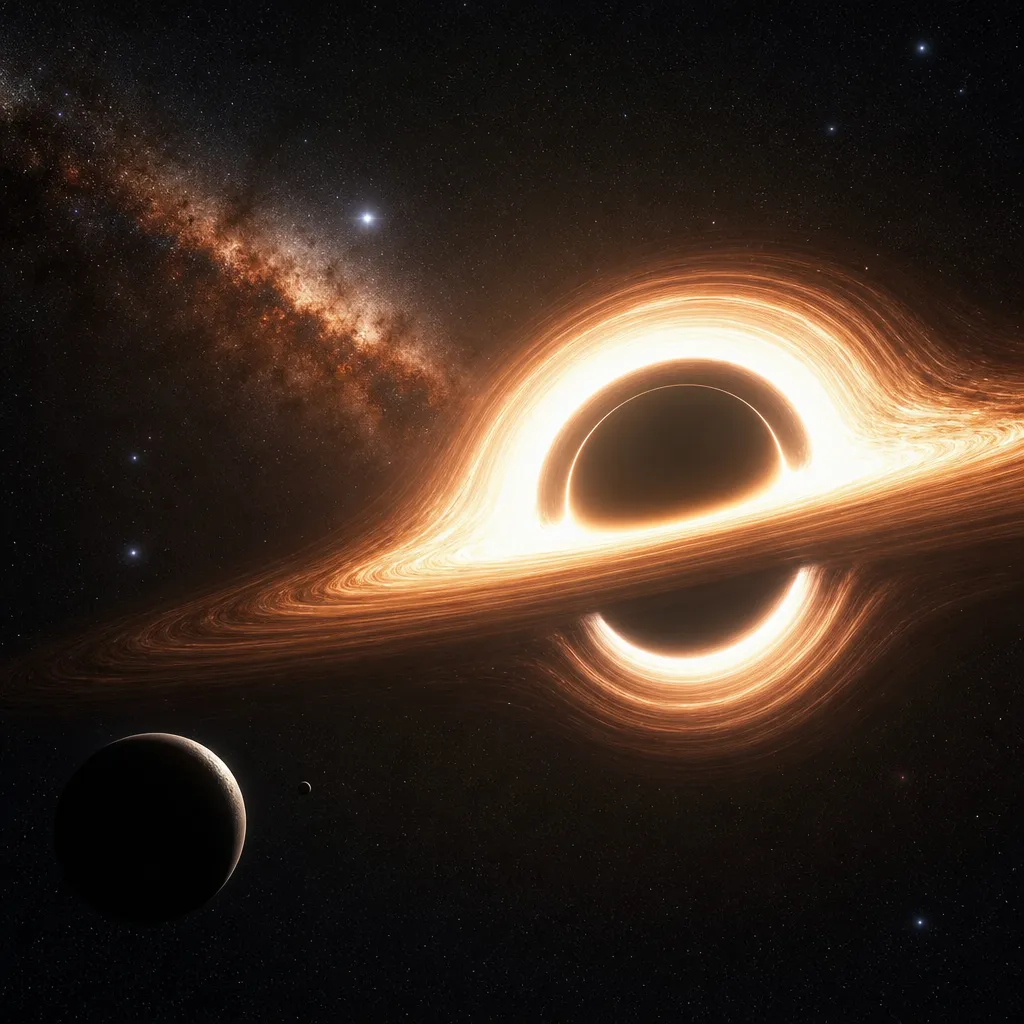
Black holes themselves emit no light in the ordinary sense. What astronomers often observe is the environment around them. Gas falling toward a black hole can form a fast-spinning accretion disk. Friction, compression, and magnetic effects heat this gas to enormous temperatures, causing it to glow in visible light, ultraviolet, and especially X-rays.
Some black holes also produce powerful jets: narrow beams of particles and energy launched from the region near the black hole. The jets do not come from inside the event horizon. They are thought to be powered by magnetic fields and the rotation of the disk, and in some models by the black hole’s spin itself.
Another important idea is the Schwarzschild radius, which gives the size of the event horizon for a non-rotating black hole of a given mass. Real black holes often rotate, so their geometry is more complex than that simple case.
| Term | Meaning | Why it matters |
|---|---|---|
| Event horizon | The boundary beyond which escape is impossible | Defines the black hole observationally and theoretically |
| Accretion disk | Hot, rotating gas spiraling inward | Produces much of the radiation we detect |
| Singularity | A region where current equations break down | Points to missing physics, likely involving quantum gravity |
| Jets | High-speed outflows from near the black hole | Influence stars, gas, and even entire galaxies |
| Spin | Rotation of the black hole | Affects nearby spacetime, disk structure, and jet production |
How black holes form
The best-established pathway for forming a stellar-mass black hole begins with a very massive star. When such a star runs out of fuel in its core, pressure can no longer support it against gravity. The core collapses. Depending on the star’s mass and the details of the explosion, the remnant may become a neutron star or a black hole.
There are also supermassive black holes in the centers of most large galaxies, including the Milky Way. These contain millions to billions of times the Sun’s mass. Their exact origin is still an active research topic. They may have grown from smaller “seed” black holes formed in the early universe, from the collapse of unusually massive gas clouds, or through repeated mergers and accretion. Scientists have strong evidence that supermassive black holes exist, but the details of how the first ones formed remain uncertain.
A third category, intermediate-mass black holes, appears to exist as well, though they are harder to confirm. They would fill the gap between stellar-mass and supermassive objects. Evidence for them has strengthened in recent years, but they are still less well cataloged.
Types of black holes
Black holes are often grouped by mass and origin rather than by appearance.
| Type | Typical origin | Scientific relevance |
|---|---|---|
| Stellar-mass | Collapse of a massive star | Links black holes to stellar evolution and supernova physics |
| Intermediate-mass | Uncertain; possible mergers or dense stellar environments | May explain how larger black holes grow |
| Supermassive | Growth of early seeds, gas accretion, and mergers | Central to galaxy evolution and active galactic nuclei |
| Primordial (hypothetical) | Possible formation from dense conditions in the early universe | Not confirmed; relevant to cosmology and dark matter ideas |
The last category, primordial black holes, remains hypothetical. They have not been confirmed, and whether they exist at all is still unknown.
How scientists know black holes are real
Since black holes emit no light directly, astronomers infer their presence from effects on nearby matter, radiation, and spacetime itself. This evidence is now strong and comes from multiple independent methods.
One classic method is to watch a visible star orbit an unseen companion. If the invisible object is very massive and compact, and no known star could fit the data, a black hole is the best explanation. This is how many stellar-mass black hole candidates were identified.
At the center of the Milky Way, astronomers tracked stars moving around a compact invisible object called Sagittarius A*. Their orbits show that about four million solar masses are packed into a tiny region. The most plausible interpretation is a supermassive black hole.
Scientists also detect black holes through X-rays from accreting gas, through gravitational lensing, and through gravitational waves. In 2015, the LIGO observatories made the first direct detection of gravitational waves from two merging black holes. That result provided striking confirmation that black holes not only exist but can collide and merge exactly as general relativity predicts.
In 2019, the Event Horizon Telescope collaboration released the first image of the shadow of a black hole, in galaxy M87. In 2022, it released the image of Sagittarius A*. These are not ordinary photographs of the black hole itself. They are images of glowing material around it, revealing a dark central shadow consistent with theoretical predictions.
What black holes do to space and matter
Near a black hole, gravity is not just strong; it changes rapidly with distance. This difference in pull from one side of an object to the other is called a tidal force. For a small black hole, these tides near the horizon can be extreme enough to stretch and compress objects dramatically. For a much larger black hole, the event horizon can be crossed before tides become severe.
Black holes also affect time. General relativity predicts that clocks in stronger gravity run more slowly relative to clocks farther away. This gravitational time dilation has been tested in less extreme environments and is part of the same framework used to describe black holes.
When black holes feed actively, they can become some of the brightest engines in the universe. Matter in accretion disks converts gravitational energy into radiation very efficiently. In galactic centers, such activity produces active galactic nuclei and quasars. These can outshine the rest of their host galaxy.
The energy released near black holes can heat or expel gas, affecting star formation in galaxies. This is one reason black holes matter far beyond their immediate neighborhoods.
Why black holes are important in astronomy and physics
Black holes sit at the intersection of gravity, quantum theory, high-energy astrophysics, and cosmology. They allow scientists to test general relativity where spacetime is strongly curved. So far, Einstein’s theory has passed these tests impressively well, but physicists expect it to be incomplete at the deepest level.
They also help explain how galaxies evolve. The mass of a galaxy’s central black hole correlates with properties of the galaxy’s central stellar bulge, suggesting a long-term connection between black hole growth and galactic history.
Black holes are also laboratories for extreme plasma physics, magnetic fields, and particle acceleration. Their mergers are now a major field of observational astronomy because gravitational-wave detectors can observe events invisible to ordinary telescopes.
Finally, black holes raise profound theoretical questions. Stephen Hawking showed that, when quantum effects are considered, black holes should emit a tiny amount of radiation, now called Hawking radiation. For astrophysical black holes this effect is far too weak to detect directly, but it creates major questions about whether information is truly lost when matter falls in. That issue remains unresolved.
What remains uncertain
Much about black holes is well established: they exist, they can form from stellar collapse, they reside in galactic centers, and they merge. But some major questions remain open.
- How did the first supermassive black holes form so early? Observations show very massive black holes already existed in the young universe. Models can explain this in several ways, but no single pathway has been confirmed.
- What exactly happens at the center? Classical relativity predicts a singularity, but most physicists expect a quantum theory of gravity to replace that prediction with something more complete.
- How is information preserved? The “information paradox” is an active area of theoretical research.
- How common are intermediate-mass black holes? Evidence is growing, but their population and role in cosmic evolution are still being mapped.
- Do primordial black holes exist? This remains hypothetical and is not part of established consensus.
How black holes are studied today
Modern black hole research uses many kinds of instruments together. X-ray observatories study hot accretion disks. Radio telescopes such as those in the Event Horizon Telescope network probe the nearest surroundings of supermassive black holes. Optical and infrared telescopes track stars orbiting invisible massive objects. Gravitational-wave detectors listen for mergers of black holes and neutron stars.
Numerical simulations are equally important. Because the physics involves strong gravity, magnetized plasma, turbulence, and radiation, researchers use supercomputers to model what observations should look like. Those simulations are then compared with data.
This combination of observation, theory, and simulation is why black hole science is unusually strong. We do not rely on a single line of evidence. Instead, many different methods point to the same basic picture.
Can a black hole suck up the entire universe?
No. A black hole’s gravity at large distances works like the gravity of any other object with the same mass. If the Sun were somehow replaced by a black hole of equal mass, the planets would continue orbiting in nearly the same way, though Earth would of course lose sunlight and heat.
Can light really not escape?
Not from inside the event horizon. Outside the horizon, light can still escape if it is emitted with the right direction. This is why material around black holes can be brightly visible even though the black hole itself is dark.
How do scientists know where a black hole is if they cannot see it directly?
They measure its effects: stars orbiting an unseen mass, hot gas emitting X-rays, radio emission from matter near the horizon, gravitational lensing, and gravitational waves from mergers.
Is Sagittarius A* dangerous to Earth?
No known evidence suggests any current danger. Sagittarius A* is far from Earth, and although it is the Milky Way’s central supermassive black hole, it is relatively quiet compared with active galactic nuclei in some other galaxies.
Could a human survive falling into one?
For a small stellar-mass black hole, tidal forces near the horizon would likely be fatal. For a very large supermassive black hole, a person could in principle cross the horizon before tides became extreme, but they could not return or send signals back from inside.
Have we ever photographed a black hole?
We have imaged the shadow and surrounding emission near black holes, most notably M87* and Sagittarius A*, using the Event Horizon Telescope. These images are strong evidence for the predicted structure near an event horizon.
Do black holes evaporate?
According to Hawking’s theoretical work, black holes should emit Hawking radiation and lose mass extremely slowly. For astrophysical black holes, this process would take far longer than the current age of the universe and has not been directly observed.
Sources
- NASA, Black Holes
- Event Horizon Telescope Collaboration, First M87 Event Horizon Telescope Results
- LIGO Laboratory, Gravitational Waves and Binary Black Hole Mergers