A trip to Mars typically takes about six to nine months with current spacecraft and conventional chemical rockets, but there is no single fixed answer. Travel time depends on the positions of Earth and Mars, the energy of the chosen trajectory, the mass of the spacecraft, and whether the mission is carrying cargo, robots, or eventually people. Some robotic missions have taken a little under seven months, while others have taken longer because mission planners chose a lower-energy path or different launch conditions. Reaching Mars, then, is not just a matter of distance; it is a problem in orbital mechanics.
That question matters because time in transit affects fuel needs, launch opportunities, radiation exposure, communications delay, mission cost, and the physical and psychological demands on astronauts. Scientists and engineers know these travel times from decades of interplanetary missions, precise tracking data, and the well-tested physics of gravity and motion. What remains uncertain is not whether Mars can be reached, but how quickly humans can go there safely and sustainably.
Why the journey time is not a simple distance problem
Mars is not a stationary target. Both Earth and Mars orbit the Sun, and the distance between them changes constantly. At their closest, they can be separated by roughly 54.6 million kilometers, but at their farthest the separation is much greater, well over 300 million kilometers. A spacecraft usually cannot aim straight at where Mars is when it launches. Instead, it must travel to where Mars will be when the spacecraft arrives.
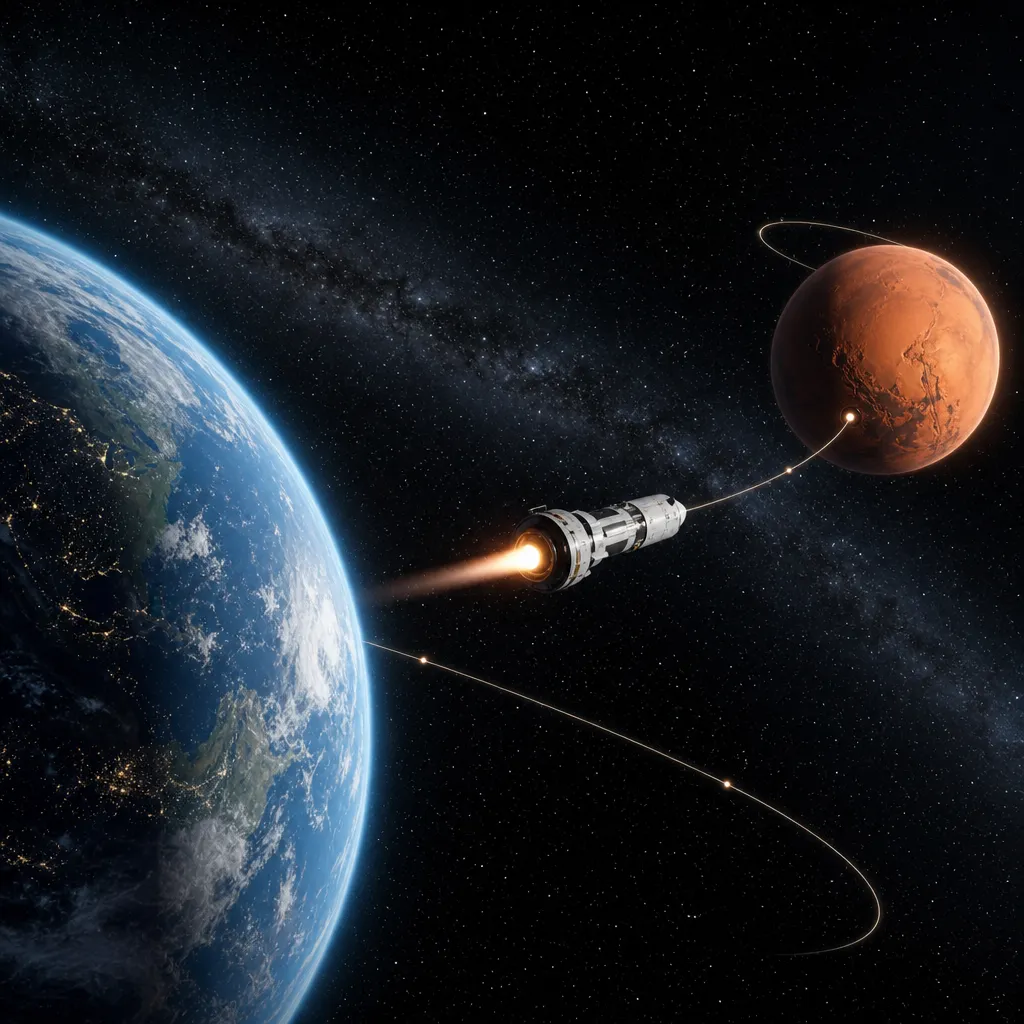
This is why mission design relies on transfer orbits rather than straight-line travel. The most common path is a Hohmann transfer, an energy-efficient elliptical orbit that carries a spacecraft from Earth’s orbit around the Sun to Mars’s orbit. That route is not the shortest possible in distance, but it often minimizes the amount of propulsion required.
In practice, mission planners choose a launch window when Earth and Mars are favorably aligned. These windows occur about every 26 months. Missing one can delay a mission by more than two years, which is a major constraint for both robotic and future human exploration.
How spacecraft actually get to Mars
To leave Earth for Mars, a spacecraft must first reach Earth orbit or be placed directly onto an escape trajectory by its launch vehicle. It then performs a trans-Mars injection, entering a solar orbit that intersects Mars’s orbit. During the cruise phase, engineers monitor and adjust the trajectory with small correction burns.
The spacecraft is pulled mainly by the Sun’s gravity for most of the trip, not by Mars. Earth’s gravity matters at departure, and Mars’s gravity takes over near arrival, but the mission is fundamentally an orbit around the Sun connecting one planet’s path to another.
When the spacecraft reaches Mars, arriving is only part of the challenge. It may need to enter orbit, land, or fly by. Each option changes mission design. A lander or crewed vehicle must also slow down enough to survive the atmosphere and touch down safely. That requirement affects how much mass can be carried and what trajectory is practical.
| Factor | How it affects travel time | Why it matters |
|---|---|---|
| Earth-Mars alignment | Determines the available transfer path and launch window | Can shorten or lengthen the cruise and strongly affects fuel use |
| Trajectory energy | Higher-energy trajectories can reduce travel time | Requires more propulsion and usually more launch mass or less payload |
| Spacecraft mass | Heavier spacecraft are harder to accelerate | Especially important for cargo and human missions |
| Propulsion system | Sets how much speed can be gained and how efficiently | Affects both mission duration and architecture |
| Arrival requirements | Orbit insertion or landing can constrain the trajectory | Fast arrival is not useful if the spacecraft cannot safely slow down |
Typical travel times from real Mars missions
Robotic missions provide the clearest evidence for what is practical today. NASA’s Mariner 4, the first successful Mars flyby, launched in 1964 and reached Mars in 1965 after about eight months. More recent examples are similar. NASA’s Curiosity rover launched in November 2011 and landed in August 2012, taking about eight and a half months. NASA’s Perseverance launched in July 2020 and landed in February 2021, after about seven months.
Other agencies have shown similar cruise times. ESA’s Mars Express launched in 2003 and arrived later that year, and India’s Mars Orbiter Mission launched in 2013 and entered Mars orbit in 2014. These variations reflect different launch dates, mission goals, spacecraft masses, and transfer strategies rather than a fundamental difference in the laws of physics.
The important point is that modern Mars trips with chemical propulsion usually cluster around the same range: roughly 200 to 300 days. That is not arbitrary. It reflects the balance engineers currently accept between travel time and fuel efficiency.
| Mission | Agency | Mission type | Approximate cruise time |
|---|---|---|---|
| Mariner 4 | NASA | Flyby | About 8 months |
| Mars Express | ESA | Orbiter | About 6 months |
| Curiosity | NASA | Lander/Rover | About 8.5 months |
| Mars Orbiter Mission | ISRO | Orbiter | About 10 months |
| Perseverance | NASA | Lander/Rover | About 7 months |
Could we get there faster?
In principle, yes. In practice, it is difficult. A spacecraft can shorten the trip by leaving Earth faster and following a higher-energy trajectory. But that demands more propellant, a more powerful launch system, a smaller payload, or all three. What looks like a simple time-saving measure quickly becomes a mission-wide engineering trade-off.
For uncrewed probes, high-speed transfers may be acceptable for some mission designs. For human missions, however, the spacecraft must carry life support, shielding, communications equipment, supplies, and a safe landing or return system. That extra mass makes fast travel harder.
Advanced propulsion concepts could change the picture. Nuclear thermal propulsion has been studied for decades because it could offer higher performance than conventional chemical rockets. Electric propulsion, already used in some deep-space missions, is very efficient but produces low thrust, so it does not automatically mean a short trip for heavy crewed vehicles. Other ideas, such as fusion-based propulsion, remain speculative and are not operational for Mars transport.
So while shorter journeys may become possible, claims of dramatically quick trips should be treated cautiously unless tied to a specific, demonstrated propulsion system and realistic spacecraft mass.
Why travel time matters so much for human missions
A seven-month voyage to Mars is not just a scheduling issue. It shapes nearly every risk faced by astronauts. The longer a crew spends in interplanetary space, the more they are exposed to cosmic radiation and solar energetic particles. Unlike crews in low Earth orbit, Mars-bound astronauts would spend most of the trip outside Earth’s protective magnetic field.
Microgravity is another major concern. Months without normal gravity can weaken muscles and bones and affect the cardiovascular system, balance, and vision. The International Space Station has shown that these effects can be managed to some degree, but a Mars mission would be longer and more isolated.
There is also logistics. A longer trip requires more food, water, spare parts, medical capability, and psychological support. Communication delays complicate everything. Depending on the geometry of the planets, a one-way radio signal between Earth and Mars can take from a few minutes to more than twenty minutes. That means crews must be far more autonomous than astronauts in Earth orbit.
The return trip is part of the same problem
When people ask how long it takes to get to Mars, they often imagine only the outbound journey. But a full human mission would involve much more. With currently favored mission architectures, astronauts may need to wait on Mars for a favorable return window rather than turn around immediately.
That is because the same orbital mechanics that govern departure from Earth also govern departure from Mars. If a crew arrives on an energy-efficient trajectory, the return opportunity may not line up for many months. As a result, a complete mission could last well over a year, and often much longer in many proposed plans.
This is one reason Mars exploration is fundamentally different from Apollo-style lunar missions. The Moon is only a few days away. Mars is a deep-space expedition shaped by planetary alignment, long-duration habitation, and the need to survive far from rapid rescue.
How scientists and engineers know these times
The basic answer comes from celestial mechanics, one of the oldest and most successful parts of physics. The motions of Earth, Mars, and spacecraft can be predicted using Newton’s laws of motion and gravitation, with refinements from modern astrodynamics and relativity where needed for precision. Mission planners calculate transfer orbits long before launch and then compare predictions with real tracking data.
Space agencies track spacecraft using radio signals. By measuring the time it takes signals to travel and the way frequencies shift because of motion, navigators can determine a spacecraft’s distance and velocity with great accuracy. This is how they confirm that the spacecraft is following the intended path or needs a correction maneuver.
The evidence is therefore both theoretical and practical. We do not rely on guesswork. We have a long history of successful Mars missions from multiple countries, and their cruise times closely match what orbital mechanics predicts.
What remains uncertain
The main uncertainty is not the travel time for a robotic spacecraft using today’s methods. That is well understood. The larger open questions involve future human transportation systems and whether new propulsion technologies can safely reduce trip duration.
Researchers are still studying how best to protect astronauts from radiation during long missions, how much shielding is practical, whether artificial gravity systems might help, and which mission architectures offer the safest balance between speed and mass. There is also uncertainty about launch cadence, in-space assembly, refueling, and the performance of landing systems for large crewed vehicles at Mars.
In other words, the route is known, but the optimal way to send humans along it remains an engineering challenge rather than a solved problem.
Why this question matters beyond curiosity
Knowing how long Mars travel takes helps define what kind of future exploration is realistic. It sets the scale of the life-support systems, the radiation protection strategy, the propulsion technology, and the mental demands placed on a crew. It also shapes the science return: a faster mission may reduce risk, but only if it does not sacrifice payload or reliability.
Mars is the most accessible planet that may once have had environments suitable for life. Reaching it in a practical timeframe is therefore central to planetary science, astrobiology, and long-term human space exploration. The answer to the travel-time question is not only about speed. It is about what kind of civilization can operate safely beyond Earth.
Frequently Asked Questions
How long would astronauts likely take to reach Mars?
With current chemical-propulsion mission concepts, astronauts would likely take about six to nine months to reach Mars. The exact time would depend on the launch window, spacecraft mass, and mission design.
What is the shortest possible trip to Mars?
There is no single shortest practical number because it depends on propulsion and payload. In theory, a higher-energy trajectory can reduce travel time, but with current technology that usually means much higher fuel demand and major engineering trade-offs.
Why can’t a spacecraft just fly straight to Mars?
Because Mars is moving around the Sun, and the spacecraft is also moving with Earth when it launches. Interplanetary travel is mostly about changing solar orbit, not crossing a fixed gap in space.
How often can missions launch to Mars?
Good launch opportunities occur about every 26 months, when Earth and Mars are properly aligned for efficient transfer trajectories.
Would humans be in danger during the trip?
Yes, there are real risks. The biggest include radiation exposure, long-term microgravity, isolation, limited medical support, and the difficulty of handling emergencies far from Earth.
How do we know the expected travel time is accurate?
Scientists use orbital mechanics and direct spacecraft tracking. Predictions are tested against real missions, and the observed travel times match the calculations closely.
Could nuclear propulsion make Mars trips shorter?
Possibly. Nuclear thermal propulsion is a serious area of study and could reduce travel time compared with some chemical systems, but it has not yet been used for a crewed Mars mission. Its real operational advantages remain to be demonstrated in practice.
Why is the return trip harder to plan than people think?
Because astronauts may have to wait on Mars for the planets to realign for an efficient return trajectory. A mission is governed by orbital timing in both directions, not just the trip outward.
Sources
- NASA, Mars Exploration Program
- European Space Agency, Mars Express mission overview
- Jet Propulsion Laboratory, Basics of Space Flight