

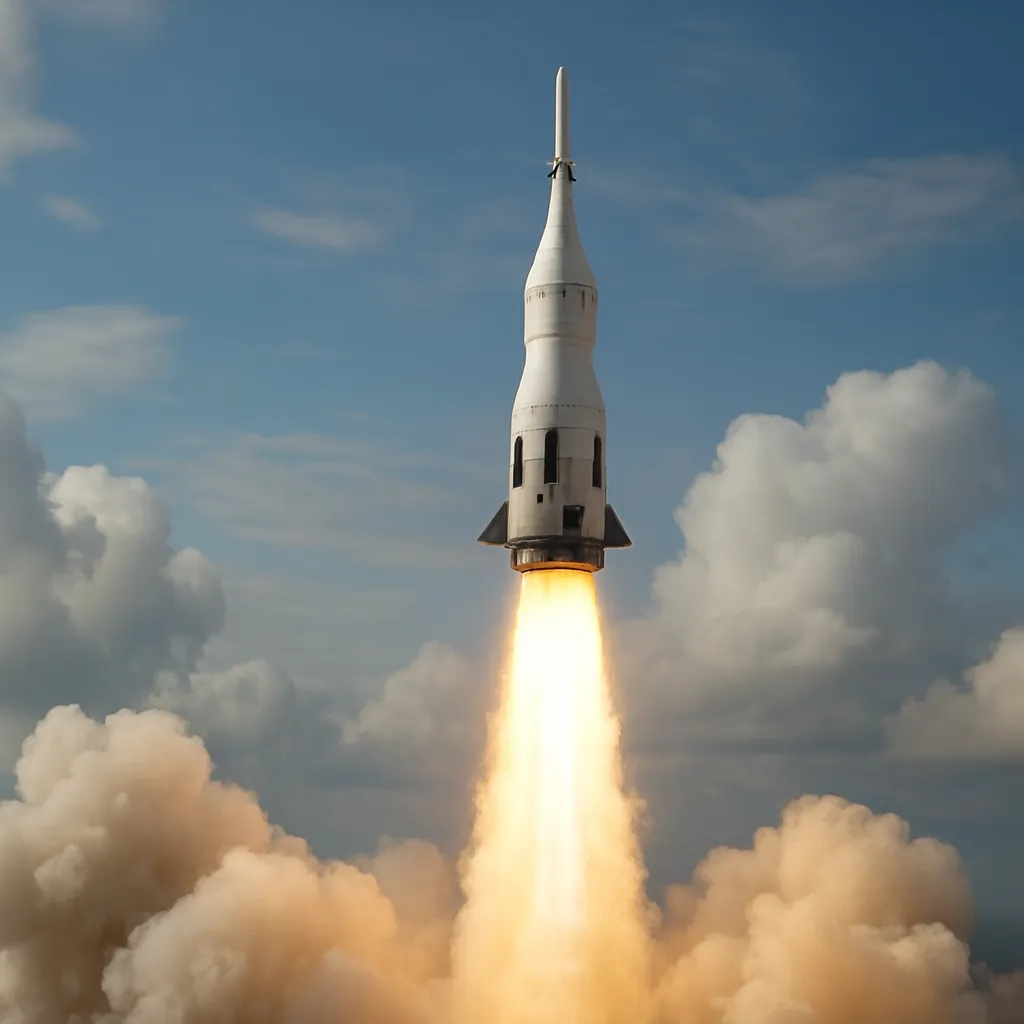
Launch escape systems (LES) are specialized safety mechanisms designed to extract the crew module from a rocket in emergencies. They must act within fractions of a second to overcome immense forces. By analyzing the physical laws governing motion, thrust, and structural response, engineers develop highly reliable systems that can operate under the most extreme conditions. This article delves into the fundamental physics behind these life-saving technologies, exploring how Newtonian dynamics, aerodynamics, and material science converge to deliver a robust abort capability for space missions.
Fundamental Dynamics and Escape Theory
At its core, a launch escape system must generate enough thrust to accelerate the crew capsule away from a malfunctioning launch vehicle. According to Newton’s second law, F = m·a, the net force (F) applied to the capsule produces acceleration (a) proportional to its mass (m). Engineers select rocket motors and propellant combinations that maximize the thrust-to-mass ratio, ensuring rapid departure from danger. In practice, achieving a high acceleration within strict weight limits poses significant challenges in mass ratio optimization.
Escape Velocity vs. Abort Velocity
While escape velocity traditionally refers to the speed required to leave a planet’s gravitational influence, launch escape systems target a much shorter time and distance scale. The term abort velocity describes the minimum speed needed to clear the rocket’s trajectory and minimize exposure to debris, shockwaves, and aerodynamic heating. Calculating abort velocity involves solving the equations of motion under changing external forces, including atmospheric drag and varying gravitational pull as altitude increases.
Key Equations of Motion
- Newton’s second law: F = m·a
- Drag force: D = ½·ρ·v²·Cd·A
- Thrust equation: T = Isp·ṁ·g0
- Trajectory integration: y(t) and x(t) from differential equations
Propulsion, Thrust Profile, and Timing
Effective operation of an LES hinges on its ability to ignite reliably within milliseconds of a detected anomaly. Early systems used solid-propellant motors equipped with pyrotechnics to sever connections and initiate separation. The resulting thrust curve must reach peak output almost instantaneously to achieve the necessary g-loads for rapid clearance. Designers perform detailed analysis of nozzle geometry, propellant composition, and burn rate to shape the thrust-time profile.
Nozzle Design and Exhaust Dynamics
A critical component of rocket performance is the nozzle, which accelerates exhaust gases to produce thrust. Convergent-divergent nozzles exploit the choked flow phenomenon, allowing expansion to supersonic speeds in the divergent section. The thrust F can be expressed as:
F = ṁ·ve + (pe – p0)·Ae
where ṁ is the mass flow rate, ve is exhaust velocity, pe is chamber pressure at the exit, p0 is ambient pressure, and Ae is exit area. LES nozzles are optimized for sea-level conditions since abort may occur early in ascent.
Thrust Vectoring and Stability
Maintaining a stable trajectory during escape is vital. Some LES designs incorporate small movable vanes or gimbals to adjust the direction of thrust, countering any off-axis forces. This stability augmentation prevents tumbling and ensures the capsule reaches a safe separation corridor. Engineers use computational fluid dynamics (CFD) simulations to predict exhaust plumes and interactions with the launch vehicle, refining nozzle placement and shielding.
Aerodynamic and Structural Considerations
Once launched, the escape tower and capsule encounter dense atmospheric layers. Balancing the trade-off between minimal mass and adequate structural strength requires advanced materials and design. The structural frame must absorb peak loads during separation, including shock from explosive bolts and sudden thrust onset. Excessive weight in reinforcement reduces available payload mass, demanding precise finite-element analysis (FEA) of stress distribution.
Drag, Heating, and Thermal Protection
High-speed ascent generates significant aerodynamic drag and heating. Although the LES phase is brief, surface temperatures can rise due to compression heating and shock formation. Thermal protection systems (TPS) such as ablative coatings or heat-resistant composites protect both the tower and its jettisoned fairings. Engineers calculate convective heat flux q using equations like:
q = k·ρ0.5·v³·Ch
where k is a constant, ρ is air density, v is velocity, and Ch is a heat-transfer coefficient. CFD and wind-tunnel testing validate thermal models before flight.
Separation Mechanics and Pyrotechnic Devices
Separation events rely on pyrotechnic separation nuts or frangible joints that release instantaneously. The design must guarantee clean breaks without imparting unwanted rotation. High-speed cameras and inertial sensors record test firings, allowing engineers to adjust the energy output of charge sizes. Critical timing ensures separation occurs only after thrust build-up, avoiding damage to the capsule’s base heat shield.
Integration, Testing, and Future Innovations
Rigorous testing underpins the reliability of any escape system. Full-scale abort tests simulate failures at various flight regimes, from pad abort to maximum dynamic pressure (max-q). Data acquisition systems measure acceleration profiles, structural strains, and fluid pressures. Any anomaly triggers redesign of components, from electronic sensors that detect engine anomalies to the flight computer algorithms that command escape initiation.
- Redundancy in sensors and firing circuits to eliminate single points of failure
- High-fidelity simulations coupling structural, thermal, and fluid models
- Advanced materials like carbon-carbon composites for weight savings
- Next-generation propulsion using green propellants or hybrid motors
Emerging concepts include integrated abort thrusters embedded in the service module, replacing the tall escape tower. This approach reduces mass and aerodynamic drag during nominal ascent, but requires complex sequencing to ensure reliability. As commercial spaceflight expands, LES technology will continue evolving, driven by advances in materials science, computational modeling, and propulsion chemistry. The interplay of trajectory planning, rapid thrust generation, and structural integrity remains at the heart of designing safe, efficient escape systems for humanity’s journey into space.