

Exploring the cosmos uncovers realms that defy ordinary experience, where the laws of physics stretch to their limits. From regions of crushing gravity to zones of searing heat and near-perfect vacuum, these settings challenge our concepts of matter and energy. Join this journey through some of the universe’s most extreme environments.
Black Holes: Titans of Gravity
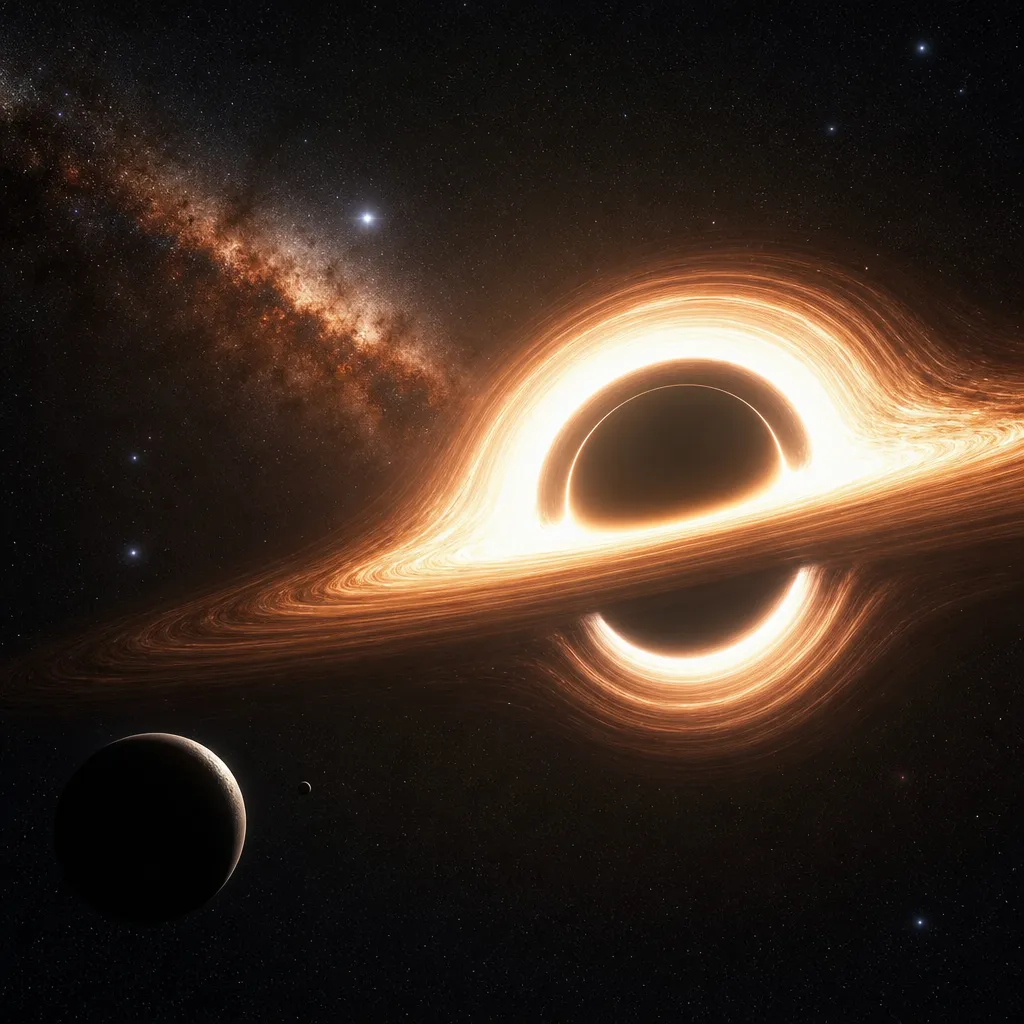
Black holes represent the pinnacle of gravitational power. These objects arise when massive stars collapse under their own weight, compressing mass into an infinitesimal point called a singularity. Surrounding this singularity is the event horizon, the boundary beyond which not even light can escape. Within this region, gravity becomes so intense that spacetime itself is warped to extremes.
- Event Horizon: The one-way threshold around a black hole.
- Singularity: A point of infinite density where classical physics breaks down.
- Accretion Disk: A hot, glowing whirlpool of gas and dust spiraling inward.
The temperature in the accretion disk can exceed millions of degrees Kelvin, producing powerful X-ray and gamma-ray emission. Jets of plasma launched from the poles travel at relativistic speeds, carrying away angular momentum. Observations of these jets help astronomers measure black hole spin and mass. Supermassive black holes, millions to billions of times the mass of our Sun, dwell at galactic centers, powering some of the brightest objects in the universe: quasars.
Neutron Stars and Pulsars: Cosmic Lighthouses
Neutron stars form when stars with initial masses between 8 and 20 solar masses end their lives in supernova explosions. The core compresses until protons and electrons combine, creating a sphere made almost entirely of neutrons. With diameters of merely 20 kilometers yet masses around 1.4 times that of the Sun, these objects exhibit densities rivaling an atomic nucleus.
A subset known as pulsars emits beams of electromagnetic radiation from their magnetic poles. As the star rotates—sometimes hundreds of times per second—these beams sweep across space like a lighthouse. Detectors on Earth record pulses with astonishing regularity, making pulsars precise cosmic clocks.
Key features include:
- Ultra-High Density: A teaspoon of neutron star matter weighs billions of tons.
- Magnetic Fields: Reaching up to 1011 teslas—trillions of times stronger than Earth’s.
- Rapid Rotation: Millisecond pulsars complete hundreds of spins every second.
In the most magnetic of these stars, called magnetars, the magnetic energy can power giant flares of gamma rays and X-rays capable of affecting Earth’s ionosphere from thousands of light-years away. Studying neutron stars tests theories of nuclear physics and subatomic interactions under conditions inaccessible in terrestrial laboratories.
Exoplanetary Extremes: Worlds Beyond Imagination
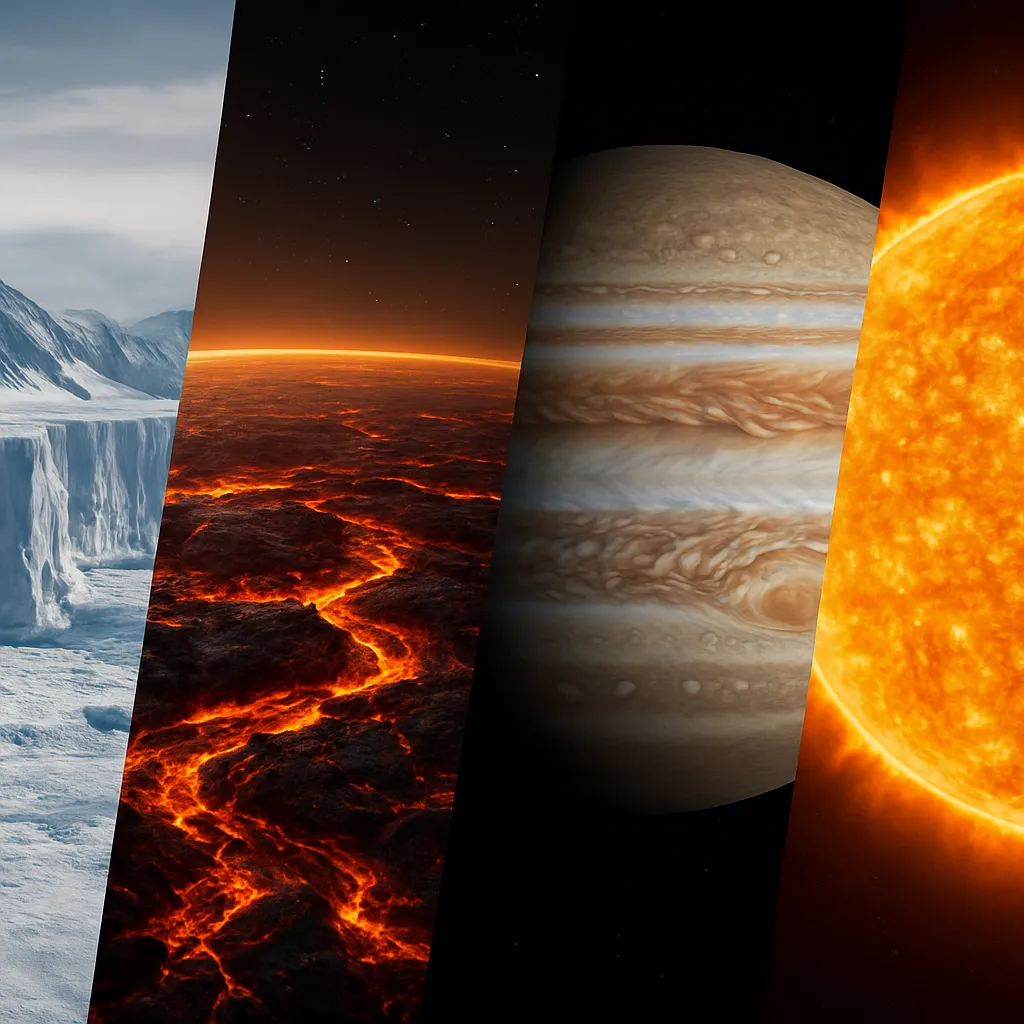
Beyond our solar system lies a vast menagerie of planets exhibiting environments far harsher than anything on Earth. Some examples:
- Hot Jupiters: Gas giants orbiting within a few million kilometers of their stars, with surface temperatures above 2,000 K.
- Lava Worlds: Rocky planets tidally locked to their stars, featuring oceans of flowing magma and surface temperatures up to 3,000 K.
- Ice and Carbon Planets: Bodies where temperatures plunge below 50 K, freezing atmospheres into exotic ices of methane, ammonia, and even diamond.
One of the strangest discoveries is a planet with iron rain: surface temperatures so high that metal vapor rises, cools, and condenses into droplets of molten iron that fall like torrential downpours. Another is Proxima Centauri b, located in the habitable zone of our nearest stellar neighbor, yet bathed in intense flares that bathe the planet in lethal radiation. These extreme exoplanets expand our understanding of planetary formation and atmospheric chemistry.
Intergalactic Space and the Cosmic Void
The regions between galaxies, known as the intergalactic medium (IGM), represent one of the coldest and most tenuous environments. Particle densities drop to a few atoms per cubic meter, approaching a perfect vacuum. Temperatures vary widely:
- In vast voids: a few Kelvins above absolute zero.
- In galaxy cluster filaments: millions of Kelvins, with ionized gas emitting faint X-rays.
Despite its low density, the IGM contains most of the baryonic matter in the universe. Cosmic rays and high-energy particles traverse these expanses, sometimes for billions of years before encountering a galaxy. Vast magnetic fields thread the voids, influencing the motion of charged particles and contributing to the large-scale structure known as the cosmic web.
Supernovae and Gamma-Ray Bursts: Cataclysms of Creation
Death of massive stars gives rise to supernova explosions that outshine entire galaxies for days or weeks. Temperatures and pressures in the core exceed those in neutron stars, driving shock waves that synthesize heavy elements such as gold, uranium, and platinum.
In rare cases, a collapsing star forms a black hole and launches two narrow jets of material at nearly the speed of light. When one of these jets points toward Earth, we observe a gamma-ray burst (GRB). For a few seconds, a single GRB can release more energy than the Sun will emit over its entire 10-billion-year lifetime. The conditions within these jets involve:
- Relativistic Speeds: Lorentz factors above 100.
- Extreme Pressures: Trillions of times atmospheric pressure.
- Ultra-High Energies: Photons exceeding MeV and GeV ranges.
Studying these bursts probes the nature of matter under the most violent conditions known and tests relativity and nuclear physics in the highest-energy regimes.