
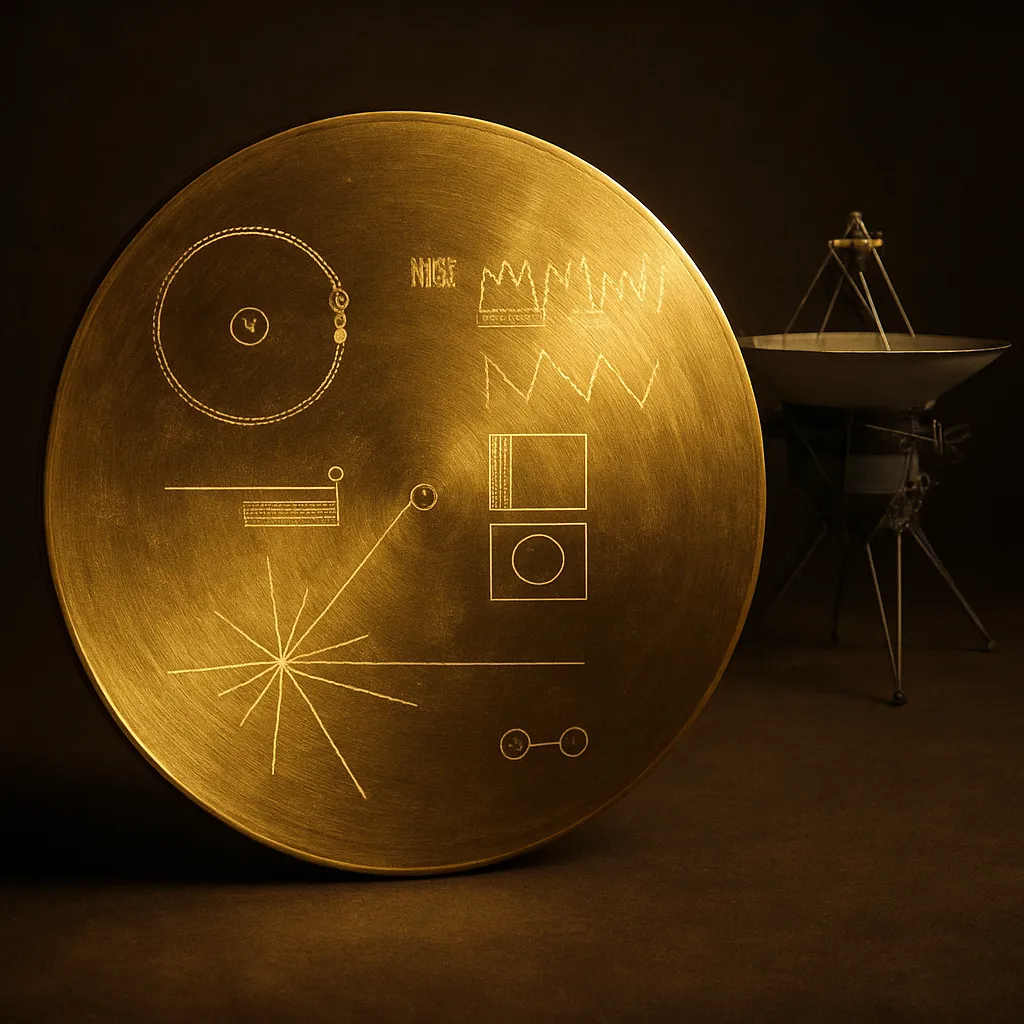
When the twin spacecraft embarked on their epic odyssey in 1977, a brilliant concept emerged from NASA’s labs: to carry a time capsule into the void of space, transmitting a snapshot of human culture and scientific achievement. This “message in a bottle” would journey beyond the borders of the Solar System, carrying hopes that one day, it might be discovered by extraterrestrial beings or future humankind. This remarkable artifact is forever known as the Golden Record, a symbol of our species’ curiosity, creativity, and aspiration to connect across the cosmos.
Origins and Mission Objectives
The Voyager probes were designed to exploit a rare planetary alignment that occurs once every 176 years, offering a gravitational assist to explore the outer planets with minimal fuel. Beyond the primary mission of visiting Jupiter and Saturn, mission planners envisioned a deeper purpose: to craft a universal greeting. Under the direction of a committee chaired by famed astronomer Carl Sagan, engineers and artists collaborated to condense the essence of Earth onto gold-plated copper discs, ensuring longevity and resistance to the harsh environment of deep space.
The inclusion of the Golden Record elevated Voyager from a mere planetary scout to a vessel of interstellar diplomacy. The probes would carry our voice into regions no human has seen, perhaps inspiring contact with unknown civilizations or serving as a testament of terrestrial life long after Earth has changed beyond recognition. This fusion of scientific rigor and artistic ambition forged a singular achievement in space exploration.
Designing a Message for Eternity
Translating the diversity of human experience into a finite set of data presented daunting challenges. What visual and auditory elements best represent Earth? How can one transcend linguistic and cultural barriers? The team assembled over 100 images and 90 minutes of sounds—everything from the keening cry of a humpback whale to the rhythmic beats of Senegalese percussion. Voices uttered greetings in 55 different languages, while mathematical diagrams and the structure of DNA aimed to convey universal principles of science.
Contents of the Golden Record
- 115 analogue images depicting human anatomy, daily life, architecture, and natural phenomena
- Time-encoded audio of music spanning Bach, Beethoven, Chuck Berry, and traditional songs from around the globe
- Greetings in 55 languages, from Sumerian to Mandarin
- Natural sounds: wind, thunder, birdsong, and the murmur of human breathing
- Scientific diagrams illustrating our position in the galaxy and the location of our home planet
A stylus and symbolic instructions etched onto the record’s cover provide guidance on playback, while the gold plating ensures durability against cosmic radiation. This innovative design has endowed the record with a survival time that may outlast the Sun itself.
Journey Through the Endless Expanse
Since their launch, Voyager 1 and Voyager 2 have traversed the outer reaches of our planetary neighborhood and entered interstellar space. As of now, Voyager 1 is the most distant human-made object, more than 150 astronomical units from Earth. Each moment, the probes carry their precious payload farther into the void, representing our only physical emissary to the stars.
The interstellar medium that envelopes the spacecraft is a sparse mixture of charged particles and magnetic fields, yet the Golden Record remains intact. Provided the probes avoid collision with dust grains that could damage the electronics, the record will endure for millions of years—its surface immune to corrosion in the vacuum of space. Should another intelligent species, or perhaps a future human civilization, discover one of the Voyagers, they will inherit a time capsule that spans continents and epochs.
Impact on Science and Culture
The legacy of the Golden Record extends far beyond its scientific mission. It has sparked endless debates about humanity’s place in the cosmos and the ethics of sending our likenesses into the unknown. Artists, writers, and filmmakers have drawn inspiration from this bold gesture, weaving themes of interstellar communication into works of fiction that capture our collective imagination.
Within academia, the project has become a case study in interdisciplinary collaboration, demonstrating how engineers, musicians, linguists, and visual artists can join forces to craft a unified expression of identity. It also raised awareness of the fragility of planetary ecosystems and the value of preserving cultural diversity, as encapsulated in those sounds and images etched in gold.
Musicians have reimagined the Golden Record’s selections in modern compositions, while visual artists have produced installations that mimic its design. Educational programs across the globe use the record to teach students about astronomy, anthropology, and the art of translation. In each instance, the echo of Voyager’s greeting resonates, reminding us that our quest for knowledge is inseparable from our desire to share that knowledge with others.
Continuing the Quest for Connection
Long after the planetary flybys are forgotten, the Voyager spacecraft will survive as silent ambassadors, bearing witness to an era of exploration driven by wonder. Their Golden Record stands as a testament to human ingenuity and the enduring hope that we are not alone. As technology advances, new projects may follow in Voyager’s footsteps—sending more sophisticated messages to the stars or probing deeper into the mysteries of dark matter and exoplanetary systems.
Ultimately, the Golden Record’s greatest achievement lies in its ability to unite people on Earth, transcending borders and ideologies in a shared act of cosmic goodwill. Its presence beyond the Solar System reminds us that while our planet may appear small and fragile in the grand theater of the universe, our collective voice can ring out across the void, carrying the story of humanity to wherever the winds of the galaxy may blow.