
Navigating the vast expanse beyond Earth requires meticulous planning, cutting-edge technology, and a deep understanding of the cosmos. Space agencies blend physics, engineering, and computer science to chart precise courses for probes and crewed vehicles traveling millions of kilometers. From mastering celestial mechanics to ensuring reliable data links, each element plays a vital role in mission success.
Principles of Deep Space Navigation
At the heart of any interplanetary mission lies a foundation built on trajectory planning and orbital dynamics. Engineers calculate transfer orbits using Kepler’s laws, adjusting for perturbations caused by solar radiation pressure and the gravitational fields of planetary bodies. A thorough grasp of stellar reference frames and inertial measurement units enables position determination with unprecedented accuracy. Agencies often rely on the International Celestial Reference Frame (ICRF) to define orientation in space, ensuring consistency across global tracking facilities.
Gravity Assist Techniques
To conserve propellant and shorten travel times, missions frequently employ gravity assist maneuvers. By swinging past planets, spacecraft gain momentum without expending fuel. Careful timing is paramount, as windows for optimal flybys can open only once every few years. Mission designers simulate thousands of orbital arcs to find the most efficient sequence of planetary encounters.
- Earth-Venus-Earth gravity assists for inner solar system probes
- Jupiter slingshots to reach the outer planets
- Deep space maneuvers using Mars as a stepping stone
Trajectory Design and Optimization
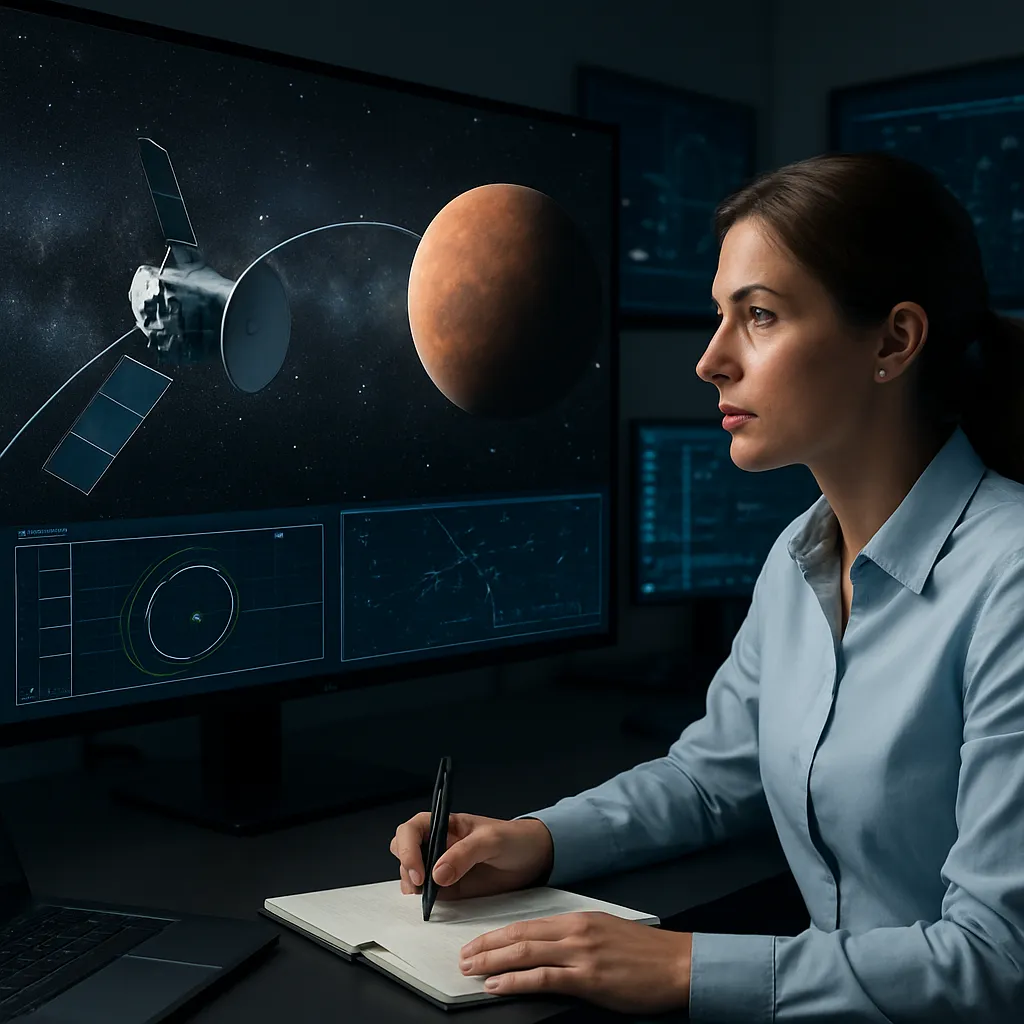
Designing a viable path through the solar system demands advanced navigation algorithms and high-fidelity models of spacecraft dynamics. Teams use specialized software to perform Monte Carlo simulations, accounting for uncertainties in thrust, mass properties, and external forces. Sensitivity analyses reveal how tiny deviations at launch can magnify into significant course errors millions of kilometers away.
Software and Simulators
State-of-the-art simulators replicate the space environment, allowing planners to test mission scenarios under varied conditions. These platforms integrate atmospheric drag when crafting aerobraking passes and model solar wind variations that affect onboard instruments. Real-time simulation feeds into mission control consoles, where operators practice contingency procedures for unexpected trajectory deviations.
Communication and Signal Processing
Maintaining a robust link between ground and spacecraft underpins all navigation efforts. Deep space missions depend on the Deep Space Network (DSN), a global array of large antennas capable of receiving faint signals across billions of kilometers. Engineers optimize signal processing algorithms to extract telemetry data buried in cosmic noise, using techniques like error-correcting codes and spread-spectrum modulation.
- Time delay compensation to synchronize uplink and downlink commands
- Automated fault detection using redundant communication paths
- Adaptive data rates to handle varying link margins
Autonomous Navigation and Onboard Systems
As distance increases, reliance on real-time ground guidance becomes impractical. Modern probes incorporate spacecraft autonomy, allowing them to compute position fixes and execute trajectory updates without Earth-based intervention. Star trackers capture images of the celestial sphere, comparing observed patterns against an onboard catalog to determine orientation. Optical navigation uses images of asteroids, moons, or planetary rings to refine trajectory estimates.
Machine Learning Applications
Recent missions explore artificial intelligence for enhanced autonomy. Navigation algorithms powered by machine learning can detect subtle anomalies in sensor data, correcting biases that traditional filters might miss. These intelligent systems reduce operator workload and increase mission resilience when communication windows are infrequent.
Mission Resilience and Contingency Planning
Uncertainties in deep space demand robust contingency measures. Agencies develop backup trajectory plans that activate automatically if the primary route becomes untenable. Fault-tolerant systems ensure that critical navigation software can recover from radiation-induced errors. Engineers also script safe-hold modes, instructing the spacecraft to maintain power and orientation until ground teams reestablish control.
- Redundant inertial sensors to cross-check attitude data
- Predefined escape trajectories for asteroid rendezvous missions
- Software watchdogs that reset systems in the event of anomalies
Future Innovations in Deep Space Navigation
Looking ahead, space agencies are exploring novel methods such as X-ray pulsar-based navigation, which uses the regular pulses of neutron stars as cosmic lighthouses. Laser communication networks promise higher bandwidths and more precise ranging measurements, enhancing real-time position tracking. Collaboration between aerospace firms and research institutions continues to drive breakthroughs in mission resilience and precision guidance.
Advances in micropropulsion and adaptive optics will allow smaller probes to venture farther, while quantum sensors might one day detect minute gravitational fluctuations, refining our ability to chart courses through interplanetary space. By combining proven techniques with pioneering technologies, navigators will steer humanity toward the next frontier among the stars.