
In the quest to unlock cosmic secrets hidden beyond Earth’s sky, astronomers have long wrestled with the distorting influence of our atmosphere. From shimmering starlight to blurred planetary images, Earth’s protective gaseous envelope complicates efforts to gather crisp, accurate data. Innovations in both ground-based and space-borne observatories aim to overcome these challenges. This article explores the sources of atmospheric distortion, the cutting-edge techniques employed on terrestrial facilities, and the design philosophies that enable space telescopes to deliver unparalleled clarity.
Origins of Atmospheric Distortion
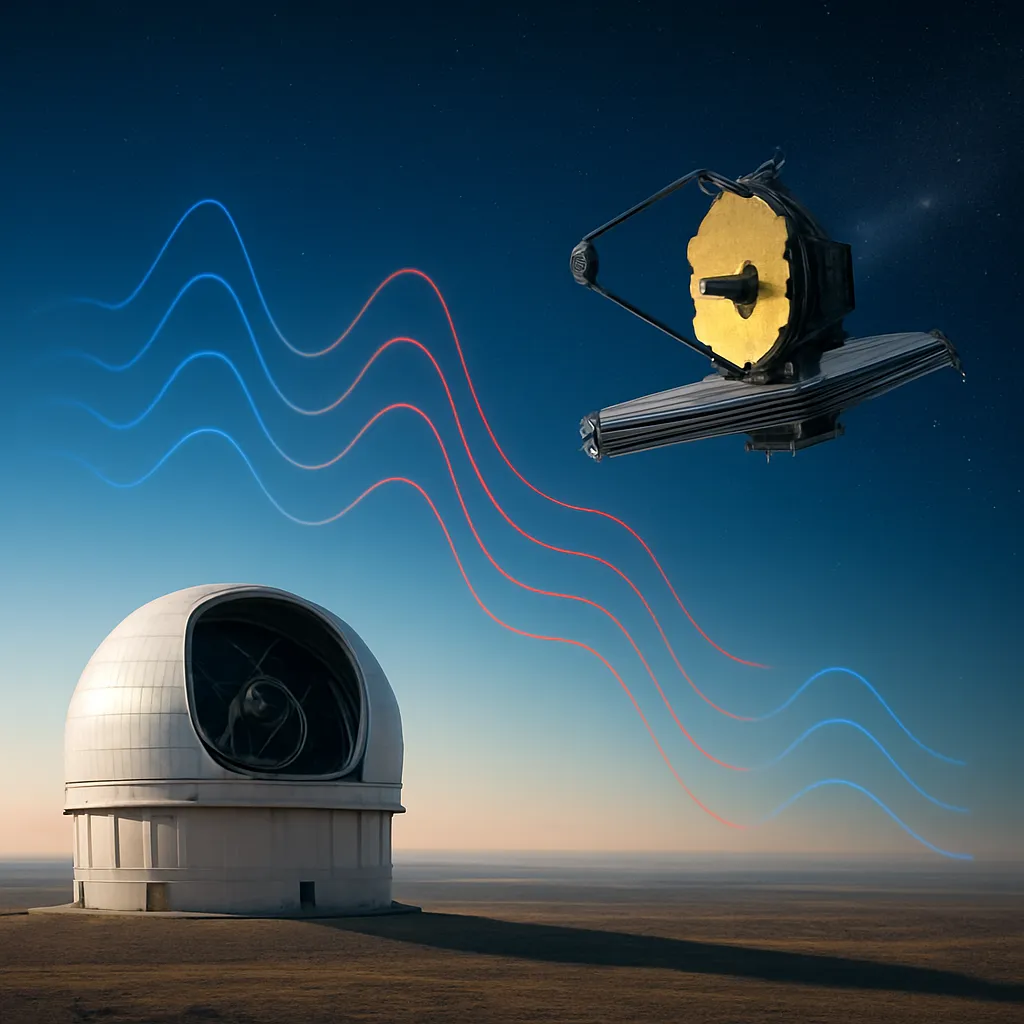
As photons travel from distant stars and galaxies towards Earth, they must pass through layers of air that vary constantly in temperature, density and composition. This ever-shifting medium degrades incoming wavefronts in several ways. The combined effect is often characterized by a “seeing disk”—the apparent diameter over which a point source appears smeared. Typical seeing values at good astronomical sites range from 0.5 to 1.5 arcseconds, whereas space telescopes can achieve resolutions better than 0.1 arcsecond.
Three principal phenomena contribute to atmospheric distortion:
- Scattering: Air molecules and aerosols deflect photons, reducing contrast and causing a diffuse glow around bright objects. Rayleigh scattering dominates at shorter wavelengths, while Mie scattering from larger particles affects red and infrared bands.
- Refraction: Systematic bending of light occurs as rays traverse layers of different refractive index. This effect shifts apparent positions of stars by up to an arcminute near the horizon and introduces chromatic dispersion across the spectrum.
- Turbulence: Chaotic eddies in the troposphere create rapidly varying refractive indices. These fluctuations break the incoming wavefront into cells of coherent phase, described by the Fried parameter (r0). Typical values of r0 at optical wavelengths are 10–20 cm, limiting the coherent patch size for high-resolution imaging.
Beyond these, water vapor, carbon dioxide and ozone selectively absorb infrared and ultraviolet light, carving out opaque bands that restrict ground-based observations. Even at high-altitude sites like Mauna Kea, the submillimeter windows and mid-infrared ranges remain partially blocked, compelling astronomers to seek platforms above the densest layers.
Advancements in Ground-based Observatories
Despite inherent limitations, Earth-bound telescopes have pushed technological boundaries to deliver impressive images and spectra. Two transformative approaches—adaptive optics and optical interferometry—address atmospheric blur by actively correcting or synthesizing large apertures.
Adaptive Optics Systems
Adaptive optics (AO) measures real-time wavefront distortions using a bright reference source, either a natural star or an artificial laser beacon projected into the sodium layer at 90 km altitude. High-speed wavefront sensors sample distortions hundreds to thousands of times per second. A deformable mirror, controlled by an array of piezoelectric or microelectromechanical actuators, adjusts its surface to counteract aberrations. This feedback loop restores near-diffraction-limited performance at infrared wavelengths, dramatically improving the resolution of ground-based instruments.
Progressive variants include multi-conjugate AO, which uses several deformable mirrors conjugated to different atmospheric layers, and tomographic AO, which reconstructs three-dimensional turbulence profiles via multiple guide stars. These methods expand the corrected field of view from a few arcseconds to over a minute, enabling sharper images of star clusters, nebulae and galactic nuclei.
Interferometric Arrays
Interferometry links separate telescopes to simulate a single, giant aperture equal to the maximum baseline. Facilities like the Very Large Telescope Interferometer (VLTI) and the Center for High Angular Resolution Astronomy (CHARA) array achieve milli-arcsecond resolution in the near-infrared and optical bands. By carefully delaying and combining light paths, these arrays compensate for atmospheric phase shifts over dozens or hundreds of meters. While they excel at resolving stellar surfaces and binary systems, interferometers often struggle with sensitivity for very faint or extended sources due to limited collecting area and complex beam combination.
Site selection further enhances performance: high-altitude, dry environments such as the Atacama Desert reduce water-vapor absorption, and remote locations minimize light pollution. However, no ground facility can fully escape turbulence, motivating the deployment of airborne and stratospheric platforms for certain wavelength regimes.
Engineering Principles Behind Space Telescopes
Elevating telescopes above 99% of Earth’s mass removes nearly all atmospheric interference, providing stable, high-contrast views across a broad spectral range. Space observatories must endure launch stresses, microgravity and extreme temperatures, demanding rigorous design strategies to maintain optical performance.
- Nanometer-precision mirror surfaces, often achieved through computer-controlled polishing and ion-beam figuring, reduce diffraction sidelobes and increase light-gathering efficiency.
- Active thermal control employs multi-layer insulation, heat pipes, and radiators to maintain instrument temperatures within a few tenths of a degree. This stability prevents focus shifts and reduces thermal background in sensitive detectors.
- Structural stability relies on low-expansion materials such as silicon carbide, beryllium or carbon-fiber composites. Tensioned trusses and vibration-damping mounts preserve alignment under thermal cycling and pointing maneuvers.
- Cryogenically cooled detectors, especially in the infrared, minimize dark current and read noise, opening windows at wavelengths where Earth’s atmosphere is opaque or emits strongly.
Orbit selection plays a crucial role. Low Earth Orbits (LEO) allow frequent data downlinks but suffer from Earthshine and South Atlantic Anomaly radiation. Lagrange points such as L2 offer stable thermal environments, continuous solar illumination for power and uninterrupted views of deep space with minimal eclipse interruptions.
Breakthrough Technologies in Space Observatories
Recent missions demonstrate how innovative architectures extend observational reach. The segmented primary mirror of the James Webb Space Telescope unfolds post-launch to provide a 6.5-meter aperture optimized for near- and mid-infrared studies. The Nancy Grace Roman Space Telescope will use a coronagraph instrument to directly image exoplanets by suppressing starlight by factors exceeding one billion. Proposed starshade formations, flying tens of thousands of kilometers apart, promise even higher contrast without complex onboard coronagraphs.
Next-generation detectors incorporate photon-counting capabilities, enabling time-resolved imaging of fast transients like gamma-ray bursts. CubeSat and small-satellite constellations, equipped with miniaturized optics and star trackers, perform targeted surveys in ultraviolet, soft X-ray and terahertz bands at a fraction of traditional mission costs. Meanwhile, adaptive secondary mirrors in space—thin shells actively shaped by piezoelectric arrays—offer prospects for real-time wavefront correction in microgravity.
As technology advances, novel materials such as graphene-based thermal coatings, deployable membrane optics and laser communication links will further reduce mass and increase data throughput. These innovations promise to widen humanity’s window into the cosmos, revealing faint galaxies, characterizing Earth-like exoplanets and probing the very origins of our universe with clarity unattainable from the ground.