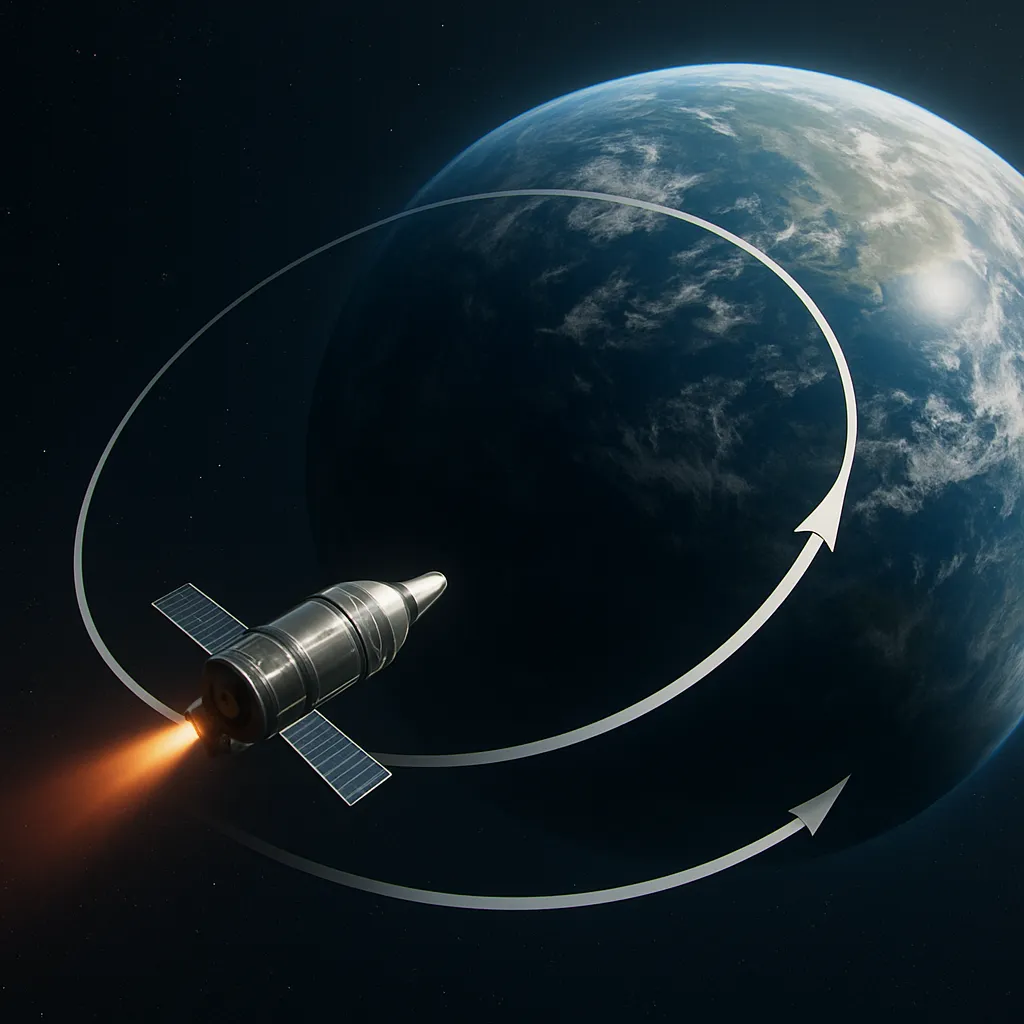
Exploring how spacecraft maneuver into and out of planetary orbits reveals a blend of physics, engineering and precision planning. By mastering the interplay between gravitational forces and propulsion systems, mission designers ensure that probes and crewed vehicles can safely arrive, operate and depart from diverse celestial bodies. This article delves into the fundamental principles, insertion techniques, departure strategies and emerging innovations shaping orbital missions.
Principles of Orbital Mechanics
At the heart of any orbital mission lies Newton’s laws of motion and the universal law of gravitation. A spacecraft in free fall around a planet adopts an elliptical or circular path determined by its speed and altitude. Critical parameters include periapsis (closest approach) and apoapsis (farthest point). Achieving a stable orbit requires balancing centripetal force against gravity through precise velocity. Two key speeds define orbital behavior:
- Orbital velocity: The minimum horizontal speed needed to maintain a circular orbit at a given altitude.
- Escape velocity: The speed required to overcome a planet’s gravitational pull and travel indefinitely away.
Mission planners quantify maneuvers in terms of delta-v, a measure of the thrust impulse needed to change velocity. Budgeting delta-v accurately ensures fuel reserves suffice for insertion, station-keeping and departure burns. Trajectory design often employs the Hohmann transfer, an energy-efficient method to move between orbits via two engine firings: one to raise apoapsis and another to circularize at the new altitude. More advanced techniques, like bi-elliptic transfers or low-thrust spirals, trade time for fuel savings.
Techniques for Orbit Insertion
Placing a spacecraft into the desired orbit involves a sequence of carefully timed maneuvers. Three primary methods dominate:
- Propulsive Capture: A retrograde burn opposite to the spacecraft’s motion reduces velocity enough to be captured by the planet’s gravity.
- Aerobraking and Aerocapture: Utilizing atmospheric drag to slow down, saving mass by minimizing onboard propellant consumption.
- Gravity Assist Manoeuvres: Swinging past a moon or planet to adjust trajectory and speed without expending fuel.
Propulsive capture remains the most straightforward: at arrival, thrusters fire to decelerate, transitioning the craft from a hyperbolic approach trajectory to a bound ellipse. However, for high-mass missions or when propellant margins are tight, aerobraking becomes invaluable. By dipping into the upper atmosphere repeatedly, the spacecraft trades kinetic energy for heat, gradually lowering apoapsis until the desired orbit is reached. This method demands robust thermal protection and precise guidance to avoid excessive heat loads.
Gravity assists can precede insertion burns. For instance, the Cassini mission used multiple flybys of Venus, Earth and Jupiter to gain the extra momentum needed for Saturn orbit insertion. Each flyby tweak altered the spacecraft’s trajectory and velocity, economizing delta-v for the final capture maneuver.
Strategies for Orbital Departure
Departing a planetary orbit and heading towards another celestial target requires its own set of tactics. The goal is to raise the spacecraft’s energy to exit the planet’s gravitational well and align with the interplanetary transfer trajectory:
- Trans-planetary Injection Burn: A prograde burn at periapsis increases kinetic energy, setting the craft on a escape trajectory.
- Bi-elliptic Transfer: For very high departure energies, a three-burn sequence may reduce total delta-v compared to a single burn.
- Oberth Effect: Executing engine firings at the lowest possible altitude maximizes efficiency by taking advantage of higher orbital speeds.
Timing the injection burn is crucial. Launching the burn at periapsis leverages the Oberth effect, where the same thrust yields a greater change in orbital energy than at higher altitudes. In practice, navigation teams calculate ignition windows to ensure that by the end of the burn, the craft follows a precise heliocentric or barycentric trajectory aimed at its next destination.
For sample-return missions or crewed flights, departure procedures also consider safe trajectories to avoid atmospheric entry risks or moon impacts. In the Apollo program, Trans-Earth Injection maneuvers were plotted to guarantee that any mid-course corrections could still safely position the capsule for reentry corridors around Earth.
Case Studies of Historical Missions
Learning from past missions illuminates best practices and lessons learned:
- Mars Reconnaissance Orbiter: Employed a direct propulsive insertion burn lasting nearly 30 minutes to transition from cruise to a highly elliptical orbit, later refined through aerobraking.
- Galileo Mission: Utilized Venus and Earth gravity assists to gain enough velocity for Jupiter insertion, demonstrating the power of multi-planet flybys.
- MESSENGER: A complex series of flybys (Earth, Venus, Mercury) and propulsive maneuvers allowed insertion into Mercury’s orbit despite the Sun’s intense gravitational pull.
Each mission required meticulous delta-v accounting, with margins kept tight to accommodate mid-course corrections and unforeseen anomalies. Advances in computing and simulation have improved the fidelity of navigation models, but fundamental physics remains unchanged.
Emerging Technologies and Future Directions
Innovations promise more efficient entry and exit maneuvers in coming decades. Electric propulsion systems, such as Hall-effect thrusters and ion engines, deliver high specific impulse, allowing long-duration, low-thrust spirals that drastically reduce propellant mass. Solar sails offer propellant-free momentum exchange by reflecting photons, albeit at very low acceleration rates. Nuclear thermal rockets could combine high thrust with superior specific impulse, revolutionizing how quickly and flexibly spacecraft transfer between orbits.
Aerocapture, never yet executed operationally, is under active study. By entering an atmosphere once, slowing sufficiently, then raising a new orbit without a retrograde burn, missions to Mars or Venus could save massive amounts of fuel. Achieving reliable thermal protection and real-time guidance through unpredictable atmospheric conditions remains a significant engineering challenge.
Meanwhile, autonomous navigation algorithms and machine learning promise onboard decision-making for unanticipated anomalies during critical burns. As humanity eyes return to the Moon, Mars sample returns and asteroid rendezvous, mastering the nuanced art of orbital insertion and departure will remain central to mission success.