
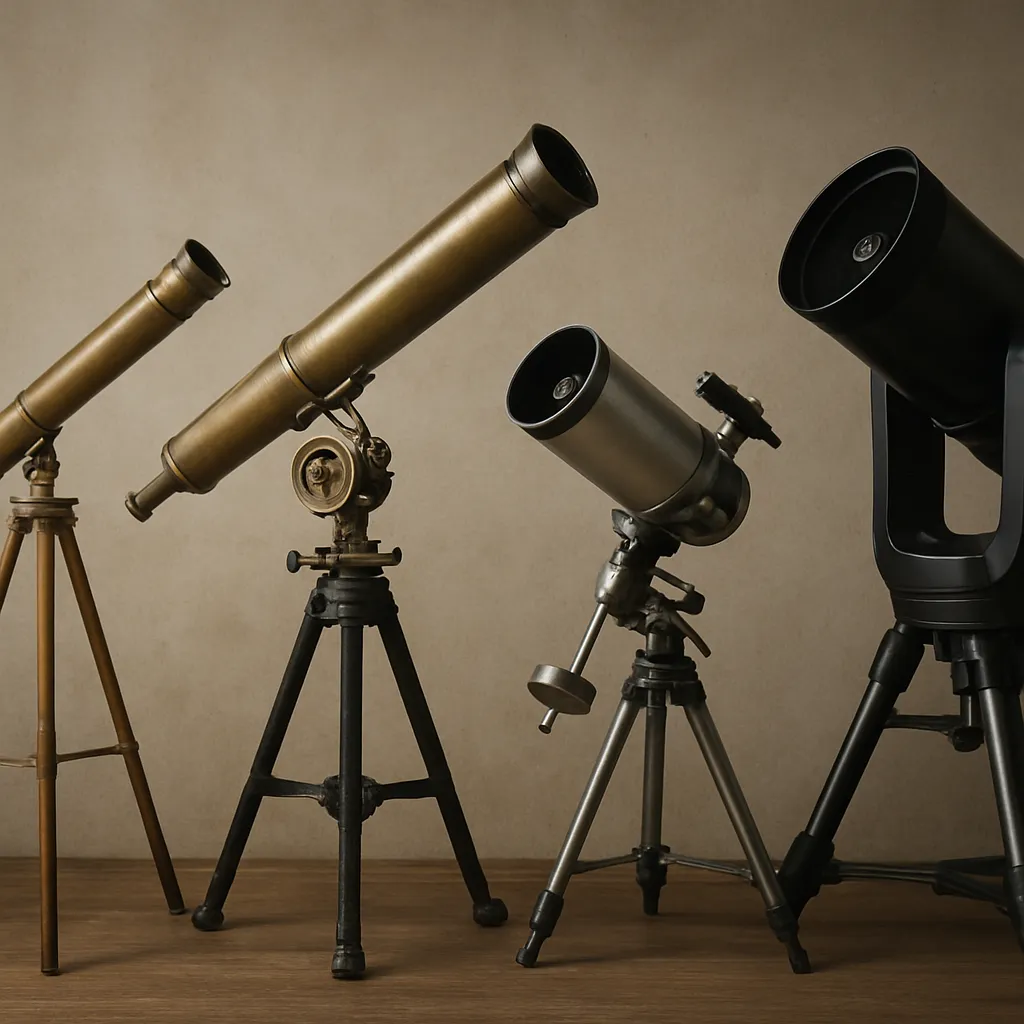
The journey of the telescope spans centuries of human curiosity and relentless innovation. From simple glass lenses to complex instruments orbiting Earth, each advance has expanded our vision of the cosmos. Astronomers have pushed the limits of optics and technology to capture fainter objects, sharper details, and a broader spectrum of light. As we trace this evolution, we uncover how seminal breakthroughs reshaped the field of astronomy and paved the way for modern exploration beyond our planet.
The Birth of Refracting Instruments
During the early 17th century, the first astronomical devices relied on simple glass elements. A convex lens gathered light while a second lens magnified the image, forming the prototype refractor. In 1609, pioneering observers like Galileo Galilei refined this basic design, achieving modest magnifications yet revealing lunar craters and Jupiter’s moons for the first time.
Key challenges included chromatic aberration—colored fringes caused by varying wavelengths focusing at different points. Innovators such as Johannes Kepler and Christiaan Huygens proposed multi-element lenses to mitigate distortion. Huygens, for instance, introduced long focal lengths that improved image resolution but demanded massive tubes sometimes exceeding 50 feet. These behemoths showcased early dedication to clarity over convenience.
Despite their bulk, refractors dominated observatories for centuries. Their sealed tubes prevented dust and moisture, ensuring stable visual performance. The world’s largest refractor, built in the late 19th century, reached a 40-inch aperture and remained in operation for decades, cementing the refractor’s legacy as a critical tool in stellar parallax measurements and planetary studies.
The Rise of Reflecting Designs
By the mid-17th century, scientists recognized that mirrors could bypass chromatic issues inherent to lenses. Sir Isaac Newton’s experiments led to the first successful reflecting telescope in 1668, using a polished metal mirror to gather and focus light. This Newtonian reflector proved more compact and free of color distortion, marking a significant leap for observational capability.
Later refinements replaced metal mirrors with silver-coated glass, greatly enhancing reflectivity and allowing for larger apertures. William Herschel’s famous 40-foot reflector, completed in 1789, boasted a 48-inch glass mirror and unveiled a wealth of nebulae and binary stars. Though difficult to maintain, these large reflectors heralded a new era of deep-sky exploration.
In the 20th century, mirror technology evolved further with the introduction of lightweight substrates and active control systems. Segmented mirrors, each precisely adjusted by actuators, enabled telescopes to achieve unprecedented sizes. Instruments such as the Keck Observatory in Hawaii employ multiple hexagonal segments that function as a single 10-meter primary mirror, gathering faint galactic light from billions of light-years away.
Radio Waves and Multiwavelength Observatories
The mid-20th century revealed that celestial objects also emit radio frequencies, invisible to optical devices. Karl Jansky’s detection of cosmic radio noise in the 1930s paved the way for the development of the first radio telescopes. These instruments use large parabolic dishes to collect and focus radio waves, unveiling phenomena like pulsars and the cosmic microwave background.
Advances in electronics and signal processing allowed arrays of dishes—such as the Very Large Array—to operate in concert. Through interferometry, radio astronomers achieved angular resolution levels far surpassing single-dish instruments. Later, infrared, ultraviolet, X-ray, and gamma-ray telescopes joined the observational arsenal, each designed to capture specific parts of the electromagnetic spectrum.
By combining data across multiple wavelengths, astronomers built a more comprehensive understanding of the universe. Observatories like the Atacama Large Millimeter/submillimeter Array (ALMA) investigate cold molecular clouds, while high-energy satellites reveal the violent cores of distant galaxies. Such synergy underscores the importance of broad-spectrum observatories in uncovering the universe’s hidden facets.
Space-Based Platforms and Future Prospects
Ground-based telescopes face atmospheric turbulence, absorption, and light pollution. To overcome these limitations, engineers launched the first orbiting observatories in the latter half of the 20th century. The Hubble Space Telescope, deployed in 1990, ushered in a golden age of precision imaging, free from atmospheric distortion. Its sharp views of distant galaxies, nebulae, and exoplanet transits revolutionized our cosmic perspective.
Since Hubble, numerous missions have followed: the Chandra X-ray Observatory, the Spitzer Space Telescope, and the James Webb Space Telescope. Each leverages cutting-edge technology—from cryogenically cooled detectors to segmented deployable mirrors—to probe ever-fainter signals. Webb’s 6.5-meter primary mirror, for instance, promises to peer back to the first stars formed after the Big Bang.
Looking ahead, planned instruments like the Extremely Large Telescope (ELT) and the Square Kilometre Array (SKA) will further extend humanity’s reach. Adaptive optics systems will correct for real-time distortions, while novel materials and manufacturing techniques may yield even lighter and stronger components. As we push on toward interplanetary missions and lunar-based observatories, the next chapters in telescope evolution will continue to challenge our ingenuity and deepen our grasp of the cosmic tapestry.