

The construction of the International Space Station stands as one of humanity’s greatest engineering feats. Over a period spanning more than a decade, dozens of countries and space agencies joined forces to assemble a research laboratory in the harsh environment of low Earth orbit. Each mission delivered critical components, relying on precise coordination, advanced technology and unwavering dedication. This article explores the origin, design, assembly and ongoing impact of this remarkable outpost above our planet.
Origins of the Ambitious Program
The dream of a permanent orbital laboratory emerged in the 1980s, when space agencies recognized the need for a stable platform to conduct long-duration research in microgravity. Early concepts combined elements from NASA’s Freedom station and the Soviet Mir-2 project. In 1993, agreements between NASA, Roscosmos, ESA, JAXA and CSA solidified plans for a joint endeavor. Key motivations included:
- Advancing science in biology, physics and Earth observation
- Demonstrating sustained human presence beyond Earth
- Fostering international collaboration and peaceful cooperation
By merging resources and expertise, partners overcame budget constraints and technical challenges. Early workshops defined the station’s modular architecture, paving the way for an incremental assembly approach in orbit.
Modular Design and International Contributions
The station’s modularity allowed components to be built independently and integrated later in space. Major modules included:
- Unity Node (Node 1) – the first U.S. segment acting as a central connector
- Zarya – the Russian-built Functional Cargo Block providing initial power and propulsion
- Zvezda – the Service Module supplying life support, sleeping quarters and command systems
- Destiny Laboratory – the U.S. research module equipped for experiments in materials, fluids and combustion
- Columbus Laboratory – Europe’s contribution for life sciences and technology demonstrations
- Kibo – Japan’s multipurpose module featuring a pressurized lab and remote robotic arm
Each partner manufactured hardware to stringent specifications. For instance, solar array wings unfolded to generate up to 120 kilowatts of electricity, powering research equipment and environmental control systems. This engineering synergy exemplified global teamwork, overcoming differences in metric standards, safety protocols and documentation.
Assembly in Orbit: Shuttle Missions and Spacewalks
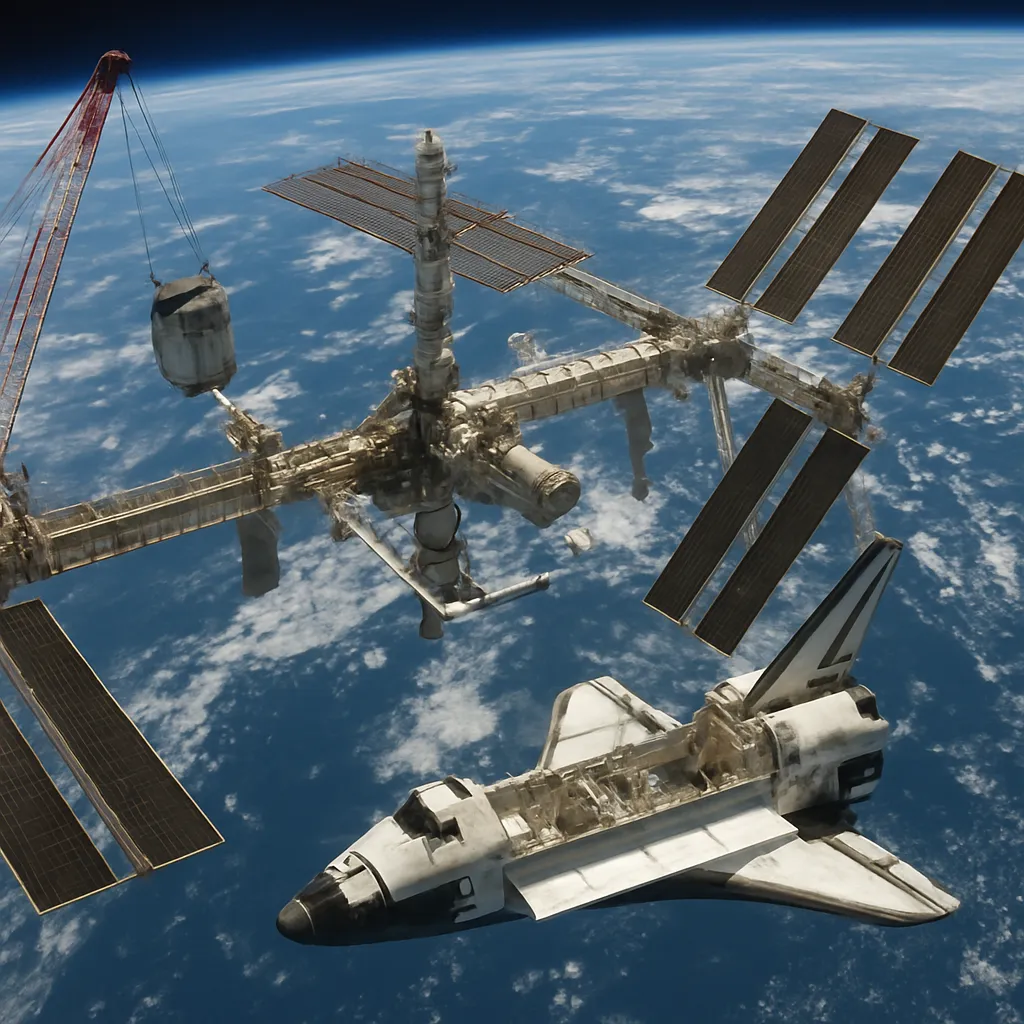
Between 1998 and 2011, more than 30 space shuttle flights and numerous Russian Proton and Soyuz launches delivered station elements and crew. Astronauts performed over 160 extravehicular activity (EVA) sessions to bolt modules together and connect power and data cables. Highlights included:
- STS-88: Unity and Zarya mated by shuttle Endeavour astronauts
- STS-100: Installation of Canadarm2, a robotics marvel that now assists in module relocation
- Expedition missions: Long-duration crews who powered up systems, tested life support and installed micrometeoroid shields
Precision was paramount. Even minor misalignments could jeopardize docking ports or solar panel articulation. Ground controllers in Houston, Moscow and European mission centers provided round-the-clock support, monitoring telemetry and updating software to ensure seamless integration.
Technological Innovations and Operational Challenges
Operating the station demanded breakthroughs in multiple domains:
- Logistics: Supply ships like Progress, ATV, HTV and Cygnus delivered food, water, air and experiment payloads on a regular schedule.
- Life Support: The Environmental Control and Life Support System recycled air and water, reducing the need for frequent resupply.
- Automation: Advanced computers and the Canadarm2 robotic complex handled module berthing and external maintenance tasks.
- Radiation Shielding: Multi-layer blankets and specialized alloys protected crew from high-energy particles.
Despite meticulous planning, crews faced unexpected anomalies such as coolant leaks, sensor failures and micrometeoroid impacts. Rapid diagnosis and repair under microgravity tested the resilience of both hardware and personnel. Lessons learned have influenced designs for future deep-space habitats.
Continuing Expeditions and the Road Ahead
The station has orbited Earth for more than two decades, hosting over 250 individuals from 20 nations. Recent commercial cargo and crew launches by private providers have expanded access, while new modules like Nauka and Prichal bolster living and research capacity. Planned upgrades aim to enhance solar arrays, communication arrays and docking ports.
As exploration extends toward the Moon and Mars, the ISS remains a vital platform for testing technologies and human adaptation. Its legacy will inform the next generation of spacecraft and habitats, ensuring that the spirit of cooperation and discovery continues to thrive beyond our home planet.