
The origin of Earth’s only natural satellite, the Moon, remains one of the most captivating puzzles in planetary science. Over decades of research, several hypotheses have emerged to explain its formation, each supported by different lines of geological, geochemical, and dynamical evidence. Understanding how the Moon formed offers insights not only into our planet’s early history, but also into the processes shaping terrestrial bodies throughout the solar system.
The Giant Impact Hypothesis
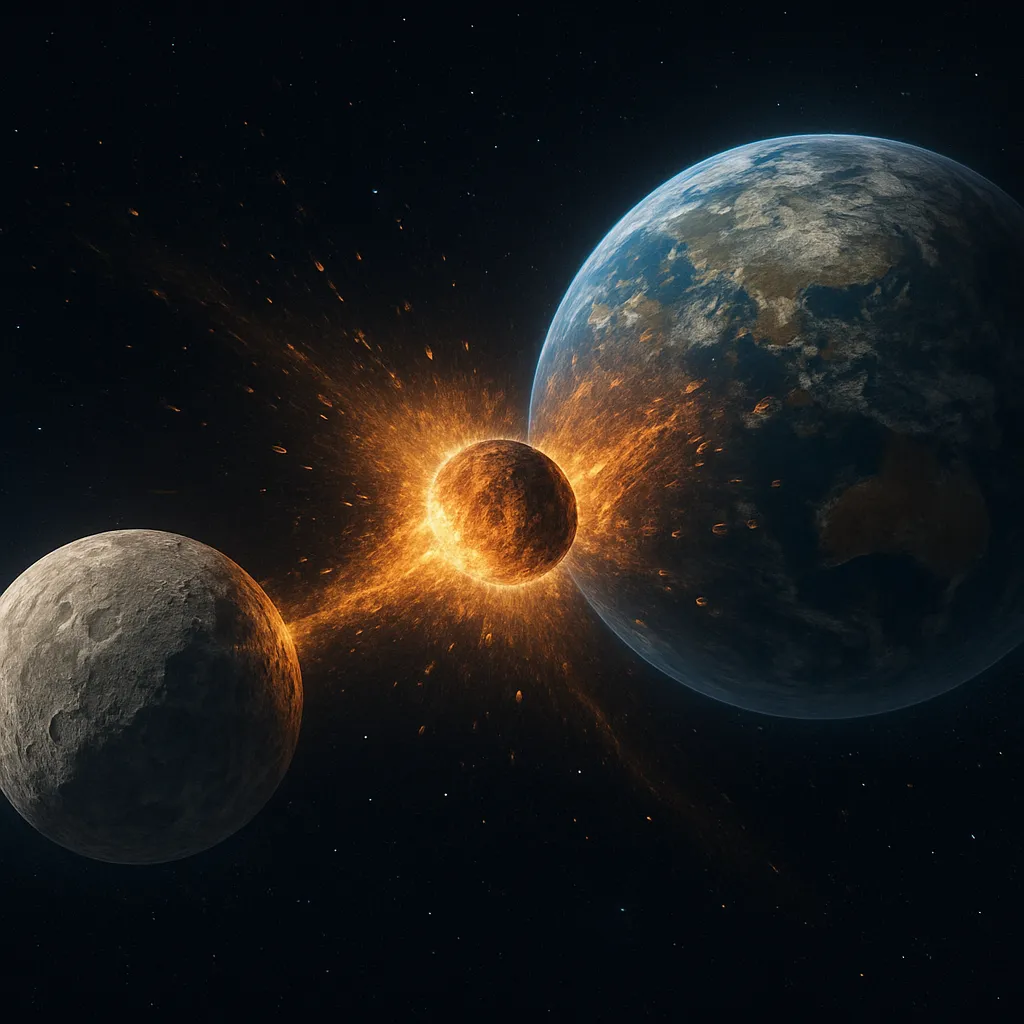
One of the most widely supported scenarios is the Giant Impact Hypothesis. According to this model, a Mars-sized body—often called Theia—collided with the proto-Earth roughly 4.5 billion years ago. This cataclysmic collision ejected substantial debris into orbit, which then coalesced through accretion into the Moon we observe today.
Mechanics of the Collision
- The projectile’s mass and velocity were critical in imparting sufficient angular momentum to Earth–Moon system.
- Impact angle influenced the quantity and composition of the ejected material.
- High-energy conditions led to partial melting and vaporization of silicate rock.
Computer simulations of the impact show a ring of molten and vaporized material around Earth. Over time, this circumterrestrial disk cooled and aggregated into a single lunar body. The hypothesis elegantly accounts for the Moon’s relatively small iron core and the similarity in isotopic composition between lunar and terrestrial rocks.
Geochemical Footprints
Precise measurements of oxygen isotopes reveal that lunar samples have nearly identical ratios to Earth’s mantle. This suggests a common origin for much of their material. Enrichments in volatile elements and siderophile (iron-loving) elements further constrain the impact’s energy, indicating only a fraction of late-impactor core material survived to integrate into the Moon.
The Co-Accretion Model
In contrast, the Co-Accretion Model proposes that the Moon formed alongside Earth from the same protoplanetary disk. As solar nebula gas and dust condensed, discrete planetesimals aggregated, eventually forming both bodies in close proximity.
Fundamental Principles
- Mutual gravitational attraction caused proto-Earth and proto-Moon to orbit a common center-of-mass.
- Planetesimal collisions within the feeding zone supplied mass to each proto-body.
- Relative velocities had to remain low enough to permit gentle accretion rather than disruptive impacts.
Although this model naturally explains the isotopic similarities, it struggles to account for the current high angular momentum of the Earth–Moon system. Additionally, it fails to justify the Moon’s depleted volatile inventory and small core size, unless invoking ad hoc processes to strip volatiles or segregate iron during formation.
Challenges and Counterarguments
Critics of co-accretion highlight that the feeding zone for Earth likely extended only a few lunar radii, limiting the material available to build a Moon-sized body. Moreover, dynamical studies demonstrate that two large bodies forming so close would probably collide or be perturbed by other planets, undermining a stable co-accretion scenario.
The Capture Theory
Another intriguing possibility is that Earth captured a wandering planetary embryo. According to the Capture Theory, the Moon originated elsewhere in the solar system and became bound to Earth during a close encounter.
Requirements for Capture
- Atmospheric dissipation or a third-body interaction to remove excess kinetic energy from the passing body.
- Fine-tuned approach trajectory to avoid collision or runaway escape.
- Mass ratio and velocity constraints to allow stable orbital insertion.
Early versions of this theory invoked Earth’s primordial atmosphere as a brake. However, the atmosphere would have needed to be extraordinarily dense—far beyond plausible models—to capture a Moon-sized object. Alternatively, a third-body mechanism involving a planetesimal swarm was suggested, but simulations have shown that stable capture under realistic conditions is exceedingly unlikely.
Isotopic Discrepancies
The most serious obstacle for capture lies in geochemical composition. If the Moon formed far from Earth, its isotopic signature should differ markedly. However, lunar rocks exhibit near-identical isotope ratios for oxygen, titanium, and silicon as terrestrial samples. This strong geochemical affinity argues against an extrasolar or even solar-system-wide origin distinct from Earth’s.
Hybrid Models and New Developments
Despite the dominance of the Giant Impact Hypothesis, researchers continue to explore hybrid and modified scenarios to reconcile remaining anomalies. These include:
- Hit-and-run collisions where Theia skims Earth, gradually shedding material before escaping.
- Dual-impact models suggesting two smaller bodies collided sequentially with Earth.
- Vapor-rich impact disks with extended cooling times, affecting volatile retention.
Advanced Simulations
Recent studies employ high-resolution hydrodynamic codes to resolve fine-scale mixing during the impact. Results indicate that under certain conditions, Earth’s mantle and impactor material can mix thoroughly, generating isotopic homogenization inline with observations. These detailed models emphasize the importance of initial spin rates and impact geometry in determining the final Moon mass and iron fraction.
Exoplanetary Analogues
Observations of debris disks around young stars provide natural laboratories for studying Moon-forming processes. Infrared excesses and transient collision signatures hint at frequent giant impacts during terrestrial planet formation. By comparing disk lifetimes and dust composition in other systems, astronomers refine constraints on how often and under what conditions large satellites can form.
Future Prospects
Ongoing missions and sample-return projects promise to deepen our understanding of lunar origin. The planned Artemis missions aim to explore the Moon’s south pole and collect new rock samples. Advanced geochemical analyses, combined with isotopic dating at sub-percentage precision, may reveal subtle differences between lunar regions, tracing back to diverse impactor contributions or sequential accretion events.
Geophysical Investigations
Seismic networks deployed on the lunar surface will probe its internal structure and search for remnants of a buried core. Magnetic field studies may detect ancient dynamo signatures, shedding light on how long the Moon retained a molten core after formation. These findings will refine models of early thermal evolution and solidification.
Interdisciplinary Insights
Collaboration between dynamicists, geochemists, and astronomers continues to be essential. By integrating orbital mechanics, high-pressure petrology, and stellar observations, research teams are narrowing down the range of plausible scenarios. The convergence of evidence from multiple disciplines is driving the consensus toward impact-driven origins, but alternative nuances remain under active debate.
Key Takeaway: While the Giant Impact Hypothesis remains the leading explanation, ongoing research explores variations that address outstanding questions about the Moon’s detailed composition and early thermal history. The story of lunar formation is a testament to the dynamism of our young solar system and underscores the intricate interplay between impact processes and planetary evolution.