

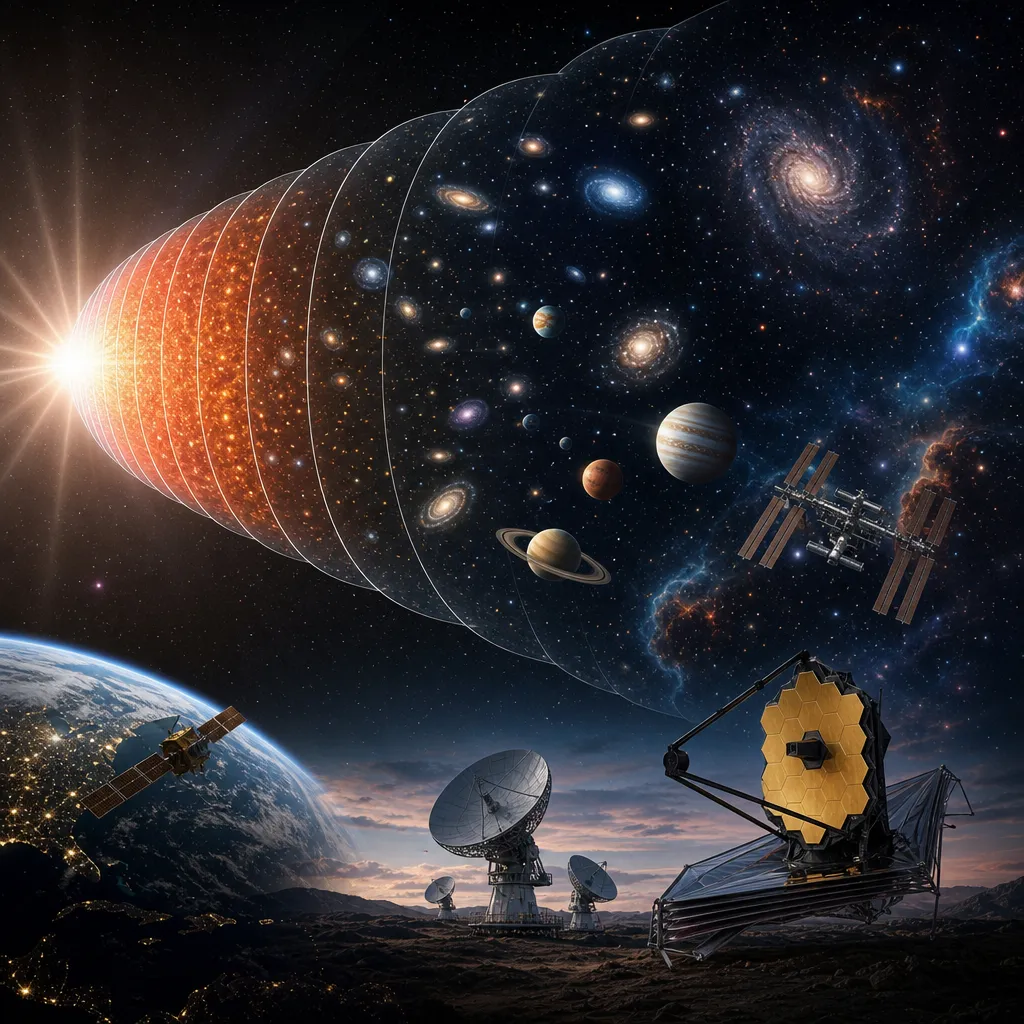
The universe, as far as modern cosmology can tell, was not formed as an explosion into empty space. It began about 13.8 billion years ago in an extremely hot, dense early state, and space itself has been expanding and cooling ever since. Over time, simple particles formed, then atoms, then stars and galaxies, and much later planets and the chemical ingredients needed for life. This broad picture is strongly supported by observations, although the deepest questions about what happened at the very beginning remain open.
When scientists ask how the universe formed, they are really asking several linked questions: how space, time, matter, and radiation evolved from the earliest moments; how structure emerged from near-uniform beginnings; and why the cosmos looks the way it does today. The best current framework is the Big Bang model, refined by ideas such as cosmic inflation and tested by decades of astronomical measurements.
What “the Big Bang” actually means
The Big Bang is often misunderstood. In science, it does not mean a conventional blast from a single point into preexisting emptiness. Instead, it describes the early expansion of the universe from a state in which matter and energy were packed into extraordinary density and temperature everywhere.
According to general relativity, space can expand. If the universe is expanding now, then tracing that expansion backward implies that the observable universe was once much smaller, hotter, and denser. In that early era, the conditions were so extreme that atoms could not exist, stars had not formed, and the familiar structures of the modern cosmos had not yet emerged.
The term also does not necessarily tell us what happened at the absolute beginning, if such a moment can even be defined in a meaningful physical way. The equations of current physics work extremely well back to very early times, but they become incomplete when pushed to conditions where quantum effects of gravity should matter.
The earliest known stages of cosmic history
Scientists divide the universe’s early history into eras, each governed by different physical conditions. Some of these stages are well supported by evidence, while the very earliest are more model-dependent.
A very hot, dense beginning
In the first tiny fraction of a second, the universe was filled with energy and elementary particles. The known forces of nature may have behaved differently under those conditions than they do now. As the universe expanded, it cooled, allowing different kinds of particles and interactions to emerge in stable forms.
Inflation: a leading but not directly proven idea
Many cosmologists think the universe underwent a brief period of extremely rapid expansion called cosmic inflation. Inflation is not the same thing as the overall expansion described by the Big Bang model; it is a proposed phase that may have occurred very early and then ended.
Inflation helps explain several important features of the universe. It can account for why the cosmos appears nearly flat on large scales, why regions far apart in the sky have almost the same temperature, and how tiny quantum fluctuations could later grow into galaxies and clusters. However, while inflation is strongly supported indirectly, its exact mechanism is not established, and multiple versions of the idea exist.
Formation of the first particles
As temperatures fell, energy produced stable particles such as quarks, electrons, and eventually protons and neutrons. A little later, protons and neutrons combined in a process called Big Bang nucleosynthesis, producing most of the universe’s hydrogen nuclei and much of its helium, along with tiny amounts of lithium.
This is one of the best-tested parts of early-universe physics. The observed abundances of these light elements broadly match predictions from the theory.
How atoms, light, stars, and galaxies appeared
For a long time after the beginning, the universe remained too hot for electrons to bind to atomic nuclei. Matter existed as an ionized plasma, and light could not travel freely because it scattered constantly off charged particles.
After the universe had cooled enough, electrons combined with nuclei to make neutral atoms, mostly hydrogen and helium. This event is known as recombination, though it was actually the first stable combination in cosmic history. Once neutral atoms formed, light could travel much more freely through space.
That ancient light still fills the universe today as the cosmic microwave background, or CMB. It is one of the strongest pieces of evidence for the early hot universe.
After this came the so-called cosmic dark ages, before stars had formed. Gravity slowly amplified tiny density differences. Regions with slightly more matter attracted more matter, eventually collapsing into the first stars and galaxies. Those first stars forged heavier elements such as carbon, oxygen, and iron, which later became part of new stars, planets, and eventually living organisms.
| Stage | What happened | Why it matters |
|---|---|---|
| Possible inflation | A hypothesized burst of very rapid early expansion | May explain the universe’s large-scale uniformity and the seeds of structure |
| Particle formation | Elementary particles became stable as the universe cooled | Created the building blocks of matter |
| Big Bang nucleosynthesis | Hydrogen, helium, and traces of lithium formed | Provides a direct test of early-universe theory |
| Recombination | Neutral atoms formed and light traveled freely | Produced the cosmic microwave background |
| First stars and galaxies | Gravity pulled matter into dense regions | Began the long history of cosmic structure and chemical enrichment |
The forces and ingredients that shaped the universe
Several physical ingredients governed cosmic evolution. The most obvious is gravity, which pulled matter together and built stars, galaxies, and larger structures. Without gravity, the universe would have remained much smoother and more diffuse.
Radiation also mattered greatly in the early universe. When the cosmos was very young and hot, radiation strongly influenced how matter behaved. As expansion continued, matter became more important for structure formation.
Two less familiar components dominate modern cosmology: dark matter and dark energy. Dark matter does not appear to emit or absorb light, but its gravity helps galaxies form and stay bound. Dark energy is the name given to whatever is causing the expansion of the universe to accelerate today.
Both are inferred from observations, not directly seen in the laboratory in the same way as ordinary matter. Their existence is strongly supported by evidence, but their fundamental nature remains uncertain.
How scientists know this picture is broadly correct
The modern account of cosmic formation is not based on a single observation. It rests on several independent lines of evidence that fit together remarkably well.
Galaxies are moving apart
Light from distant galaxies is shifted toward longer, redder wavelengths. This redshift shows that space is expanding. The farther away a galaxy is, the more its light is generally redshifted, which matches the idea of an expanding universe.
The cosmic microwave background
The CMB is relic radiation from the early universe, now cooled into microwaves by cosmic expansion. It has been mapped in great detail by missions such as COBE, WMAP, and Planck. Tiny fluctuations in its temperature reveal the small density variations from which later structures grew.
Light element abundances
The observed amounts of hydrogen, helium, and some lithium in the universe are consistent, within known tensions and uncertainties, with predictions of Big Bang nucleosynthesis. This gives scientists a way to test conditions in the first minutes of cosmic history.
Large-scale structure
When astronomers map the distribution of galaxies across vast distances, they see a cosmic web of filaments, clusters, and voids. Computer simulations based on the expanding-universe model, plus dark matter, reproduce many of these patterns with impressive accuracy.
| Evidence | How it is measured | What it supports |
|---|---|---|
| Galaxy redshift | Spectroscopy of distant galaxies | Expansion of space |
| Cosmic microwave background | Microwave observations from space missions | A hot, dense early universe and the seeds of later structure |
| Light element abundances | Spectroscopy and astrophysical modeling | Conditions during the universe’s first minutes |
| Galaxy clustering | Sky surveys and simulations | Growth of structure under gravity, especially with dark matter |
What the universe was formed from
This question has a subtle answer. In the earliest known stages, matter as we know it had not yet settled into atoms. The universe consisted of energy, elementary particles, radiation, and fields governed by fundamental physics.
Ordinary matter, made of protons, neutrons, electrons, and eventually atoms, formed as the universe cooled. Yet ordinary matter is only a small fraction of the cosmic total. Most of the universe’s content appears to be dark matter and dark energy.
That does not mean scientists know exactly what these are. Dark matter is a well-supported inference from its gravitational effects. Dark energy is a name for the observed acceleration of cosmic expansion. Both are central to current models, but both are still active research topics.
Why this matters scientifically
Understanding how the universe formed is not only about origins in a philosophical sense. It tells scientists how the laws of physics behave under extreme conditions, how galaxies and stars came to exist, and why the chemical elements needed for planets and life are present at all.
Cosmology also connects the very large and the very small. The structure of the universe depends on particle physics, gravity, quantum fluctuations, and the behavior of matter and radiation across billions of years. Questions about the earliest universe can point toward new physics beyond today’s standard models.
This field also shapes how astronomers interpret observations. Every distant galaxy is seen in the past because light takes time to travel. In that sense, telescopes are tools for studying cosmic history directly, though only through the light and other signals that reach us.
What remains uncertain
Despite the success of modern cosmology, important mysteries remain. Scientists do not yet know what, if anything, preceded the hot early state described by the Big Bang model. They also do not have a complete theory that unifies quantum mechanics with gravity, which is likely necessary to describe the earliest moments accurately.
The exact cause and mechanism of inflation, if inflation occurred, is unresolved. The nature of dark matter is unknown, despite many experiments. The physical explanation for dark energy is also unsettled.
There are also measurement tensions in cosmology, including differences between some methods of estimating the current expansion rate of the universe. These tensions may eventually be explained by improved data and modeling, or they could hint at new physics. At present, the issue remains under active investigation.
So the broad outline of cosmic formation is robust, but the opening chapter is still incomplete.
How future observations may improve the picture
New telescopes and surveys are helping astronomers study earlier cosmic eras and test cosmological models more precisely. The James Webb Space Telescope is observing very distant galaxies, offering new data on early structure formation. Ground-based observatories and sky surveys continue to map galaxy positions and motions across huge volumes of space.
Scientists are also searching for better clues to inflation, dark matter, and dark energy. Future measurements of the cosmic microwave background, gravitational lensing, and large-scale structure may narrow the possibilities. Experiments in particle physics may also help identify the nature of unseen cosmic components.
It is possible that the next major advance will come not from one dramatic discovery but from many precise measurements that reveal where the standard picture works and where it begins to fail.
Did the universe begin from a single point?
Not in the simple everyday sense often imagined. The Big Bang model says the early universe was extremely hot and dense everywhere within the observable region, and that space itself expanded. Whether there was a true mathematical “point” at the start is a deeper question that current physics cannot answer with confidence.
Was the Big Bang an explosion?
No. An ordinary explosion expands into surrounding space, but the Big Bang describes the expansion of space itself. Galaxies are generally not flying away from a central location in preexisting emptiness.
How do scientists know the universe is expanding?
They measure the redshift of light from distant galaxies using spectroscopy. The overall pattern shows that more distant galaxies are generally receding faster, which matches an expanding universe.
What is the strongest evidence for the early universe?
Several lines of evidence are crucial together: the expansion of the universe, the cosmic microwave background, and the abundances of light elements formed early in cosmic history. No single observation explains everything, but together they form a consistent picture.
What came before the universe formed?
Scientists do not know. Some theoretical models propose earlier phases or cyclic behavior, but none is established as fact. Current evidence does not yet allow a definitive answer.
Could the universe have formed without dark matter?
Current evidence suggests dark matter, or something that behaves similarly through gravity, is needed to explain many observations, especially how cosmic structure developed. Alternative ideas exist, but the standard cosmological model with dark matter remains the best-supported framework.
Can we observe the moment the universe began?
Not directly with light. The cosmic microwave background comes from a time when the universe had already cooled enough for light to travel freely. Earlier epochs must be inferred from theory, indirect evidence, and possibly future observations such as primordial gravitational-wave signatures, if they are detected.
Sources
- NASA, Universe 101 and cosmology educational resources
- ESA and the Planck mission science results
- Peebles, P. J. E., Principles of Physical Cosmology