
The Big Bang theory is the leading scientific explanation for how the universe began evolving from an extremely hot, dense early state and then expanded over billions of years into the cosmos we observe today. It does not describe an explosion into empty space. Instead, it describes space itself expanding, carrying galaxies apart on the largest scales. In modern cosmology, the Big Bang framework explains the universe’s large-scale growth, its cooling history, the origin of light elements, and the relic radiation still filling space.
The theory is supported by several independent lines of evidence, especially the expansion of the universe, the cosmic microwave background, and the observed abundances of hydrogen, helium, and lithium. It is one of the most successful models in science, but it does not answer every question. In particular, scientists still investigate what happened in the earliest fraction of a second, whether cosmic inflation occurred, and whether the Big Bang marks an absolute beginning or only the beginning of the observable universe’s current expansion history.
What the Big Bang theory actually says
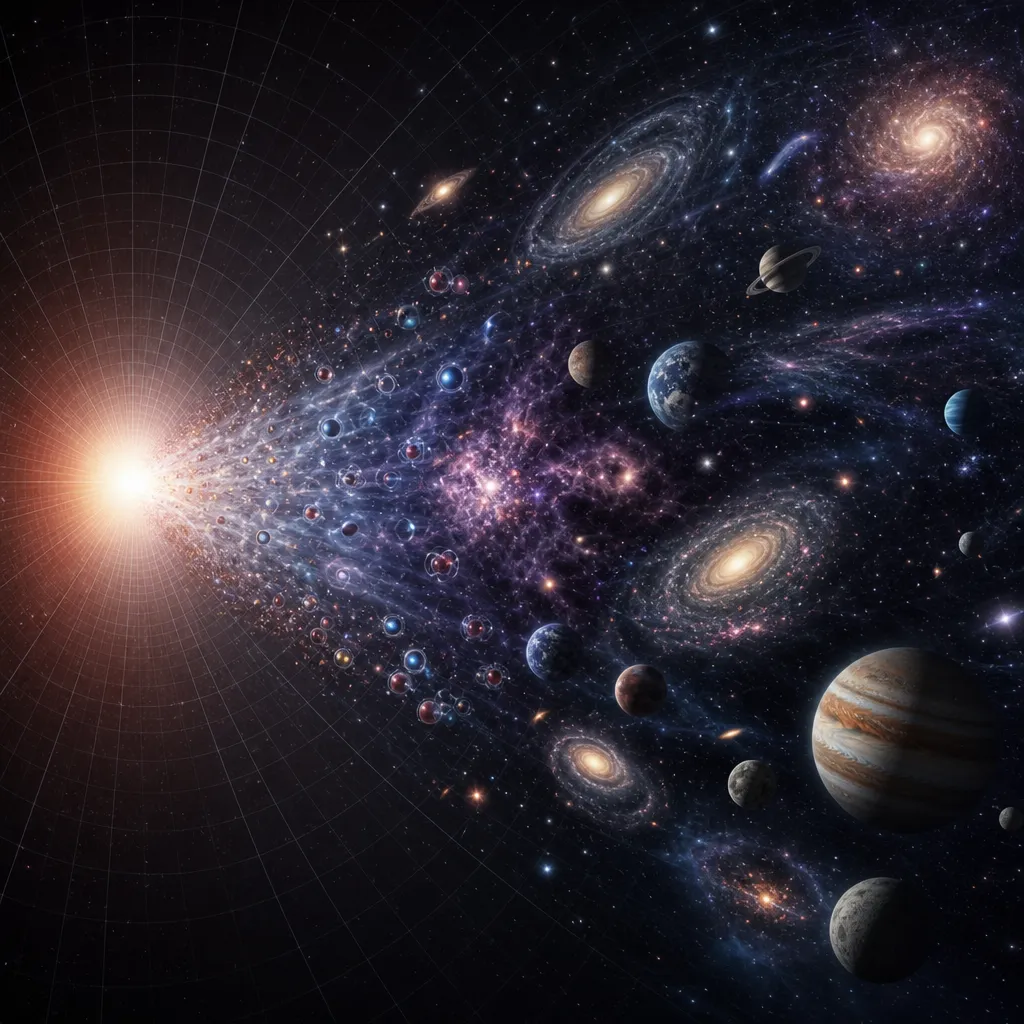
At its core, the Big Bang theory says that the observable universe was once far hotter and denser than it is now. As space expanded, matter and radiation spread out and cooled. Over time, simple particles formed, then atomic nuclei, then atoms, stars, galaxies, and eventually planets.
A common misunderstanding is that the Big Bang was like a bomb exploding from a single point into preexisting emptiness. That image is misleading. In the theory, space itself changes with time. On large scales, distances between galaxies increase because the fabric of the universe expands. Every distant region sees that expansion, so there is no unique central point of the event within ordinary space.
The phrase “Big Bang” is used in two related ways. Sometimes it refers broadly to the whole early hot, dense phase and later expansion of the universe. More narrowly, it can mean the limit where current equations trace the universe back to extremely high density. That mathematical limit is often called a singularity, but most cosmologists do not treat it as a complete physical description. It more likely signals that known physics becomes incomplete under such extreme conditions.
How the early universe evolved
The Big Bang model is really a timeline of cooling cosmic conditions. In the earliest moments that current physics can discuss with some confidence, the universe was filled with extremely energetic particles and radiation. As expansion continued, temperatures dropped, allowing new structures and processes to become possible.
From particles to nuclei
Within the first few minutes, protons and neutrons could combine to form the nuclei of light elements. This process is called Big Bang nucleosynthesis. It mainly produced hydrogen nuclei, helium nuclei, and tiny amounts of lithium. Heavier elements such as carbon, oxygen, silicon, and iron were made much later inside stars and supernova explosions.
From plasma to atoms
For hundreds of thousands of years, the universe remained so hot that electrons could not stay bound to nuclei. Matter existed as a plasma, and light scattered frequently from free electrons. As the universe cooled enough for neutral atoms to form, light could travel much more freely. That released radiation still exists today, stretched by cosmic expansion into microwaves. It is observed as the cosmic microwave background, often abbreviated CMB.
From small fluctuations to galaxies
The early universe was not perfectly smooth. It contained tiny differences in density. Gravity amplified those small irregularities over time, pulling matter into clouds, then stars, galaxies, galaxy clusters, and the vast cosmic web. Dark matter, inferred from multiple observations, played a major role in this structure formation because its gravity helped matter clump efficiently.
| Stage | What happened | Why it matters |
|---|---|---|
| Early hot, dense state | The universe was filled with extremely energetic radiation and particles | Sets the initial conditions for cosmic evolution |
| Big Bang nucleosynthesis | Light atomic nuclei formed | Explains the cosmic abundance of helium and some other light elements |
| Recombination | Electrons joined nuclei to make neutral atoms | Allowed the cosmic microwave background to travel across space |
| Structure formation | Gravity grew tiny density variations into galaxies and clusters | Connects the early universe to the large-scale cosmos seen today |
How we know the universe is expanding
The first major evidence came from observations showing that distant galaxies are generally moving away from us. Their light is shifted toward longer, redder wavelengths, a phenomenon called redshift. In an expanding universe, light traveling through stretching space is also stretched, increasing its wavelength.
This pattern is not just random motion. On large scales, the farther away a galaxy is, the greater its redshift tends to be. That relationship was developed from observations in the early twentieth century and became one of the foundations of modern cosmology.
Expansion does not mean everything in the universe is flying apart locally. Gravity and other forces hold stars, solar systems, galaxies, and even galaxy groups together. Expansion becomes important mainly across the enormous distances between large cosmic structures.
Today, astronomers study expansion with many tools, including supernova observations, galaxy surveys, and maps of the cosmic microwave background. These methods not only confirm expansion but also help measure how the rate of expansion has changed over cosmic time.
The strongest evidence for the Big Bang
The Big Bang theory is accepted because several distinct observations point to the same general picture. No single piece of evidence stands alone; together they form a robust framework.
| Evidence | How it is measured | What it supports |
|---|---|---|
| Galaxy redshifts | Spectroscopy of distant galaxies | The universe is expanding |
| Cosmic microwave background | Microwave observations from ground, balloon, and space missions | The universe was once hot, dense, and opaque |
| Light element abundances | Astronomical spectroscopy and chemical analysis | Early-universe nuclear reactions occurred as predicted |
| Large-scale structure | Galaxy maps and cosmological simulations | Tiny early fluctuations grew into today’s cosmic web |
The cosmic microwave background
The CMB is often described as the afterglow of the early universe. It was predicted before it was discovered and later measured in remarkable detail by missions including COBE, WMAP, and Planck. Its nearly uniform temperature across the sky, along with tiny fluctuations imprinted within it, strongly supports the hot Big Bang model.
Those small temperature variations are especially important. They reveal the seeds of later cosmic structure and provide precise tests of cosmological models. The observed pattern matches the idea that the early universe was almost uniform but not perfectly so.
Light elements
Big Bang nucleosynthesis predicts that a young, rapidly cooling universe should leave behind characteristic amounts of helium and other light elements. Observations broadly agree with these predictions. This is powerful evidence because it depends on nuclear physics very different from the physics used to measure cosmic expansion.
What the Big Bang theory does not explain completely
The Big Bang theory is strong, but it is not a finished answer to every cosmic question.
First, it does not by itself explain why the universe began in a hot, dense state. Standard Big Bang cosmology describes the evolution of the universe after that condition is established. The deeper origin of that state remains an open problem.
Second, the very earliest interval is uncertain. At extremely high energies, general relativity, which describes gravity on cosmic scales, likely needs to be combined with quantum physics. A complete theory of quantum gravity does not yet exist.
Third, some important ingredients of the modern cosmological model are still not fully understood in physical terms. Dark matter is inferred from gravitational effects, but its identity is unknown. Dark energy appears to drive the present accelerated expansion of the universe, but its nature is also unresolved.
Finally, there are observational tensions that scientists continue to investigate, such as different methods yielding somewhat different values for the present expansion rate. These do not overturn the Big Bang framework, but they may point to incomplete modeling, hidden systematic effects, or possibly new physics.
Where inflation fits in
Cosmic inflation is a leading hypothesis about an extremely early phase in which the universe may have expanded extraordinarily rapidly for a tiny fraction of a second. Inflation was proposed to explain several features of the observable universe, including why space appears so nearly flat and why regions far apart in the sky have very similar properties.
Inflation is not the same thing as the Big Bang theory, though many modern versions of cosmology combine them. The hot Big Bang describes the universe once it is already in a hot expanding state. Inflation, if it occurred, would help explain how that state was prepared.
There is important evidence consistent with inflation, especially the statistical pattern of tiny fluctuations seen in the CMB. However, inflation is still a theoretical framework with multiple versions, not a single directly observed event. Scientists continue searching for stronger tests, including subtle polarization signatures in the microwave background. So far, no universally accepted smoking gun has been found.
Why the Big Bang matters
The Big Bang theory matters because it gives a coherent physical history of the universe. It connects the behavior of subatomic particles to the largest structures in nature. Few scientific theories link so many scales so successfully.
It also provides the context for almost every major question in astronomy. The ages of stars, the formation of galaxies, the distribution of matter, the temperature of space, and the chemical ingredients available for planets and life all depend on cosmic history. Without a model of the universe’s expansion and cooling, those subjects would be disconnected facts rather than parts of one story.
In practical scientific terms, the theory has been highly predictive. It anticipated relic radiation, described light element formation, and gave a framework for understanding the growth of structure. Modern observatories continue testing it with ever-better data rather than treating it as final dogma.
How scientists study the early universe today
Because no one can directly watch the universe’s first moments, cosmology relies on inference from surviving signals. Scientists observe light from distant galaxies, map the microwave sky, measure elemental abundances, and compare those results with physical models and computer simulations.
Spectroscopy shows how fast galaxies are receding and what chemical elements they contain. Space telescopes and ground observatories survey galaxies across cosmic time, letting astronomers see younger stages of the universe because distant light took billions of years to reach us. CMB missions measure relic radiation with great precision. Particle physics experiments help test conditions relevant to the early universe, though they cannot reproduce its full scale.
Cosmology is therefore a combination of observation, theory, and statistical analysis. Some conclusions are very secure, such as expansion and the existence of the CMB. Others, especially concerning the first tiny fraction of a second, remain model-dependent.
Common misconceptions
- The Big Bang was not an explosion in ordinary space. It was the expansion of space itself on cosmic scales.
- It does not say the universe expanded from a visible point in the sky. The expansion happens everywhere.
- It does not mean galaxies are expanding internally. Bound systems resist cosmic expansion.
- It is not “just a guess.” In science, a theory is a tested explanatory framework supported by evidence.
- It does not fully explain the ultimate origin of everything. It explains the evolution of the universe from an early hot, dense phase.
Did the Big Bang happen at one point in space?
No. In the standard model, the Big Bang was not an event at one location inside a larger empty space. The early hot dense state existed everywhere in the observable universe, and space expanded throughout it.
How do scientists know the Big Bang theory is right?
They do not treat any theory as absolutely beyond revision, but the evidence is very strong. The expansion of the universe, the cosmic microwave background, and the observed abundance of light elements all independently support the model.
What existed before the Big Bang?
Science does not yet have a confirmed answer. Some ideas propose earlier phases, bounce models, or quantum origins, but these remain speculative. Current evidence does not establish a single accepted “before.”
Is the Big Bang the same as the origin of matter?
Not exactly. The theory describes the early evolution of the universe and the conditions under which matter and radiation behaved. Questions about why there is more matter than antimatter, and how the earliest state originated, are still active research topics.
Can we still observe evidence of the Big Bang today?
Yes. The clearest evidence is the cosmic microwave background, which fills all of space. Astronomers also observe galaxy redshifts and the chemical makeup of ancient gas clouds and stars.
Does the Big Bang mean the universe will expand forever?
Not by itself. The long-term future depends on the total contents and properties of the universe, especially dark energy. Current observations indicate that cosmic expansion is accelerating, but the ultimate fate of the universe is still studied within that framework.
What remains unknown about the Big Bang?
Major open questions include the nature of dark matter and dark energy, whether inflation occurred, what physics governed the earliest moments, and whether the Big Bang was the true beginning or part of a larger cosmic history.
Sources
- NASA, WMAP Mission: Universe 101
- European Space Agency, Planck
- Peebles, P. J. E., Principles of Physical Cosmology