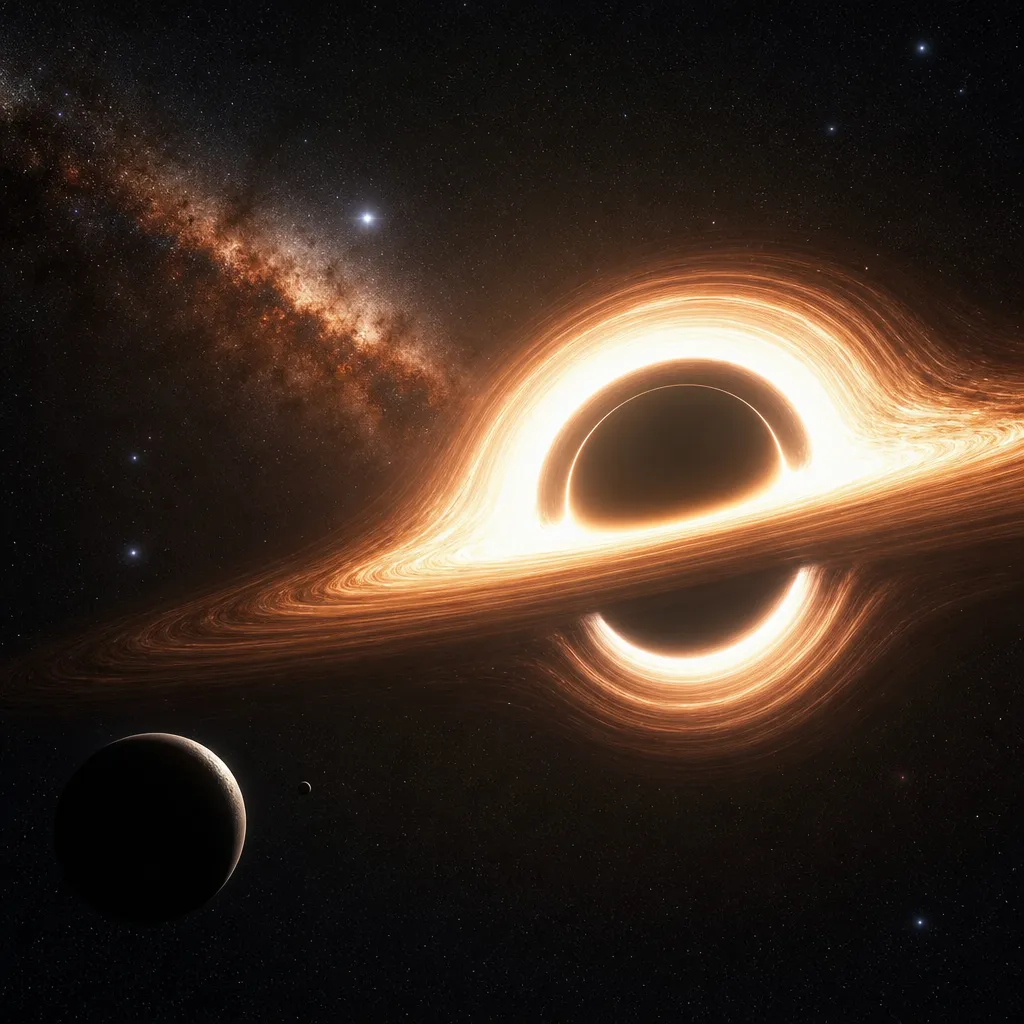

Astronomy is the science of the universe beyond Earth’s atmosphere. It studies objects such as the Moon, planets, stars, galaxies, gas clouds, black holes, and the large-scale structure of the cosmos, as well as the physical laws that govern them. In practice, astronomy combines careful observation with physics, mathematics, chemistry, and increasingly computing to understand what exists in space, how it behaves, how it formed, and how it changes over time. It matters because it helps explain our origins, our place in the universe, and the environment that affects Earth itself.
Although people have watched the sky for thousands of years, modern astronomy is not just stargazing. It uses telescopes on the ground and in space, detectors sensitive to many kinds of light, robotic spacecraft, laboratory analysis, and computer models. Much of what astronomers know is inferred from faint signals reaching Earth across vast distances, so evidence, measurement, and interpretation are central to the field.
What astronomy includes
Astronomy is a broad discipline rather than a single subject. Some astronomers focus on nearby objects, such as the Sun, planets, moons, asteroids, and comets. Others study stars, stellar remnants, nebulae, and the Milky Way. At the largest scales, astronomy overlaps with cosmology, which investigates the origin, evolution, and overall structure of the universe.
Several major branches are closely connected:
- Observational astronomy: collecting and analyzing light and other signals from space.
- Theoretical astronomy and astrophysics: using physics and mathematics to explain observations.
- Planetary science: studying planets, moons, rings, atmospheres, and small bodies.
- Cosmology: investigating the universe as a whole, including expansion and large-scale structure.
- Astrobiology: examining the conditions that could allow life elsewhere.
Astrophysics is often treated as part of astronomy, and in modern research the two are deeply intertwined. Astronomy tends to emphasize observing celestial objects and events, while astrophysics emphasizes the physical processes behind them. In reality, most researchers use both approaches.
| Field | What it studies | Why it matters |
|---|---|---|
| Planetary science | Planets, moons, asteroids, comets, atmospheres | Reveals how worlds form and whether they may be habitable |
| Stellar astronomy | Stars, their births, evolution, and deaths | Explains how elements are made and distributed |
| Galactic astronomy | The Milky Way and other galaxies | Shows how stars, gas, dark matter, and black holes shape galaxies |
| Cosmology | The universe on the largest scales | Addresses cosmic origins, expansion, and long-term evolution |
| Astrobiology | Conditions for life in the universe | Frames the search for habitable environments and biosignatures |
How astronomy works
The basic challenge of astronomy is that most targets are too far away to visit directly. Astronomers therefore rely mainly on radiation and other signals arriving from space. Visible light is only one part of the picture. Objects in the universe also emit or affect radio waves, infrared, ultraviolet, X-rays, gamma rays, neutrinos, cosmic rays, and gravitational waves.
Each kind of signal reveals different physics. Cool dust clouds glow strongly in infrared. Pulsars are prominent in radio. Very hot gas near black holes can shine in X-rays. Gravitational waves reveal collisions of massive compact objects such as black holes and neutron stars. By combining different observations, astronomers can build a more complete and reliable picture.
Physics is the engine that turns observation into understanding. Gravity shapes orbits, forms stars and galaxies, and drives collapse into compact objects. Nuclear fusion powers stars. Electromagnetism governs how matter emits and absorbs light. Atomic and molecular physics leave identifiable fingerprints in spectra, allowing astronomers to determine composition, temperature, motion, and density.
Time also matters in astronomy. Some events unfold rapidly, such as eclipses, solar flares, and supernova explosions. Others occur over millions or billions of years, including the evolution of stars, galaxies, and planetary systems. Because light takes time to travel, looking far away also means looking into the past. A distant galaxy is observed not as it is “now,” but as it was when the light began its journey.
The tools astronomers use
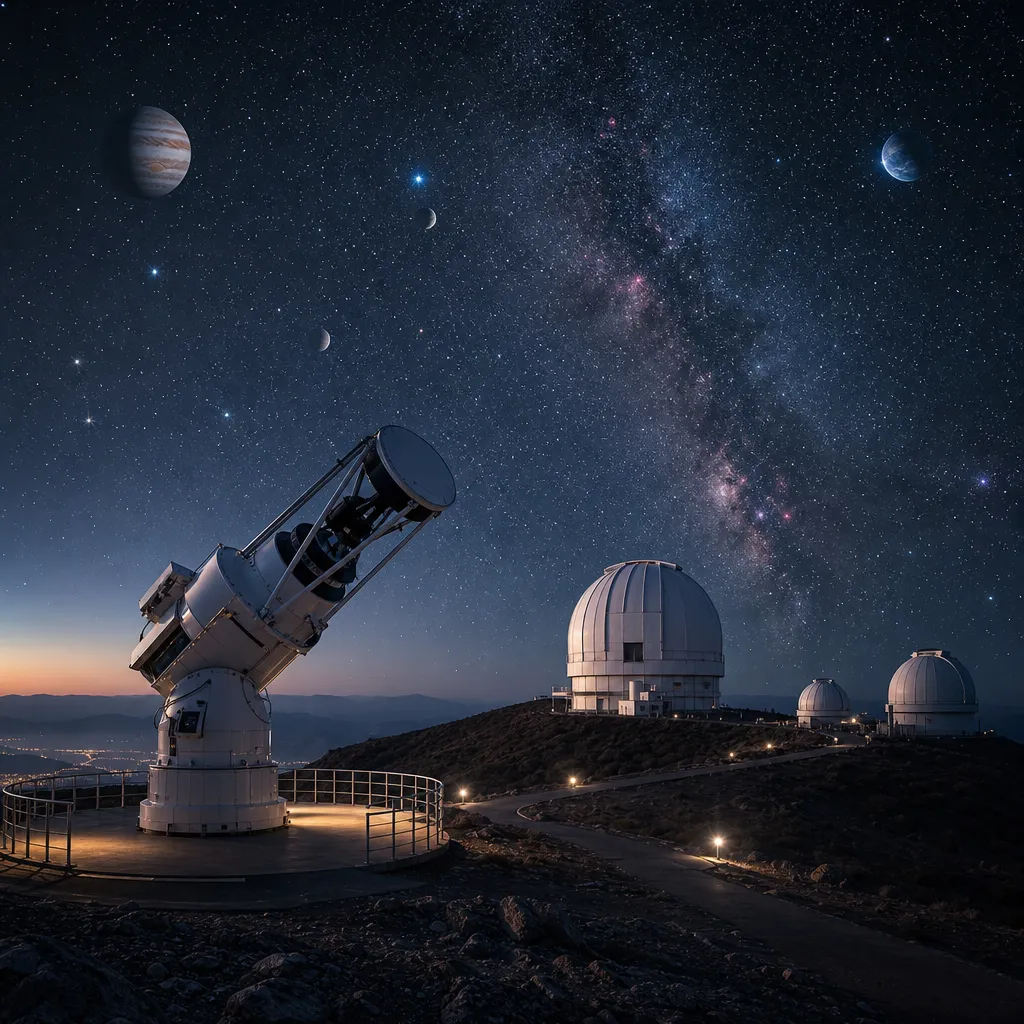
The telescope remains astronomy’s most recognizable tool, but modern instruments are highly specialized. Optical telescopes collect visible light, while radio telescopes detect much longer wavelengths. Infrared observatories can look through dust that blocks visible light. Space telescopes avoid much of the atmospheric distortion and absorption that limit ground-based observations.
Astronomers also use:
- Spectrographs to separate light into wavelengths and measure chemical composition, temperature, and velocity.
- Charged-coupled devices and other detectors to record faint signals with high precision.
- Radar to study nearby planets, moons, and asteroids.
- Spacecraft and probes to make in situ measurements of planets, moons, comets, and the solar wind.
- Computers and simulations to model processes that cannot be reproduced fully in laboratories.
Ground-based observatories often use adaptive optics to reduce blurring from Earth’s atmosphere. Radio observatories can combine signals from many dishes in a technique called interferometry, producing sharper images than a single antenna could achieve.
| Tool or method | What it measures | Typical use |
|---|---|---|
| Optical telescope | Visible light | Stars, galaxies, planets, nebulae |
| Radio telescope | Radio waves | Pulsars, cold gas, cosmic background radiation |
| Infrared observatory | Heat and infrared emission | Dusty star-forming regions, cool objects, exoplanet atmospheres |
| Spectroscopy | Wavelength patterns in light | Composition, temperature, speed, magnetic effects |
| Spacecraft instruments | Particles, fields, images, chemistry, surface properties | Direct study of solar system bodies and space environment |
How scientists know what they know
Astronomy depends on measurement, not guesswork. One of the most powerful methods is spectroscopy. Atoms and molecules absorb and emit light at specific wavelengths, creating identifiable patterns. When astronomers observe those patterns in starlight or gas clouds, they can infer what elements are present. This is how we know, for example, that stars contain hydrogen and helium and that interstellar clouds host a rich chemistry.
Motion is often measured through the Doppler effect. If an object moves toward us, its light is shifted slightly to shorter wavelengths; if it moves away, to longer wavelengths. This helps determine stellar motion, the presence of orbiting exoplanets, the rotation of galaxies, and the expansion of the universe.
Distance is harder. Astronomers use several linked methods, often called the cosmic distance ladder. For nearby stars, they can measure parallax, a small apparent shift caused by Earth’s motion around the Sun. For more distant objects, they use standard candles such as Cepheid variable stars and certain types of supernovae, whose intrinsic brightness can be estimated.
Scientists also compare observations with theories and simulations. A model becomes scientifically useful when it explains existing data and successfully predicts new observations. For example, stellar evolution theory is supported because stars of different masses and ages appear in the patterns expected from nuclear physics and gravity. In cosmology, the expanding-universe model is supported by multiple lines of evidence, including galaxy redshifts and the cosmic microwave background.
Not every conclusion is equally direct. Some planets around other stars are inferred from tiny dips in starlight or small stellar wobbles, not seen directly. Dark matter has not been identified as a particle, but its gravitational effects are strongly supported by several kinds of observations. Astronomy often advances by combining indirect evidence from many independent methods.
What astronomy has revealed about the universe
Modern astronomy has shown that Earth is one planet orbiting an ordinary star in one galaxy among many. The Sun formed from a cloud of gas and dust, and the planets formed from material left over in a rotating disk. Stars are born in dense clouds, spend most of their lives fusing hydrogen, and eventually change into red giants, white dwarfs, neutron stars, or black holes depending on their mass.
Astronomy has also revealed that galaxies evolve through star formation, mergers, and interactions with their environments. Many contain supermassive black holes at their centers. On the largest scales, the universe is expanding, and current evidence indicates that ordinary matter makes up only a small fraction of the cosmos. The rest appears to involve dark matter and dark energy, both inferred from observation but still not fully understood in a fundamental physical sense.
Closer to home, planetary science has transformed the view of our own solar system. Mars preserves evidence of ancient water. Ocean worlds such as Europa and Enceladus appear especially important in the search for habitable environments. Thousands of exoplanets are now known, showing that planetary systems are common and diverse.
Why astronomy matters
Astronomy matters scientifically because it tests physics under conditions impossible to create on Earth. It studies extreme gravity, high-energy particles, giant magnetic fields, and cosmic distances. Observations of stars and galaxies also tell the history of matter itself, including where the chemical elements needed for planets and life were made.
It matters practically as well. Solar astronomy and space weather research help protect satellites, power systems, communications, and astronauts from solar storms. Tracking near-Earth asteroids is important for planetary defense. Precision astronomy has contributed to technologies involving imaging, detectors, timing, and data analysis.
There is also a human reason. Astronomy places Earth in context. It connects everyday experience to long timescales and vast structures, while raising serious scientific questions about how common planetary systems are and whether habitable conditions exist elsewhere. It does not answer philosophical questions on its own, but it sharpens them with evidence.
What remains uncertain
Despite its successes, astronomy still contains major unknowns. The nature of dark matter remains unresolved. Astronomers can measure its gravitational influence, but what it is made of is not established. Dark energy, inferred from the accelerated expansion of the universe, is even less well understood.
There are also open questions about how the first stars and galaxies formed, how supermassive black holes grew so early, and how common potentially habitable planets really are. In exoplanet science, detecting an atmosphere is not the same as detecting life. A world may be habitable in principle without being inhabited, and possible biosignatures must be tested carefully against non-biological explanations.
Even in the solar system, important uncertainties remain. Scientists are still investigating the detailed histories of Mars, Venus, and icy ocean worlds. In stellar and galactic astronomy, many processes are understood in broad outline but not in every detail, especially where turbulence, magnetic fields, and complex chemistry interact.
This uncertainty is not a weakness. It is part of how science works. Astronomy progresses by narrowing possibilities, improving measurements, and testing explanations against new evidence.
Astronomy in the modern era
Today, astronomy is increasingly multi-messenger and collaborative. Researchers combine light across the electromagnetic spectrum with gravitational waves, neutrinos, and samples returned by spacecraft. Large surveys map millions or billions of objects, while targeted observatories probe specific systems in extraordinary detail.
Space missions and major observatories continue to reshape the field. The Hubble Space Telescope transformed optical and ultraviolet astronomy. The James Webb Space Telescope is extending infrared studies of early galaxies, star formation, and exoplanet atmospheres. Planetary missions continue to explore the Moon, Mars, the outer planets, and small bodies. Ground-based facilities, including radio arrays and extremely large optical telescopes, are designed to push sensitivity and resolution further.
As the data grow, astronomy also becomes more computational. Machine learning, statistical inference, and large numerical simulations are increasingly important. Yet the core goal remains the same as it has always been: to understand the universe through evidence.
How is astronomy different from astrology?
Astronomy is a science based on observation, measurement, physics, and testable explanations. Astrology is a belief system that claims celestial positions influence human affairs in personal ways. The two have historical connections, but they are not the same discipline.
Can astronomy be done only with visible light?
No. Visible light is only one part of the electromagnetic spectrum. Much of modern astronomy depends on radio, infrared, ultraviolet, X-ray, and gamma-ray observations, as well as gravitational waves and particle detections.
How do astronomers know what stars are made of?
Mainly through spectroscopy. Elements and molecules leave characteristic patterns in light, and those patterns can be measured in starlight. Laboratory physics on Earth provides the reference needed to interpret them.
Why do astronomers say looking far away means looking into the past?
Light travels at a finite speed. That means signals from distant objects take time to reach us. A galaxy millions or billions of light-years away is seen as it was when the observed light began traveling, not as it is at this exact moment.
Can astronomy tell us whether life exists elsewhere?
Not yet in any confirmed case beyond Earth. Astronomy can identify potentially habitable environments and study atmospheres for possible biosignatures, but no verified detection of extraterrestrial life has been made.
Is astronomy useful for life on Earth?
Yes. It helps monitor solar activity, track hazardous asteroids, improve understanding of radiation in space, and support technologies related to imaging, detectors, timing, and satellite operations. It also advances basic physics and Earth’s broader scientific context.
What are the biggest unanswered questions in astronomy?
Major open questions include the nature of dark matter and dark energy, how the first stars and galaxies formed, how common life-friendly worlds are, and whether any biosignatures or technosignatures will ever be detected reliably beyond Earth.
Sources
- NASA Science
- European Space Agency
- Encyclopaedia Britannica, Astronomy