
Harnessing the principles of charged gases and electromagnetic fields, modern spacecraft can achieve levels of acceleration once considered science fiction. Plasma propulsion systems represent a paradigm shift from traditional chemical rockets, offering remarkable gains in fuel efficiency and mission flexibility. This article delves into the underlying science, explores various thruster designs, and addresses the challenges on the path to interplanetary exploration.
Principles of Plasma Propulsion
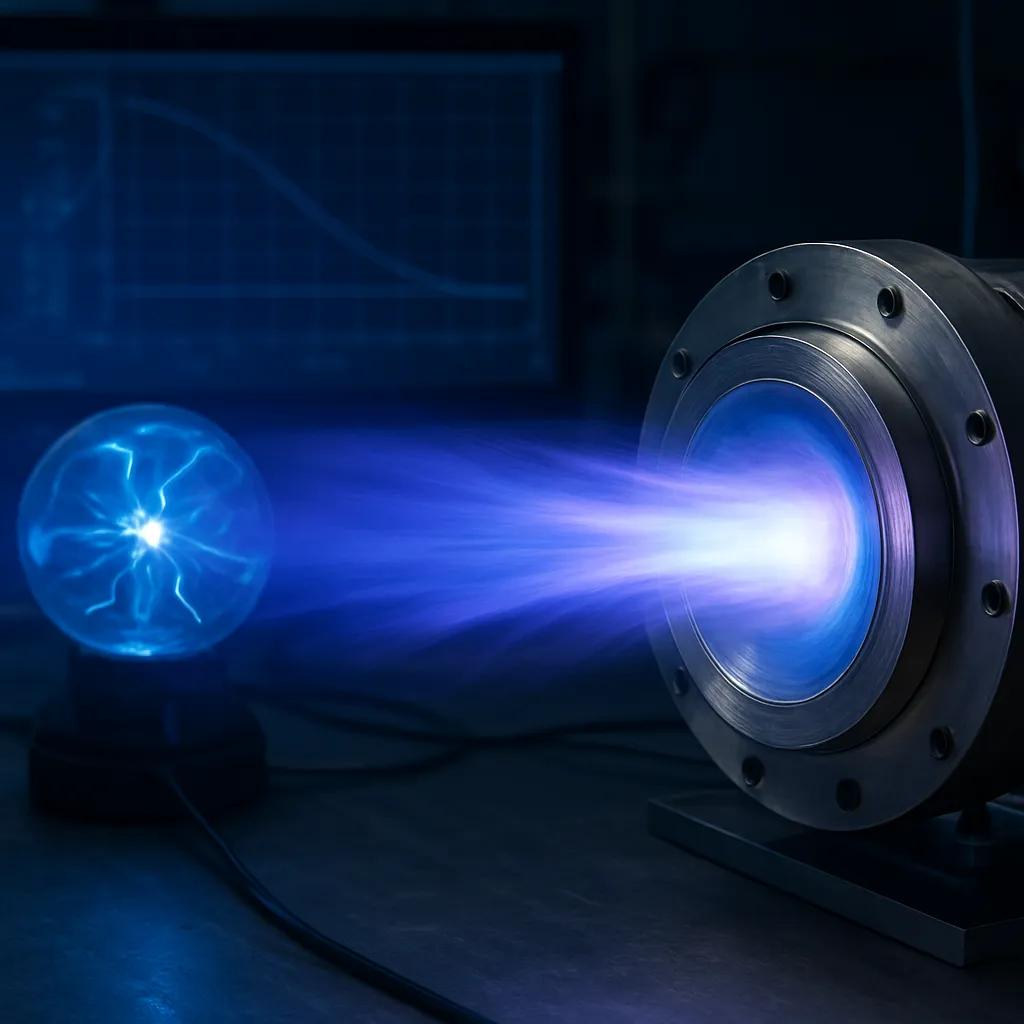
At the heart of any plasma propulsion system lies the conversion of neutral gas into a highly energized state. Through ionization, atoms are stripped of electrons to form a mixture of positively charged ions and free electrons known collectively as plasma. By using electromagnetic fields to control and accelerate this plasma, thrusters generate thrust far more efficiently than chemical rockets.
Creating and Controlling Plasma
- Electric Discharge: A high-voltage arc or radio-frequency (RF) source supplies energy to heat the propellant gas (often xenon), causing electrons to collide with atoms and strip them of their electrons.
- Magnetic Confinement: Magnetic fields trap the electrons and ions, preventing recombination and guiding the plasma toward the exhaust.
- Acceleration Grids: In ion thrusters, sets of charged grids pull ions through electric fields, expelling them at high speed.
These processes rely on precise balancing of field strengths, gas flow, and power input. The interplay between electric and electromagnetic forces enables fine control over exhaust velocity and ion beam divergence, which directly impacts overall system efficiency.
Types of Plasma Thrusters
Over the past decades, several plasma-based technologies have matured, each tailored to different mission requirements:
Ion Thrusters
One of the earliest and most studied forms, ion thrusters use a pair of grids at differing electrical potentials. Ions are accelerated to velocities exceeding 30 km/s, resulting in an extremely high specific impulse (Isp). Key features include:
- Thrust levels ranging from a few millinewtons to hundreds of millinewtons.
- Exceptional fuel economy, ideal for deep-space missions requiring long-duration burns.
- Complex power systems to generate and maintain grid voltages of several kilovolts.
Hall-Effect Thrusters
Widely used on satellites for station-keeping, Hall thrusters confine electrons in a radial magnetic field, creating an azimuthal Hall current. This current ionizes propellant and accelerates ions through an electric field. Characteristics include:
- Moderate Isp (1,500–2,000 seconds) with thrust up to several hundred millinewtons.
- Compact design and relatively simple construction.
- Robust performance for orbital transfers and attitude control.
Variable Specific Impulse Magnetoplasma Rocket (VASIMR)
VASIMR employs RF heating to energize plasma before magnetic nozzles expand and accelerate it. By tuning RF power and magnetic field strength, VASIMR can alter its specific impulse and thrust in real time. Advantages include:
- Flexibility to optimize for rapid maneuvers or fuel conservation.
- Potential for very high Isp (over 5,000 seconds).
- Significant power demands requiring nuclear or large solar arrays.
Technological Challenges and Future Prospects
While plasma propulsion systems promise transformative capabilities, several hurdles remain before widespread adoption on crewed missions:
Power Supply and Thermal Management
Delivering kilowatts to megawatts of electrical power in space demands advanced solar arrays or compact nuclear reactors. Excess heat produced during ionization and acceleration must be dissipated, requiring large radiators that influence spacecraft design and mass budgets.
Propellant and Erosion
Xenon is favored for its high atomic mass and low ionization energy, but supply and cost limit long-term missions. Alternative propellants such as krypton or iodine offer trade-offs in performance and storage complexity. Furthermore, ion bombardment can erode engine components over time, reducing thruster lifespan. Research into magnetic nozzles and erosion-resistant materials aims to extend operational hours.
Integration with Spacecraft Systems
Embedding plasma engines within a spacecraft requires seamless integration of power conditioning, thermal control, and attitude regulation. Coordinated control algorithms ensure stable thrust vectoring and prevent unwanted torques that could degrade pointing accuracy, especially critical for communication or observation satellites.
Prospects for Interplanetary Missions
Future missions to Mars, the asteroid belt, and beyond will benefit from continuous, low-thrust acceleration offered by plasma systems. By gradually building up velocity, spacecraft can achieve higher cruise speeds with less propellant mass compared to chemical rockets. Planned missions include:
- Uncrewed cargo logistics to Mars orbit using high-power ion engines.
- Crewed transit modules powered by VASIMR to reduce travel time.
- Deep-space telescopes employing Hall thrusters for fine station-keeping.
Advances in materials science, power generation, and plasma physics are driving rapid improvements. As these technologies mature, plasma propulsion will unlock new frontiers, enabling humanity to venture deeper into the cosmos than ever before.