
The journey from Earth to the stars relies on a delicate balance of timing, energy, and precision. Understanding the mechanics that govern spacecraft motion and the strategic selection of departure times is crucial for mission success. This article delves into the principles of orbital dynamics, explores why launch windows matter, and highlights the techniques engineers use to design efficient trajectories across our solar system.
Physics of Orbital Mechanics
At the heart of any space mission lies the study of orbital mechanics, the branch of dynamics that describes how objects move under the influence of gravity. Two fundamental concepts dominate this field:
- Kepler’s Laws of Planetary Motion: These laws define how bodies orbit a primary mass, such as Earth or the Sun. They explain elliptical orbits, the equal-area law, and the relationship between orbital period and semi-major axis.
- Newton’s Laws of Motion and Gravitation: Newton established that the force keeping a spacecraft in orbit is gravitational attraction. The balance between this force and the craft’s inertia produces stable trajectories.
Elliptical, Circular, and Hyperbolic Trajectories
Orbits can be classified by their shape and energy:
- Circular Orbits have constant distance from the central body and require minimal fuel efficiency once achieved.
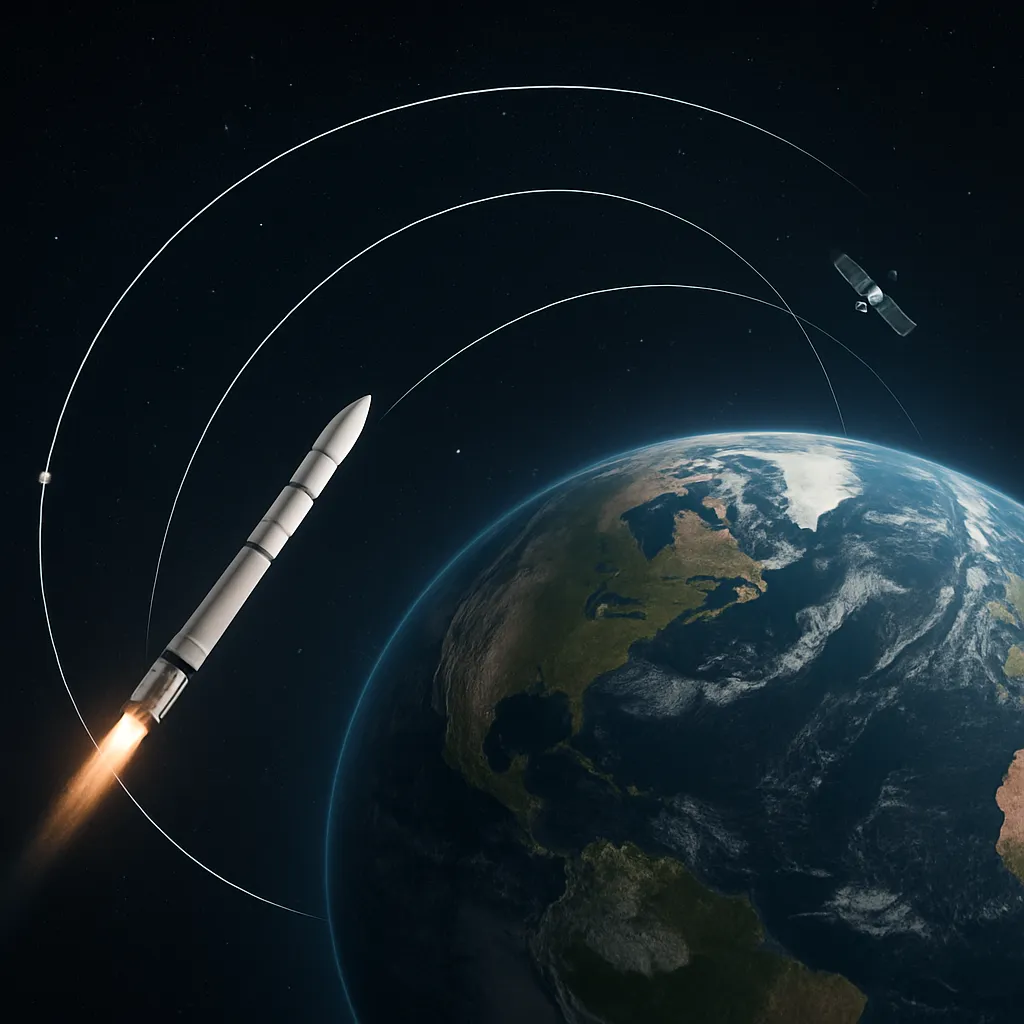
- Elliptical Orbits allow spacecraft to transfer between different altitudes by varying speed at perigee and apogee.
- Hyperbolic Trajectories escape the gravitational pull entirely, used during interplanetary departure.
Delta-v and the Energy Budget
Delta-v (Δv) measures the change in velocity needed to perform maneuvers. Every leg of a mission—launch, orbit insertion, plane change, transfer burns—demands a calculated Δv budget. Efficient trajectory design minimizes total Δv, conserving precious propellant mass.
Launch Windows: Gateway to Space
Timely departures are not arbitrary: they arise from the interplay of orbital geometry, planetary motion, and mission constraints. A launch window is a specific period when conditions align to permit a spacecraft to reach its target with optimal energy expenditure.
Types of Launch Windows
- Daily Windows: Determined by Earth’s rotation, these windows repeat every 24 hours. They are critical for missions aiming for a specific orbital inclination, aligning the ground launch site with the target orbital plane.
- Interplanetary Windows: Occurring only when Earth and the destination planet reach the correct positions in their solar orbits. These windows can open once every few months (Mars) to decades (outer planets).
- Partial and Continuous Windows: For low-energy transfers like lunar missions, short windows open multiple times per day, reflecting the Moon’s rapid orbit around Earth.
Planetary Alignment and Hohmann Transfers
The classic Hohmann transfer is the most fuel-efficient interplanetary trajectory. It requires departure at a precise relative phase angle when Earth and the target planet are aligned. Missing this window can add months of waiting time or force a more demanding, high-energy trajectory.
- Example: A Mars mission needs Earth to lead Mars by about 44 degrees in its orbit at departure.
- Consequences of delays include higher Δv requirements and extended mission durations.
Designing Optimal Trajectories and Mission Planning
Once the launch window is identified, mission designers engage in detailed trajectory optimization. This process balances multiple factors to ensure spacecraft meets scientific objectives within budget and technical constraints.
Gravity Assists and Flybys
Gravity assists exploit a planet’s motion and gravitational field to alter a spacecraft’s trajectory without burning extra fuel. By flying close to a planet, a craft can gain or shed velocity relative to the Sun:
- Voyager missions used multiple planetary flybys to tour the outer solar system with minimal propellant.
- Future missions to the outer planets and Kuiper Belt objects depend on precise alignment of Jupiter, Saturn, and other giants for cascading acceleration.
3D Trajectory Modeling and Software Tools
Modern mission planning employs advanced software that integrates celestial mechanics, spacecraft performance, and real-time data:
- Numerical Integrators calculate spacecraft position and velocity over time, accommodating perturbations like solar radiation pressure and non-uniform gravity fields.
- Optimization Algorithms (e.g., genetic algorithms, collocation methods) search vast parameter spaces to find minimum-Δv or minimum-time trajectories.
- Visualization tools present three-dimensional views, helping engineers verify that the final path avoids hazards such as asteroid belts or planetary rings.
Inclination Changes and Plane Alignments
Altering inclination mid-mission is very costly in Δv. Therefore, launch sites aim to match initial orbital plane to final mission requirements:
- Equatorial launches are ideal for geostationary orbits, reducing the need for large plane-change burns.
- Polar launches, often at high latitudes, facilitate Earth observation satellites that sweep every longitude.
Challenges and Future Innovations
Advances in propulsion and trajectory design promise more flexible launch windows and reduced travel times. Emerging concepts include:
- Electric Propulsion: Enables low-thrust continuous burns that, over time, achieve complex transfer orbits with higher specific impulse.
- Solar Sails: Harness photon pressure to adjust trajectories without propellant, potentially opening non-traditional windows.
- Autonomous Navigation: Real-time onboard decision systems that tweak mid-course trajectories, widening acceptable departure times.
In summary, the science of launch windows and orbital mechanics unites gravitational physics, celestial alignment, and cutting-edge engineering. Mastering these principles propels humanity toward new destinations, from near-Earth orbit to the far reaches of our solar system and beyond.