
The night sky has fascinated humanity for millennia, inspiring both wonder and scientific inquiry. Over time, astronomers unraveled the vast tapestry of stars, nebulae, and distant galaxies, gradually uncovering the dynamic nature of the cosmos. The journey toward understanding the expanding universe represents one of the most profound leaps in modern cosmology, reshaping our perception of origin, scale, and destiny.
Early Observations of the Universe
From Nebulae to Galaxies
In the 18th and 19th centuries, telescopic surveys revealed cloud-like objects, then termed “nebulae.” Many astronomers assumed these were diffuse regions within the Milky Way. As instruments improved, they noted spiral structures and individual stars within some nebulae. The Great Debate of 1920 between Harlow Shapley and Heber Curtis highlighted whether these were merely interstellar clouds or “island universes” – separate galaxies similar to our own. Curtis argued for the vastness of the cosmos, anticipating the revelation that our galaxy is but one among billions.
Redshift Measurements
Spectroscopy emerged as a powerful tool for probing stellar and galactic motions. By measuring the shift in spectral lines, astronomers could determine whether an object moved toward or away from Earth. In the early 20th century, Vesto Slipher recorded remarkably high redshifts for several spiral nebulae, implying they receded at astonishing velocities. These early data hinted at a possible systematic trend – a clue to a larger cosmic expansion.
Edwin Hubble’s Pioneering Work
Hubble’s Law
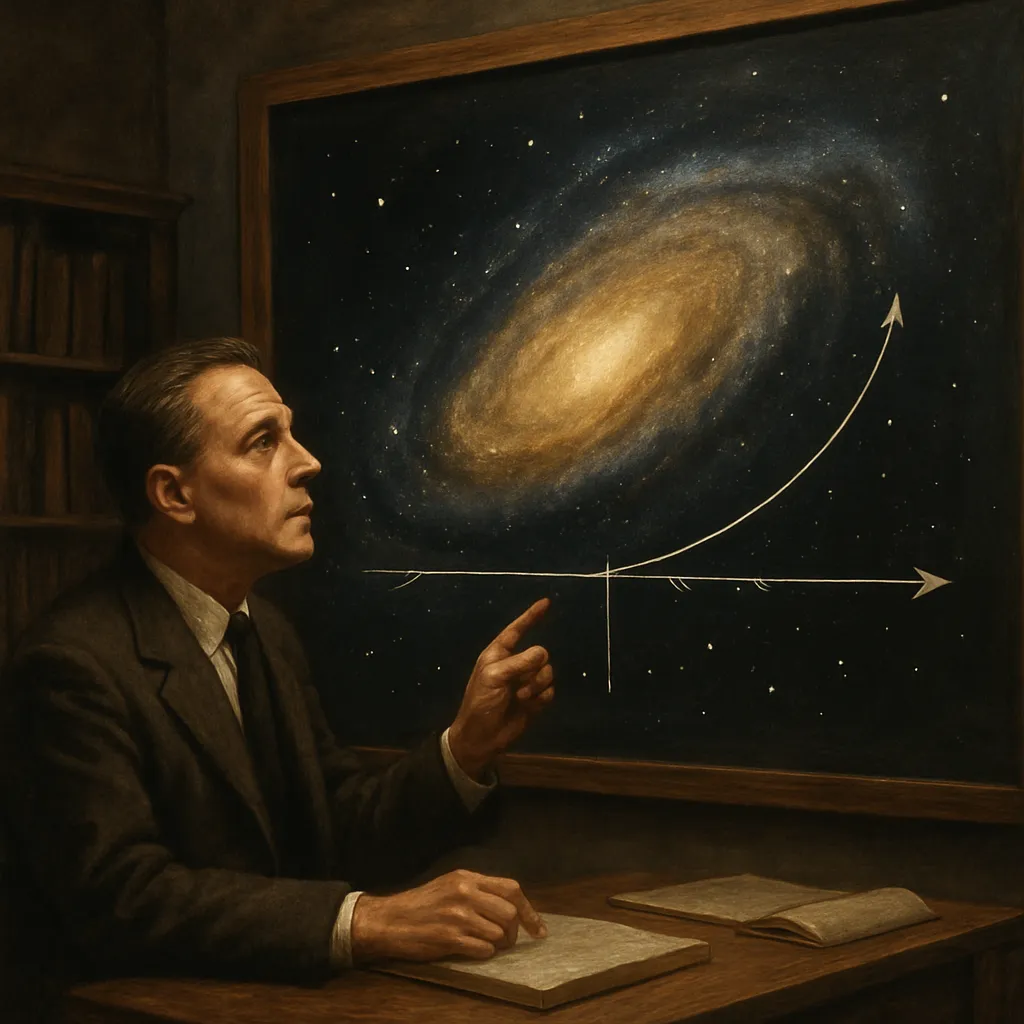
In 1929, Edwin Hubble published a landmark paper demonstrating a linear relationship between the distance of galaxies and their redshift. By combining Cepheid variable measurements for accurate distances with spectroscopic data, Hubble established that more distant galaxies appear to recede faster. This simple proportionality, now known as Hubble’s Law (v = H₀ × d), provided the first quantitative evidence that the universe was not static but in a state of continuous expansion.
Implications for Cosmology
The discovery sent shockwaves through the scientific community. Albert Einstein, who had introduced a cosmological constant to force a stationary universe, reportedly called it his “biggest blunder.” The expansion implied a finite-density cosmos that was dynamic and evolving. The idea that the universe had a finite age and possibly originated from a hot, dense state began to take shape. The expanding universe also laid the groundwork for predicting a relic background of radiation, a signature that would be confirmed decades later.
Theoretical Foundations and Evolution of the Model
Einstein’s Field Equations
Einstein’s general theory of relativity, published in 1915, provided the mathematical framework for a dynamic cosmos. His field equations related the curvature of spacetime to energy and momentum. When applied on cosmic scales, these equations predicted either an expanding or contracting universe. Initially, Einstein introduced the cosmological constant (Λ) to counteract gravitational collapse. After Hubble’s observational breakthrough, Λ was deemed unnecessary for explaining expansion, though it would later reemerge in the context of dark energy.
Friedmann and Lemaître
Aleksandr Friedmann and Georges Lemaître independently derived expanding-universe solutions to Einstein’s equations in the early 1920s. Friedmann’s models allowed for open, closed, and flat cosmologies. Lemaître went further by proposing a primeval atom hypothesis, suggesting a beginning to expansion. Despite initial resistance, their theoretical insights provided a coherent framework for interpreting Hubble’s observations and predicting cosmic evolution.
Modern Evidence and Open Questions
Cosmic Microwave Background
In 1965, Arno Penzias and Robert Wilson serendipitously discovered a uniform microwave glow permeating the sky. This cosmic microwave background (CMB) matched predictions for radiation leftover from an early, hot phase of the universe. Detailed studies by COBE, WMAP, and Planck satellites mapped minute fluctuations in the CMB, revealing the seeds of large-scale structure. These observations robustly confirmed the Big Bang paradigm and provided precise estimates of key cosmological parameters, including the Hubble constant and the total energy density.
Dark Energy and Accelerated Expansion
By the late 1990s, two independent teams studying distant Type Ia supernovae uncovered an unexpected result: the rate of expansion was accelerating, not slowing under gravity as once assumed. This acceleration implied the presence of a mysterious repulsive component, dubbed dark energy. Accounting for roughly 70% of the universe’s total energy budget, dark energy drives cosmic acceleration and forces astrophysicists to reconsider the ultimate fate of all galaxies. Is the expansion eternal, or will new physics alter this trajectory?
Tracing the Legacy of Discovery
Observational Milestones
- Vesto Slipher’s redshift catalog (1912–1917)
- Edwin Hubble’s distance measurements at Mount Wilson Observatory (1923–1929)
- Palomar Observatory surveys of distant clusters (1950s)
- COBE’s detection of CMB anisotropies (1992)
- Planck’s precision mapping of cosmological parameters (2013)
Frontiers in Research
Contemporary cosmologists explore the nature of dark matter and dark energy through large-scale surveys like the Dark Energy Survey (DES) and the Euclid mission. Ground-based telescopes, space observatories, and gravitational-wave detectors work in concert to test inflationary models, probe primordial gravitational waves, and refine measurements of the Hubble constant. Discrepancies between local and CMB-based estimates of H₀ hint at new physics beyond the standard cosmological model.
Exploring the Expanding Universe Today
Advanced instrumentation now reaches back to the first billion years of cosmic history, observing proto-galaxies and the assembly of the cosmic web. By combining multiwavelength data—from radio to gamma rays—astronomers reconstruct the evolution of structure, star formation, and chemical enrichment. Each discovery builds on the legacy of curiosity and precision that began with those first redshift measurements over a century ago. The concept of an expanding universe remains a testament to human ingenuity and the power of collaborative science.