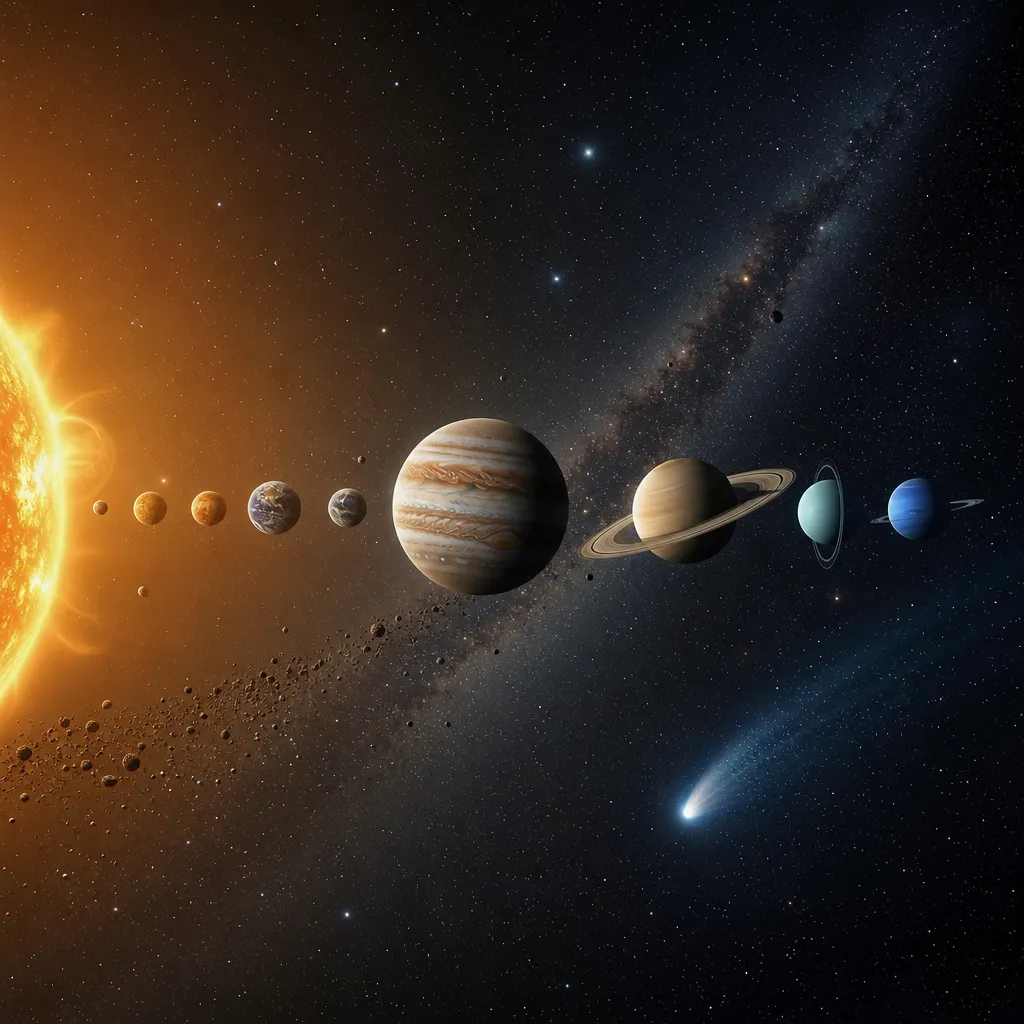
The planets in the Solar System are the eight major worlds that orbit the Sun: Mercury, Venus, Earth, Mars, Jupiter, Saturn, Uranus, and Neptune. They are not just points of light in the sky, but distinct physical systems shaped by gravity, chemistry, radiation, impacts, and billions of years of evolution. Together they record how planetary systems form and change, from small rocky bodies near a star to giant planets rich in gas and ice farther out. Studying them helps scientists understand Earth’s place in the cosmos, the history of our neighborhood in space, and the processes that may operate around other stars as well.
The modern picture of the Solar System is based on telescopic astronomy, spacecraft exploration, laboratory analysis of meteorites, and the physics of orbits and planetary interiors. Much is well established, especially the basic structure and motions of the planets, but important questions remain open, including how migration shaped the early Solar System, why some planets became habitable and others did not, and what lies deep inside the giant planets.
What counts as a planet in the Solar System?
In current astronomy, the Solar System has eight recognized planets. They orbit the Sun, are massive enough for their own gravity to make them nearly round, and have cleared most other comparable bodies from their orbital neighborhoods. This definition, adopted by the International Astronomical Union in 2006, separates the planets from smaller bodies such as dwarf planets, asteroids, and many trans-Neptunian objects.
The planets fall into two broad groups. Mercury, Venus, Earth, and Mars are the terrestrial planets, meaning rocky worlds with solid surfaces and relatively high densities. Jupiter, Saturn, Uranus, and Neptune are the giant planets. Jupiter and Saturn are often called gas giants because they are dominated by hydrogen and helium, while Uranus and Neptune are commonly called ice giants because a larger fraction of their mass consists of water, ammonia, methane, and other substances that were icy in the early Solar System.
| Planet | Main type | Key characteristics | Scientific relevance |
|---|---|---|---|
| Mercury | Terrestrial | Small, heavily cratered, large iron core, almost no substantial atmosphere | Tests ideas about early planetary formation and solar heating |
| Venus | Terrestrial | Dense carbon dioxide atmosphere, extreme greenhouse warming, sulfuric acid clouds | Important for climate science and planetary evolution |
| Earth | Terrestrial | Liquid surface water, active plate tectonics, life, oxygen-rich atmosphere | Reference world for habitability and planetary processes |
| Mars | Terrestrial | Cold, thin atmosphere, ancient river and lake evidence, polar ice | Central to past habitability and exploration studies |
| Jupiter | Gas giant | Largest planet, powerful magnetic field, deep atmosphere, many moons | Key to understanding giant planet formation and system dynamics |
| Saturn | Gas giant | Extensive ring system, low average density, many moons | Reveals ring dynamics and giant planet atmospheric physics |
| Uranus | Ice giant | Extreme axial tilt, cold atmosphere, unusual magnetic geometry | Important for understanding ice giants inside and beyond the Solar System |
| Neptune | Ice giant | Strong winds, dynamic atmosphere, distant orbit | Helps test models of outer planet weather and migration |
How the planets formed
The leading scientific explanation is that the planets formed about 4.6 billion years ago from a rotating disk of gas and dust around the young Sun. In this protoplanetary disk, tiny grains collided and stuck together. Over time, they formed larger bodies called planetesimals, then protoplanets. Gravity became increasingly important as these bodies grew, allowing them to attract more material and, in some cases, dominate their regions of the disk.
Distance from the Sun mattered greatly. In the hot inner Solar System, only rock and metal could remain solid, favoring the formation of small rocky planets. Farther out, where temperatures were lower, ices could also condense. That allowed the growing outer planets to build much larger cores. Jupiter and Saturn then captured enormous amounts of hydrogen and helium from the surrounding gas before the disk dispersed.
This framework is well supported by observations of young stars with disks, by computer simulations, and by the chemistry of meteorites, which preserve material from the earliest Solar System. Yet some details are still debated. Scientists continue to study exactly how planetesimals formed from dust, how much the giant planets migrated after their birth, and how that migration may have reshaped the asteroid belt and the architecture of the entire system.
The inner rocky planets
The four inner planets are built mainly from silicate rock and metal. They are smaller than the giant planets and have comparatively thin atmospheres, though Venus is a major exception in atmospheric density. Their surfaces preserve evidence of volcanism, tectonics, impact cratering, and atmospheric change.
Mercury is the closest planet to the Sun and has a large metallic core relative to its size. Its surface is ancient and heavily cratered, but it also shows signs of tectonic contraction as the planet cooled. Despite its proximity to the Sun, radar observations and spacecraft data have revealed water ice in permanently shadowed craters near its poles.
Venus is often described as Earth’s sister planet because of its similar size, but its environment is dramatically different. A thick carbon dioxide atmosphere creates an intense greenhouse effect, making the surface hot enough to melt lead. Radar mapping has shown vast volcanic plains, deformed crust, and relatively few impact craters, suggesting large-scale resurfacing in the geologically recent past, though the exact style of Venusian geology remains under study.
Earth is the only known planet with life. It has long-lived oceans, a nitrogen-oxygen atmosphere, active plate tectonics, and a magnetic field generated by motions in its molten outer core. These systems interact closely: volcanism helps recycle carbon, the atmosphere moderates climate, and the magnetic field shields the upper atmosphere from much of the solar wind.
Mars is now cold and dry, but orbital and rover evidence shows that liquid water once flowed on its surface. Ancient river valleys, deltas, lake deposits, and water-altered minerals all support that conclusion. The central scientific question is not whether Mars had water in the past, but how long habitable conditions lasted and whether life ever emerged there. No confirmed evidence of past or present Martian life has been found.
The giant planets and their systems
The outer planets are not simply larger versions of Earth. They are deep, layered worlds without solid surfaces in the familiar sense. Their visible clouds are only the top of vast atmospheres. Pressure and temperature increase rapidly with depth, and the material inside these planets may exist in forms not found naturally on Earth.
Jupiter is the most massive planet and strongly influences the rest of the Solar System through its gravity. Its atmosphere contains belts, zones, storms, and the long-lived Great Red Spot. Measurements by spacecraft indicate that Jupiter likely has a diluted core region rather than a simple sharply bounded solid core, but the exact internal structure is still being refined.
Saturn is famous for its rings, which are made mostly of water ice particles ranging from tiny grains to large chunks. The ring system is dynamically active, shaped by collisions, gravity, and interactions with small moons. Saturn also hosts Titan, a moon with a thick atmosphere, and Enceladus, which sprays water-rich plumes from a subsurface ocean, making the Saturn system especially important in astrobiology.
Uranus and Neptune are less explored than Jupiter and Saturn, yet they may be particularly important because planets of similar size appear common around other stars. Uranus rotates on its side, probably due to a major collision early in its history. Neptune has a more active atmosphere than its distance from the Sun might suggest, implying that internal heat still plays a major role.
Orbits, gravity, and the architecture of the Solar System
The planets orbit the Sun because gravity continually pulls them inward while their forward motion carries them around it. Johannes Kepler described the shapes and timing of planetary orbits, and Isaac Newton later explained these patterns through universal gravitation. Modern celestial mechanics uses the same principles, refined by Einstein’s general relativity where needed, to predict planetary motion with high precision.
The Solar System is not static. Planets perturb one another through gravity. Small bodies can be trapped in resonances, scattered into new orbits, or ejected entirely. Jupiter, in particular, has had a major role in shaping the asteroid belt and influencing comet paths. Resonances with Neptune help organize many objects in the Kuiper Belt.
Planetary systems also include moons, rings, asteroids, comets, and dust. In that broader context, the eight planets are the dominant members of a much richer gravitational environment. Understanding that architecture matters not only for Solar System science but also for interpreting exoplanet systems, many of which look very different from our own.
| Process or feature | How it works | Why it matters |
|---|---|---|
| Gravity | Holds planets in orbit around the Sun and shapes planetary interiors | Controls the structure and long-term evolution of the system |
| Accretion | Small particles and bodies collide and grow into planets | Explains the origin of planets from the protoplanetary disk |
| Differentiation | Dense materials sink inward while lighter materials rise | Produces cores, mantles, crusts, and layered interiors |
| Atmospheric escape | Gases are lost to space through heating, chemistry, and solar wind interactions | Helps explain why planetary climates diverged |
| Resonance | Regular gravitational relationships alter orbital behavior | Shapes belts, ring systems, and long-term orbital stability |
How scientists know what the planets are like
Knowledge of the planets comes from several complementary methods. Telescopes provide images, spectra, brightness changes, and measurements across many wavelengths, including visible light, infrared, radio, ultraviolet, and X-rays. Spectroscopy is especially powerful because atoms and molecules absorb and emit light in characteristic patterns, revealing atmospheric composition, temperatures, clouds, and motion.
Spacecraft have transformed the field. Flyby missions such as Mariner, Voyager, and New Horizons provided the first close views of many worlds. Orbiters such as Magellan, Mars Reconnaissance Orbiter, Cassini, Juno, and MESSENGER mapped surfaces, measured gravity and magnetic fields, and studied atmospheres in detail. Landers and rovers on Mars, along with past Soviet landers on Venus, made direct measurements at the surface.
Scientists also use meteorites, especially primitive chondrites, to study the early Solar System. Isotopic dating gives ages for solid material formed near the beginning of planetary history. Computer models then test whether the observed planetary arrangement, compositions, and crater records can emerge from plausible physical processes. In planetary science, many conclusions are not based on one single observation, but on independent lines of evidence that support the same explanation.
Why the planets matter scientifically
The planets are natural laboratories. They allow researchers to compare how similar starting materials can lead to very different outcomes. Venus and Earth show how two rocky planets of comparable size can evolve into radically different climate states. Mars preserves evidence of a world that was once wetter and more active. The giant planets reveal fluid dynamics, magnetic fields, and chemistry under extreme conditions that cannot be reproduced fully in laboratories.
Planetary science also matters because it informs the search for habitable worlds elsewhere. Exoplanet discoveries have shown that planetary systems are common, but Solar System studies provide the physical grounding needed to interpret those distant observations. Lessons from our own planets help scientists evaluate atmosphere loss, surface conditions, internal heating, and the role of giant planets in shaping habitable zones.
There is also practical importance. Studying planetary atmospheres improves climate modeling. Tracking near-Earth objects helps assess impact risk. Understanding radiation, dust, and surface conditions is essential for robotic and future human exploration.
Exploration history and major missions
For most of human history, the planets were observed only as wandering lights. The telescope revealed phases of Venus, surface markings on Mars, cloud bands on Jupiter, and rings around Saturn. The space age changed planetary science from observational astronomy into a hands-on exploration discipline.
Important milestones include the Mariner missions to Venus and Mars, the Venera landers on Venus, Viking on Mars, Voyager’s grand tour of the outer planets, Galileo at Jupiter, Cassini-Huygens at Saturn and Titan, MESSENGER at Mercury, Juno at Jupiter, and ongoing Mars orbiters and rovers. These missions have shown that planets are active worlds with weather, geology, magnetic environments, and complex histories.
Future exploration is also significant, but it must be described carefully. Missions to Jupiter’s moon Europa and ESA’s JUICE mission are studying giant planet systems and ocean worlds rather than planets alone. Proposed missions to Uranus and Neptune are widely regarded as scientifically valuable, but they are not yet equivalent to completed or operational missions until formally approved and flown.
What remains uncertain
Many major features of the Solar System are established, but important uncertainties remain. Scientists are still debating the full migration history of the giant planets and how strongly that migration affected the early bombardment of the inner worlds. The exact interior structures of Jupiter, Saturn, Uranus, and Neptune are incompletely known because direct sampling is impossible and must be inferred from gravity, magnetic fields, and models of matter at high pressure.
On Venus, the current level of volcanic activity remains an active area of research. On Mars, the biggest unanswered question is whether life ever existed there, not whether modern Mars is inhabited in any confirmed sense. Even Earth’s uniqueness is not fully understood: we know that life exists here, but we still do not know how common life-bearing planets may be in the universe.
There are also classification questions at the edges. Dwarf planets such as Pluto, Eris, and Ceres are not among the eight planets, but they are crucial for understanding planetary evolution. Their study reminds us that the Solar System is more diverse than any simple list can capture.
FAQ
How many planets are in the Solar System?
There are eight recognized planets: Mercury, Venus, Earth, Mars, Jupiter, Saturn, Uranus, and Neptune.
Why is Pluto not counted as one of the planets?
Pluto is classified as a dwarf planet because, although it orbits the Sun and is nearly round, it has not cleared its orbital neighborhood in the way the eight major planets have.
How do scientists know what planets are made of?
They use spectroscopy, spacecraft measurements, gravity data, magnetic field observations, radar studies, meteorite analysis, and theoretical models of how materials behave under planetary conditions.
Can all the planets be seen from Earth?
Mercury, Venus, Mars, Jupiter, and Saturn are visible to the unaided eye under suitable conditions. Uranus can sometimes be seen without optical aid from very dark locations, but it is usually observed with binoculars or a telescope. Neptune requires a telescope.
Which planets could be explored by humans?
Human exploration is most realistically discussed for Mars in the near-to-medium term. The surfaces of Mercury and Venus are extremely hostile, and the giant planets do not have solid surfaces suitable for landing.
Why are the giant planets important if humans cannot land on them?
They contain most of the planetary mass in the Solar System, shape the orbits of many smaller bodies, and help scientists understand atmospheric physics, magnetic fields, and the formation of planetary systems.
What is still unknown about the planets?
Open questions include the deep interiors of the giant planets, the detailed history of giant planet migration, the present geology of Venus, and whether Mars or any other world in the Solar System ever hosted life.
What missions are studying the planets today?
Examples include Juno at Jupiter and multiple active missions at Mars. Planetary science also relies on powerful space and ground-based telescopes that continue to monitor planetary atmospheres, surfaces, and seasonal changes.
Sources
- NASA Solar System Exploration
- European Space Agency, Science & Exploration: The Solar System
- National Academies of Sciences, Engineering, and Medicine, Origins, Worlds, and Life: A Decadal Strategy for Planetary Science and Astrobiology 2023–2032