
Measuring the vast expanses between stars and galaxies has been one of humanity’s greatest scientific pursuits. From ancient astronomers peering at the night sky with primitive instruments to modern observatories scanning the cosmos with advanced detectors, the quest to quantify cosmic distances has shaped our understanding of the Universe. The techniques we use form a complex distance ladder, where each rung builds upon the previous one, allowing astronomers to map structures from nearby stars to the farthest observable galaxies.
Parallax: The Fundamental Ruler
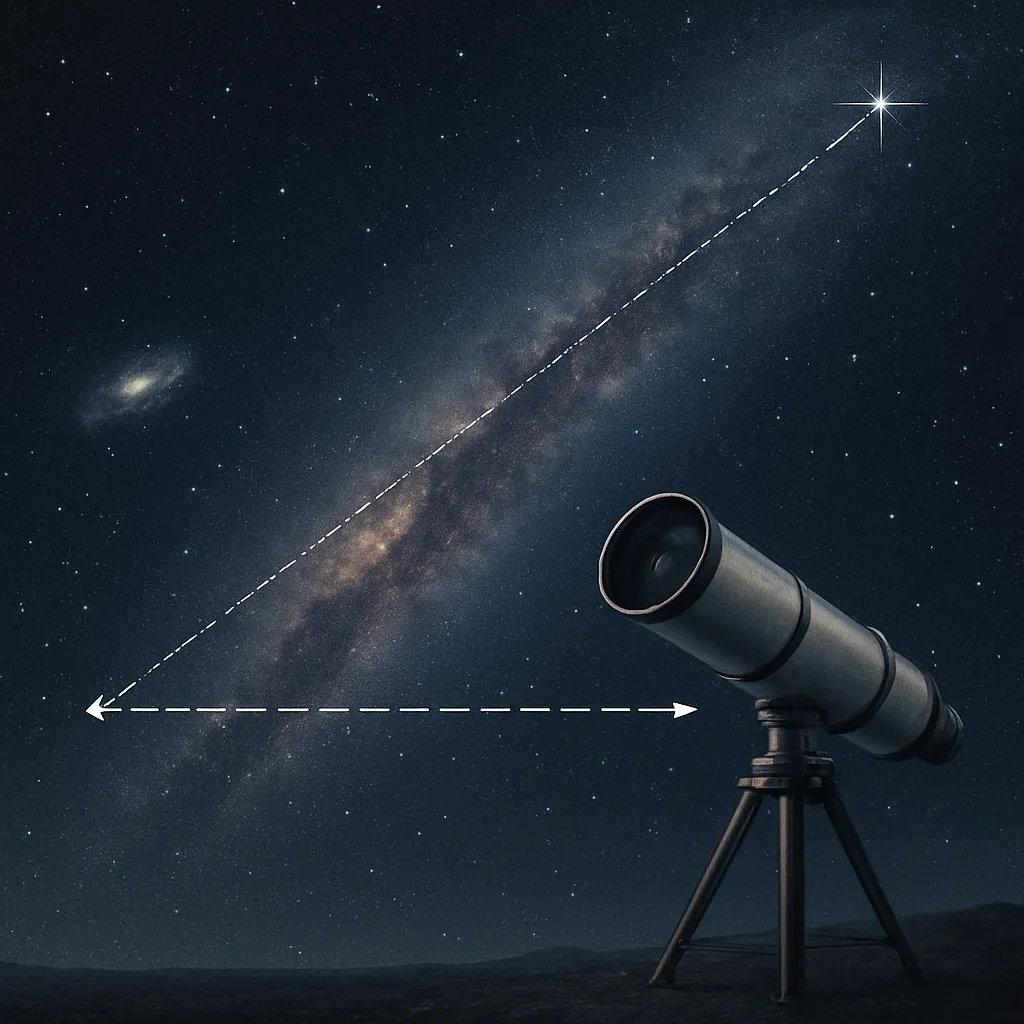
The simplest and most direct method of measuring cosmic distances relies on the parallax effect. When Earth orbits the Sun, nearby stars appear to shift their positions relative to more distant background stars. This angular shift, measured in arcseconds, is inversely proportional to the star’s distance. One parsec—the distance at which a star shows a parallax of one arcsecond—equals approximately 3.26 light-years.
Historical Development
- 17th century: First successful parallax measurements by astronomers like James Bradley.
- 19th century: Friedrich Bessel measured the parallax of 61 Cygni, confirming the method’s reliability.
- 20th–21st centuries: Space missions like Hipparcos and Gaia vastly improved parallax precision, extending reliable measurements to thousands of light-years.
Despite its elegance, parallax is limited by the size of Earth’s orbit—the baseline. Even with the most sensitive telescopes, parallax angles for stars beyond a few thousand light-years become too small to measure directly. That’s where secondary methods step in.
Standard Candles: Illuminating the Cosmos
When direct parallax fails, astronomers turn to objects whose intrinsic brightness is known or can be inferred. These are called standard candles. By comparing the observed brightness to the known luminosity, one can calculate distance using the inverse-square law of light.
Cepheid Variables
Cepheid variables are pulsating stars whose oscillation period correlates directly with their absolute luminosity. Discovered by Henrietta Leavitt in the early 20th century, this period–luminosity relation allows astronomers to determine distances to Cepheids in nearby galaxies. Cepheids served as the first rung beyond parallax in Edwin Hubble’s work, proving that spiral nebulae were separate galaxies.
Type Ia Supernovae
A more powerful standard candle is the supernova explosion of a white dwarf in a binary system. Type Ia supernovae reach nearly uniform peak brightness. Because they can outshine entire galaxies for weeks, they are visible at tremendous distances—up to several billion light-years. Observations of their brightness versus redshift led to the discovery of the Universe’s accelerating expansion.
- Calibration using Cepheids in the host galaxy.
- Peak luminosity corrections based on light-curve shape.
- Cross-checks with other methods to reduce systematic errors.
Redshift and the Expanding Universe
At the largest scales, galaxies recede from us due to cosmic expansion. Light from these galaxies is stretched, or redshifted, by an amount proportional to their velocity away from us. This redshift (denoted z) can be translated to distance using Hubble’s law, which states that recession velocity equals the Hubble constant times distance.
Measuring Redshift
Spectrographs break galaxy light into its constituent wavelengths, revealing characteristic absorption and emission lines shifted toward longer wavelengths. Precise measurements of these shifts yield galaxy velocities with high accuracy.
Inferring Distance
Given a redshift z, and assuming a cosmological model, one can compute the luminosity distance or comoving distance. Modern values of the Hubble constant (H₀) are refined using complementary methods, including observations of the cosmic microwave background and baryon acoustic oscillations.
Baryon Acoustic Oscillations and Large-Scale Structure
On scales of hundreds of millions of light-years, matter in the early Universe underwent pressure waves known as baryon acoustic oscillations (BAO). These waves left imprints in the distribution of galaxies. By measuring the characteristic BAO scale, astronomers obtain a “standard ruler” to gauge cosmic distances.
- BAO signal detected in galaxy redshift surveys.
- Correlation functions reveal the preferred separation scale.
- Comparison with cosmic microwave background results refines the cosmic expansion history.
Gravitational Lensing and Time Delays
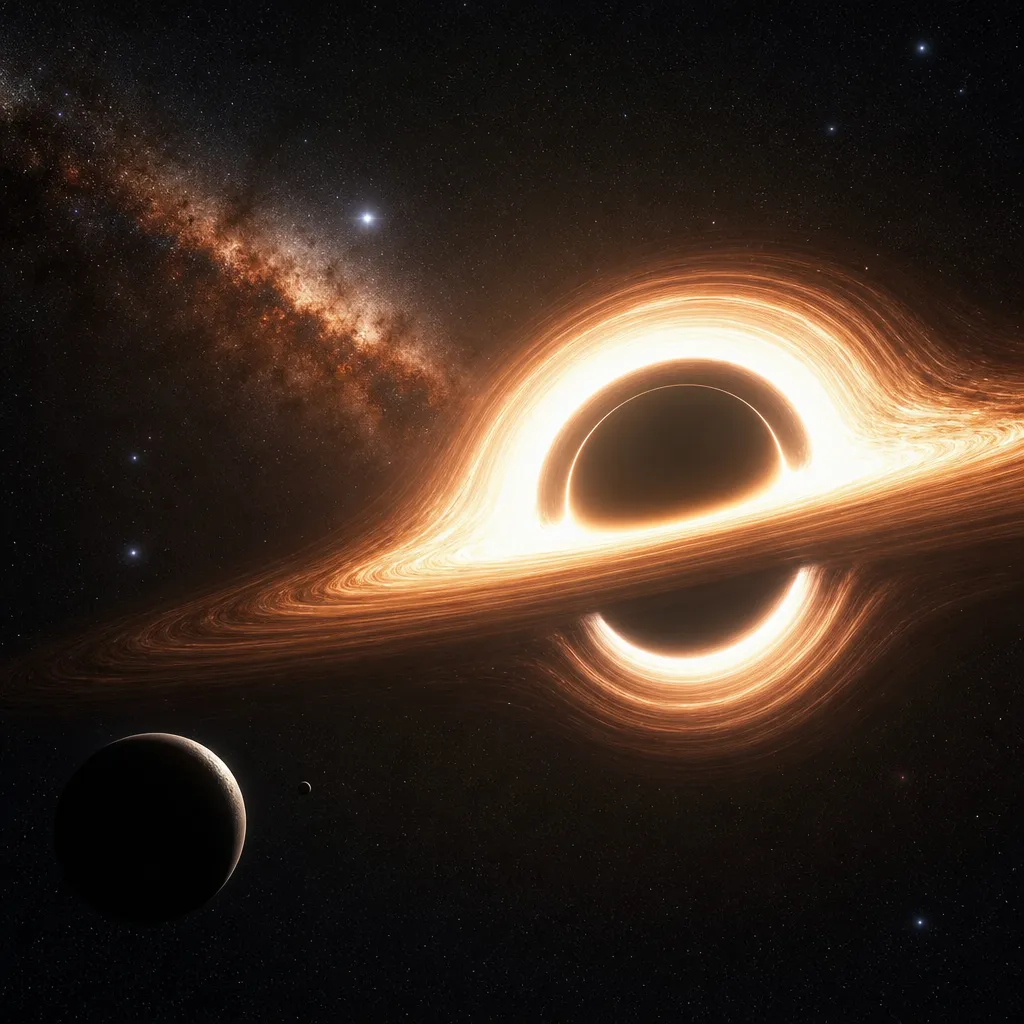
Massive objects warp spacetime, bending light from background sources—an effect called gravitational lensing. In strong lensing, multiple images of a distant galaxy or quasar appear around a foreground mass. Differences in the light-travel time between images, known as time delays, depend on the geometry of the system and thus on cosmic distances.
Applications
- Using lensed quasars with measured time delays to infer H₀.
- Combining lensing geometries with stellar dynamics of lensing galaxies.
- Cross-validating against supernova and BAO distance scales.
Combining Methods: The Cosmic Distance Ladder
No single technique covers the entire Universe. Instead, astronomers construct a distance ladder by calibrating one method against another:
- Parallax calibrates Cepheids and other nearby standard candles.
- Cepheids anchor Type Ia supernova distances in nearby galaxies.
- Supernovae extend scale to high redshift, linked to BAO and lensing.
- BAO and cosmic microwave background observations tie in the largest scales and refine cosmological parameters.
By weaving together these independent approaches, scientists achieve robust distance measurements across cosmic time, unveiling the Universe’s size, age, and fate.
Looking Ahead: Future Prospects
Upcoming missions and instruments will sharpen our cosmic measuring tools:
- Next-generation astrometry satellites will push parallax precision farther into the Milky Way and beyond.
- Large synoptic surveys will discover thousands of new supernovae and variable stars, improving standard candle statistics.
- Deep galaxy surveys and enhanced spectrographs will refine redshift mapping and BAO measurements.
- Precision studies of gravitational waves from merging binaries may offer novel distance indicators, independent of electromagnetic observations.
As we refine each rung of the ladder—parallax, standard candles, redshift, BAO, lensing—the cosmic tapestry becomes ever clearer. These combined efforts will continue to reveal the Universe’s grand architecture, guiding us toward a deeper understanding of its origin, evolution, and ultimate destiny.