
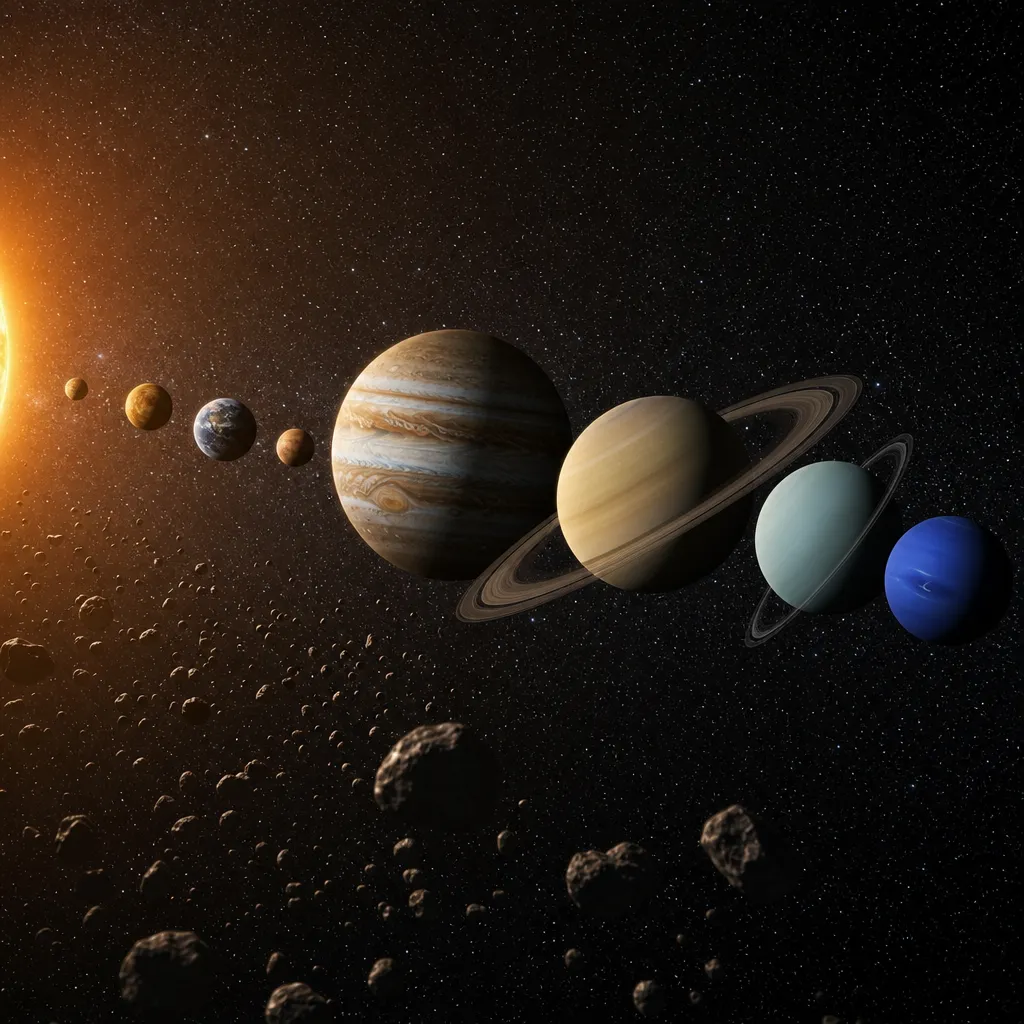
There are eight planets in the Solar System under the current definition used by the International Astronomical Union: Mercury, Venus, Earth, Mars, Jupiter, Saturn, Uranus, and Neptune. That answer is simple, but the reason it is eight rather than nine is the result of both astronomical discovery and a formal decision about what counts as a planet. Pluto, long taught as the ninth planet, is now classified as a dwarf planet. Understanding why tells an important story about how science organizes new evidence as observations improve.
The Solar System contains far more than eight major worlds. It also includes dwarf planets, hundreds of moons, millions of asteroids, vast numbers of icy bodies beyond Neptune, and smaller debris such as comets and meteoroids. So the real scientific question is not only how many planets there are, but also how astronomers distinguish planets from other kinds of objects.
What counts as a planet?
In 2006, the International Astronomical Union, or IAU, adopted a formal definition for a planet in the Solar System. Under that definition, a planet must satisfy three conditions. It must orbit the Sun, it must be massive enough for its own gravity to pull it into a nearly round shape, and it must have “cleared the neighborhood” around its orbit.
The first two conditions describe many large bodies. The third is the crucial one. “Clearing the neighborhood” does not mean a planet removes every object nearby. It means the body is gravitationally dominant in its orbital zone. Over long timescales, a true planet either accretes, captures, scatters, or otherwise controls most smaller bodies near its path.
This is why Earth is a planet even though asteroids cross Earth’s orbit, and why Pluto is not, even though Pluto is round and orbits the Sun. Pluto shares its region with many other Kuiper Belt objects.
| Criterion | What it means | Why it matters |
|---|---|---|
| Orbits the Sun | The object is in orbit around our star | Separates planets from moons |
| Nearly round | Gravity overcomes rigid material strength | Shows the body is large enough for self-gravity to shape it |
| Cleared its orbit | The body dominates its orbital region gravitationally | Distinguishes planets from dwarf planets and many small bodies |
The eight planets, in order
The eight planets are usually listed outward from the Sun:
- Mercury — the smallest planet and the closest to the Sun
- Venus — similar in size to Earth but with an extremely dense, hot atmosphere
- Earth — the only known world with life
- Mars — a cold rocky planet with evidence of ancient liquid water
- Jupiter — the largest planet, a gas giant
- Saturn — a gas giant famous for its ring system
- Uranus — an ice giant with an extreme axial tilt
- Neptune — a distant ice giant with powerful winds
The first four are often called the terrestrial planets because they are rocky. Jupiter and Saturn are gas giants, dominated by hydrogen and helium. Uranus and Neptune are commonly called ice giants, containing more water, ammonia, and methane-rich material in their deep interiors than Jupiter and Saturn do.
Why Pluto is no longer counted as a planet
Pluto was discovered in 1930 by Clyde Tombaugh and for decades was accepted as the ninth planet. Over time, however, astronomers learned that Pluto is much smaller than the major planets and is part of a larger population of icy bodies beyond Neptune called the Kuiper Belt.
The turning point came as improved telescopes revealed more large trans-Neptunian objects. In 2005, astronomers announced the discovery of Eris, a distant object comparable to Pluto in size. This forced a problem: either many newly found bodies might also have to be called planets, or the definition of planet needed to become more precise.
In 2006, the IAU chose the second path. Pluto met the first two criteria but not the third, so it was reclassified as a dwarf planet. That decision remains controversial in public culture, but it reflects a scientific attempt to make the classification consistent with growing knowledge of the outer Solar System.
This reclassification did not make Pluto unimportant. On the contrary, Pluto became scientifically even more interesting as a representative of a vast and ancient population of icy worlds.
Dwarf planets are not planets, but they are major worlds
A dwarf planet is an object that orbits the Sun, is nearly round, and has not cleared its orbital neighborhood. It is also not a moon. Pluto is the best known example, but it is not alone.
The IAU recognizes several dwarf planets, including Pluto, Ceres, Eris, Haumea, and Makemake. Many other candidates may also qualify, especially in the outer Solar System, but not all have been formally classified.
This means the Solar System has eight planets, but it has more than eight substantial planetary bodies if dwarf planets are included. The exact number of dwarf planets is not settled because many distant objects are still being studied, and for some, their shapes and physical properties are not yet known well enough.
| Object type | Round? | Orbits the Sun? | Cleared its orbit? | Example |
|---|---|---|---|---|
| Planet | Yes | Yes | Yes | Earth |
| Dwarf planet | Yes | Yes | No | Pluto |
| Moon | Sometimes | No, it orbits a planet | Not applicable | Earth’s Moon |
| Asteroid or small body | Often no | Yes | No | Vesta |
How the planets formed
The eight planets formed about 4.6 billion years ago from a rotating disk of gas and dust around the young Sun. This disk, called the protoplanetary disk, contained material left over from the Sun’s formation. Tiny grains collided and stuck together, gradually building larger bodies.
Through repeated collisions and gravitational attraction, these grew into planetesimals and then protoplanets. In the warmer inner Solar System, only rock and metal could remain solid, leading to the formation of rocky planets. Farther from the Sun, where temperatures were lower, ices could condense as well, allowing larger cores to form and capture thick envelopes of gas in the cases of Jupiter and Saturn.
Planet formation is well supported by several lines of evidence: the ages of meteorites, computer simulations, observations of young stars surrounded by disks, and images of protoplanetary systems showing rings, gaps, and structures consistent with growing planets. However, details remain active areas of research, including exactly how fast giant planets formed and how much the planets migrated from their birth locations.
How scientists know what is in the Solar System
Our count of planets comes from centuries of observation combined with modern measurements. The five brightest planets visible to the unaided eye — Mercury, Venus, Mars, Jupiter, and Saturn — were known in antiquity because they move against the background stars. Uranus was identified as a planet in 1781 by William Herschel using a telescope. Neptune was discovered in 1846 after astronomers noticed that Uranus’s orbit was being perturbed by the gravity of an unseen object.
Pluto was found through telescopic surveys in 1930. Since then, far more powerful telescopes on Earth and in space have mapped huge populations of objects beyond Neptune. Astronomers use visible light, infrared observations, orbital calculations, spectroscopy, and spacecraft flybys to determine the sizes, compositions, atmospheres, and motions of Solar System bodies.
Space missions have been especially important. Spacecraft have visited every planet, and orbiters, landers, probes, and flybys have transformed them from points of light into complex worlds. For example, NASA’s New Horizons mission showed in 2015 that Pluto has mountains, nitrogen ice plains, a layered atmosphere, and a geologically varied surface. That did not restore Pluto to planet status, but it greatly expanded scientific understanding of dwarf planets.
Why the number matters scientifically
At one level, the exact count is a classification issue. But classifications matter because they reflect how scientists organize nature. Grouping bodies by physical behavior helps astronomers compare worlds meaningfully and test theories of planetary formation and evolution.
The distinction between planets and dwarf planets highlights an important structural feature of the Solar System. The eight planets dominate their regions. By contrast, the asteroid belt between Mars and Jupiter and the Kuiper Belt beyond Neptune are populations of many bodies sharing broad orbital zones. That difference is not merely semantic; it tells us about accretion, gravity, migration, and the early dynamical history of the Solar System.
The issue also matters beyond our own system. Astronomers now know of thousands of exoplanets orbiting other stars. As planetary science expands, definitions developed in the Solar System help frame wider questions about what kinds of worlds exist and how planetary systems form.
What remains uncertain
The number of planets in the Solar System is not uncertain under the current IAU definition: it is eight. What remains uncertain is how many dwarf planets and other large trans-Neptunian objects may eventually be recognized. The outer Solar System is vast, faint, and difficult to survey completely.
There is also ongoing debate about planetary definitions. Some planetary scientists argue that geophysical properties, such as being round and internally complex, should matter more than orbital dominance. Under that kind of alternative definition, Pluto and some large moons might be considered planets. This is a real scientific and educational debate, but it is not the official classification used today.
Another open question concerns whether a large undiscovered planet exists in the distant outer Solar System. The hypothetical “Planet Nine” has been proposed to explain certain unusual orbital patterns seen among some faraway objects. At present, this remains a hypothesis, not a confirmed detection. No such planet has yet been directly observed.
Planets, exploration, and the bigger picture
The eight recognized planets span an extraordinary range of environments: airless rocky surfaces, crushing atmospheres, global oceans hidden under ice on moons, giant magnetic fields, immense ring systems, and weather patterns unlike anything on Earth. Even though only eight objects qualify as planets, the Solar System is not a simple set of isolated bodies. It is a gravitational system shaped by formation, collisions, radiation, and billions of years of orbital evolution.
Exploration continues to refine this picture. Missions to Mercury, Mars, Jupiter, and the ice giants under study for future exploration aim to answer deeper questions about planetary interiors, atmospheres, magnetic fields, and habitability. The count of eight may be stable, but our understanding of what planets are and how they behave is still growing.
Why was Pluto called a planet for so long?
Pluto was classified as a planet after its discovery in 1930 because astronomers did not yet know how many similar objects existed beyond Neptune. As later observations revealed the Kuiper Belt and more Pluto-like bodies, scientists reconsidered the definition of a planet.
How do scientists know a planet has cleared its orbit?
They study the object’s mass, orbit, and gravitational influence compared with other bodies in the same region. A planet is dynamically dominant, meaning it strongly controls nearby objects over long timescales.
Could the Solar System ever officially have more than eight planets again?
It is possible only if the official definition changes or if a new object is discovered that meets the current criteria. A hypothetical distant planet would need to be observed and shown to dominate its orbital zone.
Are dwarf planets less important than planets?
No. Dwarf planets are scientifically important because they preserve clues about the early Solar System. Objects such as Pluto and Ceres have complex geology and chemistry that help researchers study planetary evolution.
How many dwarf planets are there?
The IAU recognizes several, including Pluto, Ceres, Eris, Haumea, and Makemake. The total number of dwarf planets could be significantly larger, but many candidates have not yet been confirmed.
Can all eight planets be seen from Earth?
Mercury, Venus, Mars, Jupiter, and Saturn can be seen without a telescope under suitable conditions. Uranus is sometimes visible to very dark-adapted eyes from excellent sites, but it is usually observed with optical aid. Neptune requires a telescope.
What missions have visited the planets?
All eight planets have been visited by spacecraft, though not all have had orbiters or landers. Mars has been explored most extensively, while Uranus and Neptune have so far only been visited by Voyager 2.
Why does the definition of a planet matter?
It matters because definitions shape how scientists compare objects and test theories. In this case, the definition separates gravitationally dominant worlds from members of larger populations such as the asteroid belt and Kuiper Belt.
Sources
- International Astronomical Union, Resolution B5: Definition of a Planet in the Solar System
- NASA Solar System Exploration
- Encyclopaedia Britannica, Pluto and the classification of planets