

The short answer is that no one knows the exact number of galaxies in the entire universe. In the observable universe—the part whose light has had time to reach us since the Big Bang—modern estimates suggest there are likely hundreds of billions to perhaps around two trillion galaxies, depending on how faint and small a galaxy we count and how the estimate is modeled. The lower end reflects galaxies we can directly detect more easily; the higher end comes from extrapolating to very faint dwarf galaxies that current telescopes often miss. Beyond the observable universe, the total could be vastly larger, but that number is fundamentally unmeasurable with present physics because light from those regions cannot reach us.
This is not a simple counting problem. Galaxies differ enormously in size, brightness, and distance, and the earliest ones are extremely faint. Astronomers therefore combine direct observations with statistical methods, deep imaging surveys, and cosmological models to estimate how many galaxies exist.
What counts as a galaxy?
A galaxy is a gravitationally bound system containing stars, gas, dust, dark matter, and often a central black hole. Some are giant spirals like the Milky Way, while others are small dwarf galaxies with far fewer stars. A few are relatively bright and easy to detect; many more are dim, diffuse, or so distant that they are close to the limits of current instruments.
This matters because the answer depends partly on definition. If astronomers count only large, easily visible systems, the number is lower. If they include huge populations of tiny dwarf galaxies and very early galaxies from the young universe, the number rises sharply.
Galaxies also evolve. They merge, form stars, lose gas, and change shape over billions of years. So asking how many galaxies exist is also a question about cosmic history: how structure formed, how small systems combined into larger ones, and how many faint galaxies survive or become incorporated into bigger ones.
The observable universe versus the whole universe
When astronomers discuss galaxy counts, they usually mean the observable universe. This is a sphere centered on us, limited by the finite age of the universe and the speed of light. Because the universe is about 13.8 billion years old and space has expanded while light traveled, the observable universe is much larger than 13.8 billion light-years in radius.
The important point is that we cannot see everything that exists. Regions beyond the observable universe may contain many more galaxies, perhaps infinitely many if space is infinite, but science cannot currently measure them directly. Any statement about the total number of galaxies in the entire universe is therefore speculative beyond the observable part.
| Term | Meaning | Why it matters |
|---|---|---|
| Observable universe | The region from which light has had time to reach us since the Big Bang | This is the only part where galaxy counts can be estimated from observations |
| Galaxy | A gravitationally bound collection of stars, gas, dust, and dark matter | What is included in the count depends on detection limits and classification |
| Deep field | A very long telescope exposure of a tiny patch of sky | Used to infer how many faint, distant galaxies fill the universe |
| Extrapolation | Estimating unseen objects from the properties of observed ones | Essential because many galaxies are too faint to detect directly |
Why estimates changed so much
For a long time, a commonly quoted figure was roughly 100 to 200 billion galaxies in the observable universe. That estimate was based on the kinds of galaxies earlier telescopes could detect most reliably. Then deeper studies, especially work using the Hubble Space Telescope, suggested the true total may be much larger once faint and distant galaxies are included.
A widely discussed 2016 analysis argued that the observable universe may contain about two trillion galaxies. That result did not come from directly seeing two trillion galaxies one by one. Instead, it used deep surveys and mathematical modeling to infer how many smaller and fainter galaxies should exist below detection thresholds.
More recently, the James Webb Space Telescope has begun revealing many galaxies in the early universe with exceptional sensitivity in infrared light. Webb is improving the census of faint, distant systems, but it has not yet produced a final, exact replacement number. In practice, the galaxy count remains an estimate with substantial uncertainty, especially at the small and faint end.
How astronomers estimate the number
The process begins with sky surveys. Telescopes image a region of the sky, identify galaxies, measure their brightness, and estimate their distances. Astronomers then determine how many galaxies of different types appear within a certain volume of space.
But no telescope sees everything. Distant galaxies are dimmed by distance, and the expansion of the universe shifts their light toward longer wavelengths. Small galaxies may simply be too faint to detect. So researchers correct for incompleteness by modeling the population of galaxies that should exist below the detection limit.
One important tool is the galaxy luminosity function, which describes how many galaxies exist at different brightness levels. If the number of faint galaxies rises steeply enough, then a large hidden population may exist even though only a fraction is directly observed.
Astronomers also use redshift, which measures how much the expansion of the universe has stretched a galaxy’s light. Redshift helps place galaxies in cosmic time. By studying galaxy populations at different redshifts, researchers reconstruct how the number and sizes of galaxies changed over billions of years.
Deep fields: small patches, huge implications
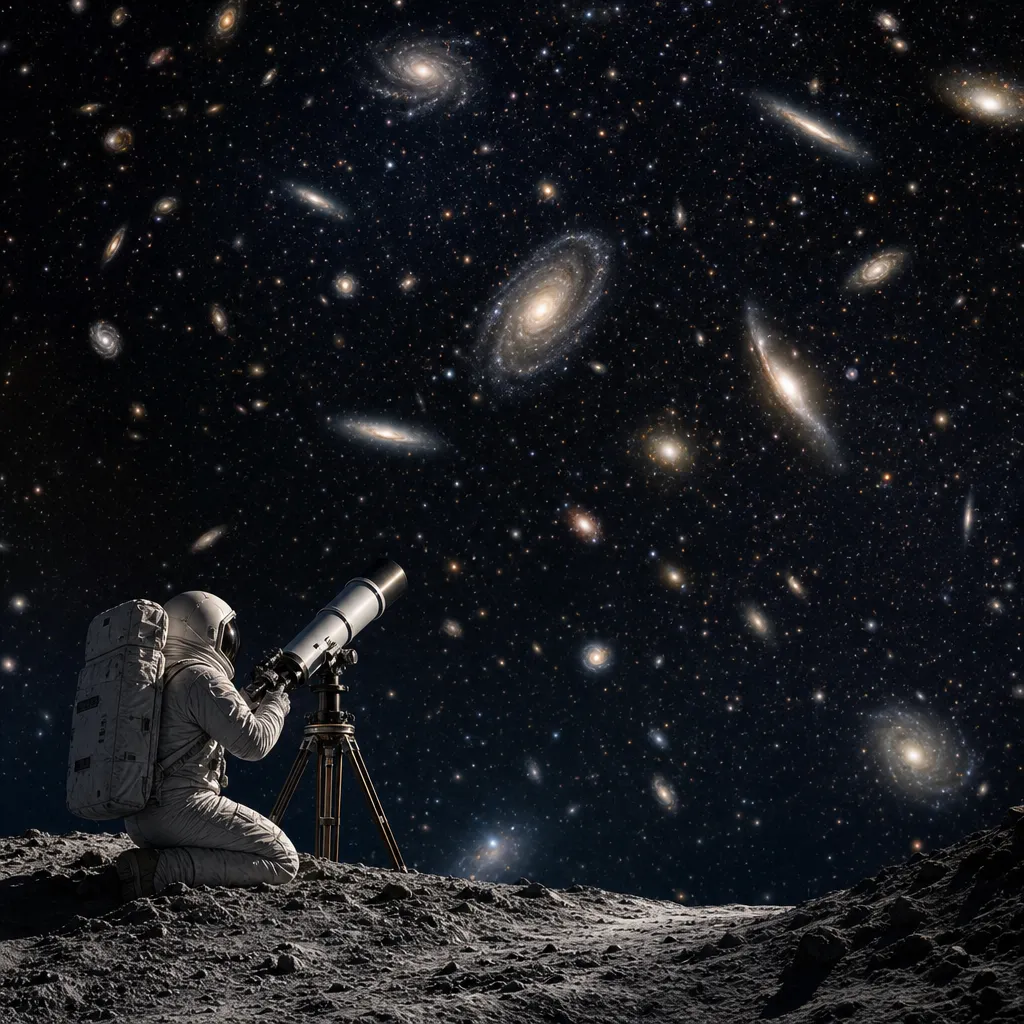
Some of the most important evidence comes from deep-field observations. In projects such as the Hubble Deep Field, Hubble Ultra Deep Field, and later deep infrared surveys, astronomers stared at tiny, apparently empty parts of the sky for long periods. The result was a crowded image full of galaxies, many of them extremely distant.
These observations showed that the sky is packed with galaxies almost everywhere one looks with enough sensitivity. Deep fields do not cover much area, so they cannot literally count the whole sky. Instead, astronomers treat them as samples and combine them with wider surveys to estimate overall cosmic populations.
This method has strengths and limits. Deep fields reveal galaxies that wide surveys miss, but because they cover such small regions, they can be affected by cosmic variance: one patch of sky may happen to contain more or fewer galaxies than average. That is one reason different analyses can produce somewhat different totals.
| Method | What it measures | Main limitation |
|---|---|---|
| Wide sky surveys | Large-scale distribution of brighter, easier-to-detect galaxies | Misses many faint and distant galaxies |
| Deep-field imaging | Very faint galaxies in small sky areas | Tiny field of view can bias samples |
| Redshift measurements | Distance and cosmic epoch | Hardest for the faintest objects |
| Population modeling | Estimated number of undetected galaxies | Depends on assumptions about faint galaxy populations |
Why faint dwarf galaxies matter so much
The biggest uncertainty is not the number of giant galaxies. It is the number of tiny, faint dwarf galaxies. These small systems may be extremely common, especially in the early universe, and many are difficult to detect individually at great distance.
In the standard cosmological picture, small structures formed first and later merged into bigger galaxies. If that picture is correct, then the early universe likely contained many more small galaxies than the modern universe does as separate systems. Over time, mergers reduced the number of distinct galaxies while building larger ones.
That means the answer also depends on when in cosmic history one is asking. At earlier times there may have been more separate galaxy-sized units, especially tiny ones. Today, many of those may have merged into larger galaxies or become so dim that they are difficult to identify.
What James Webb is changing
The James Webb Space Telescope is especially powerful for this problem because very distant galaxies are best seen in infrared light. The expansion of the universe stretches the ultraviolet and visible light from early galaxies into the infrared by the time it reaches us.
Webb has already found many bright galaxies at very early times and has expanded the known population of ancient galaxies. These results are helping astronomers refine models of galaxy formation and test whether earlier extrapolations overestimated or underestimated the number of faint systems.
However, Webb does not instantly solve the problem. Its deepest observations cover relatively small areas, and classifying the faintest objects remains challenging. Some apparent galaxies may need confirmation, and some populations may still lie below practical detection thresholds. Webb is improving the estimate, not replacing uncertainty with perfect certainty.
Why the number matters scientifically
Galaxy counts are not just trivia. They test our theories of how structure formed in the universe. The number of galaxies, especially small ones, is linked to dark matter, the growth of cosmic structure, star formation, and the history of mergers.
Counts also help astronomers estimate how much starlight has been produced over cosmic time and how galaxies contributed to major events such as cosmic reionization, when radiation from the first stars and galaxies transformed the intergalactic medium in the early universe.
More broadly, counting galaxies helps place the Milky Way in context. It tells us whether our galaxy is typical or unusual, how environments shape galaxy evolution, and how matter became organized on the largest scales.
What remains uncertain
Several uncertainties remain. First, astronomers do not yet know the full abundance of the faintest dwarf galaxies at high redshift. Second, identifying extremely distant galaxies can be difficult because some objects are near the edge of detectability. Third, different observing strategies and models can shift the inferred totals.
There is also a conceptual uncertainty: should astronomers count every small gravitationally bound stellar system as a galaxy, or do some blur into the category of star cluster? In nearby space, dark matter content and internal dynamics can help distinguish them, but at extreme distances that information is often unavailable.
So the most honest answer is this: the observable universe almost certainly contains far more than a few hundred billion galaxies, and it may contain around two trillion if faint galaxies are included, but the exact total remains an active scientific question.
How do scientists know there are so many galaxies?
They combine direct observations from telescopes with statistical estimates. Deep images reveal thousands of galaxies in tiny sky patches, and astronomers scale those samples to larger volumes while correcting for galaxies too faint to see.
Can astronomers count every galaxy directly?
No. Many galaxies are too faint, too small, or too distant for current telescopes to detect individually. The total therefore relies partly on inference and modeling, not a complete direct census.
Why is there no single exact number?
The answer depends on telescope sensitivity, the definition of a galaxy, and how many ultra-faint dwarf galaxies exist. It also depends on how astronomers model unseen populations below detection limits.
Did Hubble or James Webb discover the final answer?
No. Hubble transformed the issue by showing how crowded the deep universe is and by supporting higher estimates. James Webb is now refining the picture, especially for very early galaxies, but the final count is still uncertain.
Are there more galaxies now than in the early universe?
Not necessarily. In standard models, the early universe likely had many more small separate systems that later merged into larger galaxies. So the number of distinct galaxies can decrease over time even as galaxies grow more massive.
Does this include galaxies beyond what we can see?
No. Scientific estimates apply to the observable universe. Beyond that, there may be many more galaxies, but they are outside direct observational reach.
Can we see these galaxies from Earth?
Some nearby galaxies can be seen with small telescopes, and a few are faintly visible to the unaided eye under dark skies, such as Andromeda. But the overwhelming majority require professional telescopes, and the most distant ones need space observatories and long exposures.
Why do galaxy counts matter beyond curiosity?
They test models of cosmic evolution, dark matter, star formation, and galaxy mergers. Knowing how many galaxies exist also helps astronomers understand how the universe built structure over billions of years.
Sources
- NASA, “Hubble Reveals Observable Universe Contains 10 Times More Galaxies Than Previously Thought”
- Conselice, C. J. et al., “The Evolution of Galaxy Number Density at z < 8 and Its Implications,” The Astrophysical Journal, 2016
- Space Telescope Science Institute, James Webb Space Telescope science results and deep field observations