

Probably, yes—but no confirmed evidence of life beyond Earth has yet been found. Modern astronomy has shown that planets are common, that many stars host rocky worlds, and that some of those worlds may have conditions compatible with liquid water, chemistry, and long-term stability. At the same time, astrobiology has not yet detected an unambiguous biosignature on another planet, in our Solar System or beyond. So the scientific answer is careful: life elsewhere is plausible and perhaps even likely, but it remains unproven.
The question matters because it connects chemistry, biology, astronomy, and planetary science. It asks whether life is a rare accident or a common outcome of cosmic evolution. It also forces scientists to define what counts as evidence, how habitable environments form, and how difficult it is to recognize life remotely.
Why scientists think life elsewhere is possible
The basic argument is not based on wishful thinking. It comes from what is now well established about the universe. Stars are abundant, planets are abundant, and the raw ingredients of life as we know it are widespread. Elements such as carbon, hydrogen, oxygen, nitrogen, phosphorus, and sulfur are produced in stars and distributed through galaxies. Water exists in interstellar clouds, comets, moons, and planets.
Life on Earth appeared relatively early in our planet’s history, at least once conditions became stable enough to support long-lived oceans. That does not prove life arises easily, because one example cannot reveal the true probability. But it shows that biology can emerge from nonliving chemistry under natural conditions.
Scientists therefore separate two questions:
- Is a world habitable? That means it may offer suitable physical and chemical conditions.
- Is it inhabited? That requires evidence that life is actually present.
These are not the same. Many places may be potentially habitable yet lifeless, and some forms of life might survive in environments very different from the familiar surface conditions of Earth.
What life would need, at minimum
Astrobiology usually starts with life as we know it, because that is the only example available. On Earth, all known organisms require a liquid solvent, a source of energy, and access to useful chemical building blocks. Liquid water is the leading candidate because it is chemically versatile, abundant, and stable over a useful range of conditions.
Energy can come from sunlight, as it does for many organisms on Earth, or from chemical reactions. Deep-sea ecosystems on Earth show that life does not need direct sunlight if it can exploit chemistry from rocks and hot fluids. This greatly broadens the range of environments considered interesting.
Habitability also depends on time. A world may briefly have liquid water after an impact or volcanic episode, but biology may require stable conditions for much longer periods. Planetary mass, atmosphere, magnetic environment, internal heat, and interactions with a host star can all influence whether a habitable environment lasts.
| Requirement or factor | Why it matters | What scientists look for |
|---|---|---|
| Liquid water | Supports complex chemistry and transport of nutrients | Surface minerals, atmospheric clues, subsurface oceans, temperature-pressure models |
| Energy source | Drives metabolism and chemical disequilibrium | Sunlight, geothermal activity, redox chemistry, tidal heating |
| Essential elements | Needed to build organic molecules and cells | Spectroscopy, meteorites, surface composition, plume chemistry |
| Long-term stability | Gives prebiotic chemistry and ecosystems time to develop | Climate models, geologic history, star activity, orbital dynamics |
Where scientists are looking in the Solar System
Within our own Solar System, Mars is one of the main targets. Evidence from orbiters, landers, and rovers shows that ancient Mars had rivers, lakes, groundwater activity, and a thicker past atmosphere. The strongest current scientific view is that early Mars was more habitable than it is today. However, no mission has yet found definitive evidence of past or present Martian life.
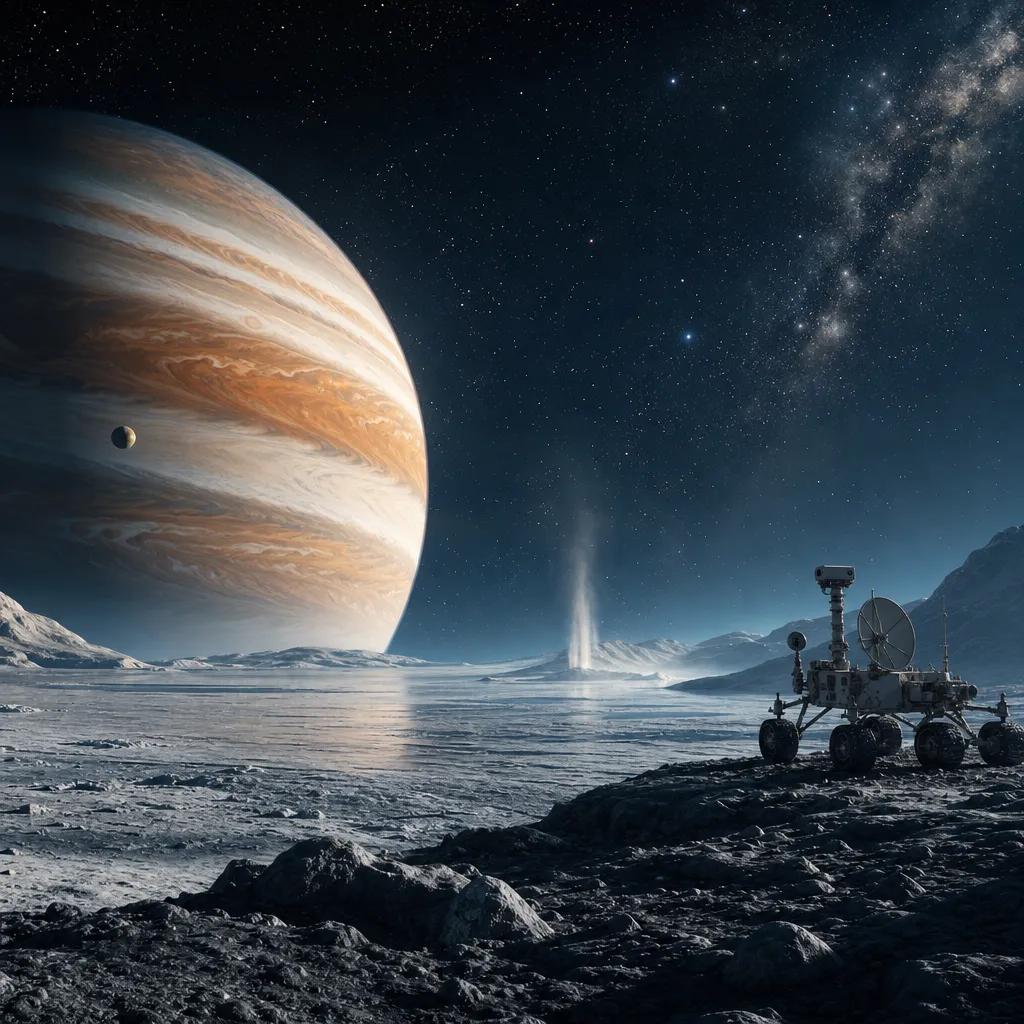
Another major class of targets is icy ocean worlds. Jupiter’s moon Europa and Saturn’s moon Enceladus are especially important because multiple lines of evidence indicate global subsurface oceans beneath ice. Enceladus also vents material into space through plumes, allowing spacecraft to sample ocean-derived material indirectly. Measurements by NASA’s Cassini mission found water vapor, salts, organic compounds, and evidence consistent with hydrothermal activity on the seafloor. That is not proof of biology, but it is a compelling habitable-environment case.
Titan, Saturn’s largest moon, is different again. It has a thick nitrogen-rich atmosphere and surface lakes of methane and ethane, while also likely hosting a subsurface water ocean. Titan is probably not Earth-like, but it is chemically rich and may help scientists understand how complex organic chemistry develops in planetary environments.
Beyond the Solar System: exoplanets and habitable zones
The biggest change in this field over the past few decades has been the discovery of exoplanets—planets orbiting other stars. Thousands are now known. Some are gas giants, some are mini-Neptunes, and some are rocky worlds roughly Earth-sized. This alone transformed the question of life elsewhere from philosophical speculation into a testable scientific problem.
A useful concept is the habitable zone, the range of distances from a star where a planet with the right atmosphere could maintain liquid water on its surface. This idea is valuable, but it is often oversimplified. Being in the habitable zone does not guarantee oceans, climate stability, or life. Venus and Earth show that similar orbital distances can still lead to very different outcomes.
Scientists also consider stellar behavior. Many potentially habitable planets orbit small, cool stars because such planets are easier to detect. But these stars can be magnetically active, producing flares and radiation that may erode atmospheres or alter chemistry. Whether such worlds remain habitable is still an active area of research.
| Target type | Why it is interesting | Main uncertainty |
|---|---|---|
| Ancient Mars | Strong evidence for past liquid water and habitable environments | Whether life ever began or left detectable traces |
| Europa | Subsurface ocean, internal heating, possible water-rock interaction | Ocean chemistry and whether energy is sufficient for sustained biology |
| Enceladus | Accessible plumes containing water, organics, and salts | No direct detection of cells or biological processes |
| Rocky exoplanets in habitable zones | Large number of possible Earth-like environments | Limited atmospheric data and ambiguous biosignatures |
How scientists search for signs of life
There are several different search strategies, and they operate at different distances and levels of certainty.
In situ exploration
For nearby worlds, spacecraft can analyze rocks, soils, ice, and atmosphere directly. Mars rovers study mineralogy, organics, and environmental conditions. Future missions to ocean worlds aim to examine ice, plumes, or near-surface material. This approach provides the most detailed local information, but it is limited to a small number of destinations.
Remote sensing of atmospheres
For exoplanets, scientists often rely on spectroscopy. When a planet passes in front of its star, some starlight filters through the planet’s atmosphere. Molecules in that atmosphere absorb specific wavelengths, leaving a spectral pattern. This can reveal gases such as water vapor, carbon dioxide, and methane under suitable conditions.
The difficulty is interpretation. A gas associated with life on Earth is not automatically a biosignature on another world. Methane, for example, can be produced biologically, but also geologically. Oxygen can be a strong clue in the right planetary context, especially if found with gases that should react away quickly, yet even oxygen may have nonbiological explanations under some circumstances.
Technosignatures
A separate search looks for evidence of technology rather than microbes. Radio SETI listens for narrow-band or unusual signals that natural astrophysical sources are unlikely to produce. Other proposed technosignatures include industrial atmospheric pollutants, optical laser signals, or large-scale infrared excesses associated with energy use. None has been confirmed. These searches are scientifically legitimate, but all candidate detections require extraordinary caution.
How we know what we know
The modern search for life rests on several powerful observational methods. Exoplanets are discovered mainly through the transit method, which measures a small drop in starlight when a planet crosses its star, and the radial velocity method, which detects the star’s slight back-and-forth motion caused by the planet’s gravity. These methods reveal size, orbit, and sometimes mass, allowing scientists to estimate density and distinguish likely rocky planets from gas-rich ones.
Spacecraft provide ground truth in the Solar System. Orbiters map surface minerals and ice, radar can probe below surfaces, and mass spectrometers can identify molecules in atmospheres or plumes. Rovers use cameras, drills, spectrometers, and environmental sensors to reconstruct geological history and assess past habitability.
Laboratory work is equally important. Researchers test how organic molecules form, how minerals preserve biosignatures, and how atmospheric chemistry behaves under different stellar radiation conditions. Computer simulations then connect these pieces into climate, chemistry, and planetary evolution models.
This layered approach matters because no single measurement is enough. A claim about life usually requires multiple independent lines of evidence that fit together better than nonbiological explanations.
What counts as convincing evidence
Scientists are especially careful because false positives are possible. Organic molecules are not by themselves proof of life; they are common in space and can form without biology. Water is not proof of life either. Even potentially biological gases in an atmosphere must be interpreted in planetary context.
A convincing case would likely involve some combination of the following:
- Chemical disequilibrium that is difficult to maintain without ongoing metabolism.
- Complex organic patterns that are hard to explain by abiotic chemistry alone.
- Microscopic structures that are clearly biological, not just mineral look-alikes.
- Isotopic signatures consistent with biological processing.
- Repeated, independent confirmation by different instruments or missions.
For remote exoplanet observations, the evidentiary bar is even higher because scientists cannot touch the planet directly. They must infer atmospheric composition from light and compare it to models. This makes context essential: star type, radiation environment, planet mass, possible oceans, clouds, and geological activity all affect interpretation.
What remains uncertain
The central uncertainty is simple: we do not know how often life begins. Earth proves that life can exist, but one inhabited world cannot reveal whether biology is common or extraordinarily rare. It is possible that habitable conditions frequently produce life. It is also possible that the transition from chemistry to biology is uncommon.
Another major unknown is whether life elsewhere would resemble terrestrial life closely enough to be recognizable. Most current strategies assume carbon-based chemistry and often emphasize water. That is a scientifically practical starting point, not a proof that no other possibilities exist.
There are also observational limits. Many exoplanets are too small, too faint, or too cloud-covered for present instruments to characterize well. In the Solar System, potentially inhabited environments may lie underground or beneath thick ice, beyond easy access. Absence of evidence in such cases is not evidence of absence.
Why the question matters scientifically
Finding life elsewhere would be one of the most important discoveries in the history of science, but even a long series of non-detections would teach us something profound. It would help constrain how unusual Earth is, how planets evolve, and which environments can sustain complex chemistry over time.
The search also improves planetary science more broadly. Techniques developed to look for biosignatures sharpen our understanding of atmospheres, climates, oceans, geology, and star-planet interactions. Missions searching for habitability often return rich results even without detecting life, as happened with Mars and the icy moons.
In short, the best current scientific position is balanced: life elsewhere is a serious and plausible hypothesis supported by the abundance of planets and habitable environments, but no confirmed extraterrestrial organism, biosignature, or technosignature has yet been found. The next advances will come from better telescopes, more capable planetary missions, and stricter ways to separate biology from chemistry.
Frequently Asked Questions
Have scientists found life on any other planet?
No. Scientists have found many environments that may be or may once have been habitable, but no confirmed evidence of extraterrestrial life has been detected.
What is the difference between a habitable planet and an inhabited planet?
A habitable planet has conditions that could allow life, such as liquid water and usable chemistry. An inhabited planet actually has life. The first does not prove the second.
Why is Mars still important if no life has been found there?
Mars preserves evidence of a wetter and potentially habitable past. Its rocks may record whether prebiotic chemistry or even ancient biology ever occurred, making it a prime target for continued exploration.
Could life exist under the ice of Europa or Enceladus?
It could, in principle. Both moons appear to host liquid-water oceans and internal energy sources. However, this remains a hypothesis until missions obtain stronger evidence.
How do scientists detect possible biosignatures on exoplanets?
Mostly through spectroscopy, which studies how a planet’s atmosphere absorbs or emits light. Scientists then compare the detected gases and conditions with physical and chemical models to judge whether biological explanations are plausible.
Is oxygen in an exoplanet atmosphere proof of life?
No. Oxygen can be a promising clue, especially in combination with other gases, but it can also arise through nonbiological processes. Context is essential.
What missions are helping answer this question?
Within the Solar System, missions to Mars and future exploration of Europa are central. For exoplanets, space telescopes and ground-based observatories study planet sizes, masses, orbits, and atmospheres.
Will we know soon whether life exists elsewhere?
Not necessarily. Progress is real, but the problem is difficult. A strong detection may require multiple missions and years of confirmation, especially for subtle atmospheric or chemical evidence.
Sources
- NASA Exoplanet Exploration
- NASA Astrobiology
- European Space Agency, Exoplanets and Planetary Science