Humans could live on Mars in the sense of surviving there with advanced technology, but not in the open and not with anything close to Earth-like ease. Mars has water ice, useful minerals, day length similar to Earth, and enough sunlight for solar power, all of which make it the most practical planet for long-term settlement beyond Earth. At the same time, it is extremely hostile: the air is too thin to breathe, the surface is cold and dry, radiation levels are much higher than on Earth, and the reduced gravity may affect human health in ways we do not yet fully understand. So the best current scientific answer is yes in principle, but only inside carefully engineered habitats and only after solving major medical, environmental, and logistical challenges.
The question matters because Mars is the nearest world where a self-sustaining off-Earth human presence might eventually be possible. It is also a planetary science laboratory for understanding climate evolution, habitability, and whether life ever arose independently beyond Earth. Decades of robotic exploration have turned Mars from a distant red point of light into a mapped and measured world, but living there would still be far harder than sending robots.
Why Mars is the leading candidate
Mars is not a second Earth, but among the planets and moons we know well, it offers a rare combination of accessibility and resources. It has a solid surface, polar caps and buried ice, a day lasting about 24.6 hours, and seasons caused by an axial tilt somewhat like Earth’s. These features simplify human operations compared with places such as Venus, whose surface is crushingly hot and pressurized, or the giant planets, which have no solid surface at all.
It also sits close enough to Earth for robotic missions to arrive in months rather than years or decades. That does not make travel easy, but it keeps Mars within reach of foreseeable propulsion systems. From an engineering perspective, distance matters because every kilogram of air, water, food, spare parts, and radiation shielding is expensive to launch.
Mars may also provide many of the raw materials needed for local industry. Water ice can be split into hydrogen and oxygen. Carbon dioxide, which makes up most of the Martian atmosphere, can be processed into oxygen and fuels through known chemical pathways. Regolith, the loose soil and broken rock on the surface, may be usable for construction, shielding, and perhaps extraction of metals. None of this means a colony would quickly become independent, but it means Mars is not entirely dependent on shipments from Earth.
What makes Mars so difficult for humans
The biggest obstacle is that Mars is fundamentally not habitable to unprotected humans. Its atmosphere is very thin and composed mostly of carbon dioxide, with far too little pressure and oxygen for breathing. Without a pressure suit, a person would quickly lose consciousness.
Cold is another serious problem. Average surface temperatures are well below freezing, though conditions vary by place, season, and time of day. Liquid water is unstable at the surface under most Martian conditions, which is one reason modern Mars is so dry.
Radiation is among the most important long-term hazards. Earth is protected by a thick atmosphere and a global magnetic field. Mars has neither in an Earth-like form. Its atmosphere provides some shielding, but much less than Earth’s, and the planet lacks a strong global magnetic field to deflect charged particles. Astronauts on Mars would be exposed to galactic cosmic rays and bursts of energetic particles from the Sun.
Dust adds another layer of difficulty. Martian dust is fine, pervasive, and easily lofted by wind. Global dust storms can reduce sunlight for weeks and interfere with solar power, thermal control, surface operations, and machinery. Dust may also be a health risk if it enters habitats, although the exact medical effects remain uncertain because humans have not yet lived there.
| Challenge | What it means on Mars | Why it matters for people |
|---|---|---|
| Thin atmosphere | Very low surface pressure and almost no breathable oxygen | Humans need pressurized habitats and spacesuits |
| Radiation | Less shielding from space radiation than on Earth | Raises long-term health risks including cancer and tissue damage |
| Cold and dryness | Low temperatures and little stable surface liquid water | Demands heating, water extraction, and careful life support |
| Low gravity | About 38% of Earth’s surface gravity | Could affect bones, muscles, circulation, and development |
| Dust | Fine, widespread particles and occasional planet-scale storms | Threatens equipment, seals, filters, and possibly human health |
What humans would need to survive there
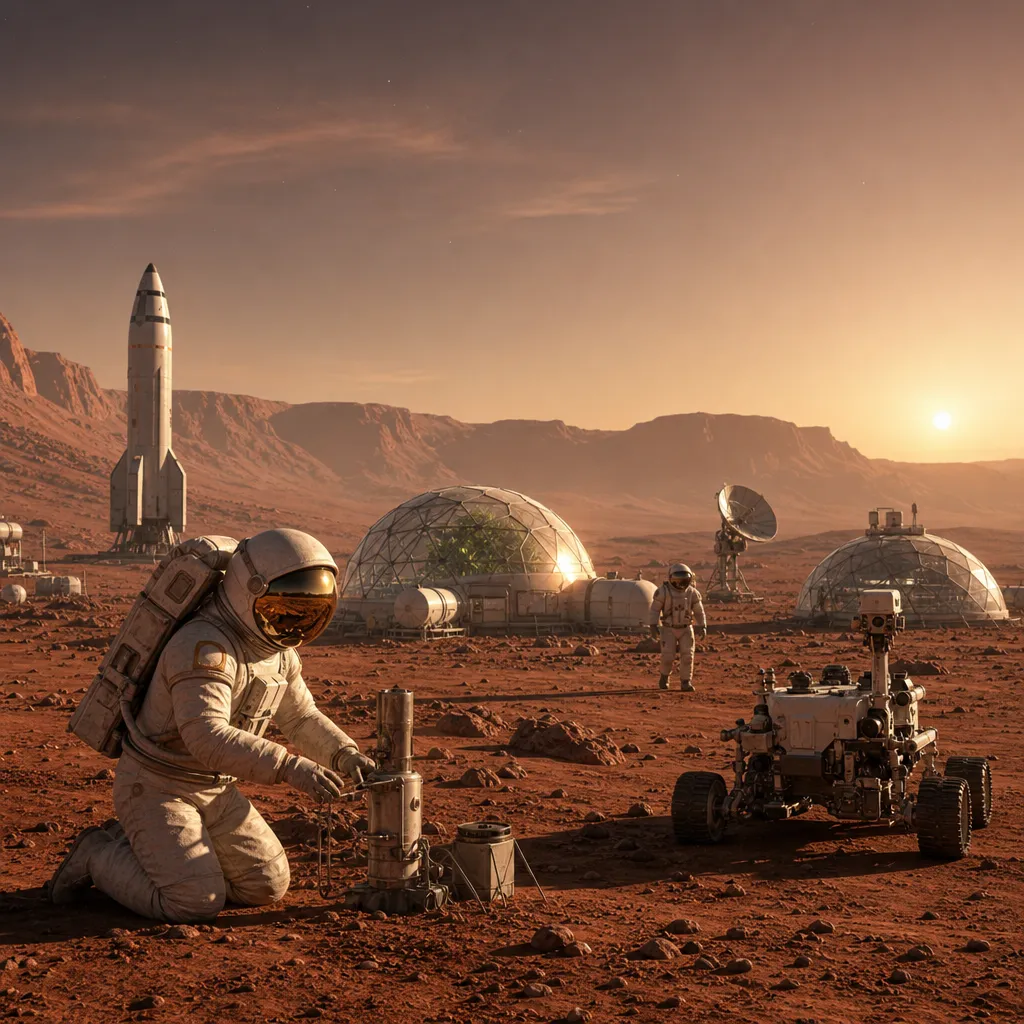
A human presence on Mars would depend on life-support systems far more robust than anything used for short missions in Earth orbit. At minimum, settlers would need pressurized habitats, oxygen production, carbon dioxide removal, water recycling, food systems, reliable power, medical support, and protection from radiation and dust.
Habitats could be built from landed modules, inflatable structures, or underground spaces carved into rock or lava tubes if suitable sites exist. Burying habitats under regolith is often proposed because soil can provide radiation shielding and thermal stability. This is an engineering concept, not yet a demonstrated Martian capability.
Water is central to almost every survival system. It is needed for drinking, hygiene, food production, oxygen generation, and potentially rocket fuel manufacture. Orbital and surface missions have shown that water ice exists at the poles and in many subsurface regions, and some landing-site planning focuses on access to that ice. Turning buried ice into a dependable industrial resource, however, remains a future challenge.
Food could initially be supplied from Earth, but long-term residence would probably require local agriculture or other forms of biological and chemical food production. Plants offer food, oxygen production, and psychological benefits, yet farming on Mars would not mean planting seeds in open ground. It would require controlled environments with carefully managed water, nutrients, light, temperature, and air chemistry. Martian soil may contain compounds such as perchlorates that would complicate direct agricultural use.
Can Mars provide the resources needed?
The idea of in situ resource utilization, usually shortened to ISRU, is central to most serious Mars plans. ISRU means using local materials instead of bringing everything from Earth. On Mars, that mainly involves the atmosphere, ice, and regolith.
Carbon dioxide in the atmosphere can be processed into oxygen. NASA’s Perseverance rover carried an experiment called MOXIE, which demonstrated oxygen production from Martian carbon dioxide on a small scale. This did not prove that a full human oxygen plant is ready, but it did show that the basic chemistry works in real Martian conditions.
Water ice could be melted and purified for life support, then split by electrolysis into oxygen and hydrogen. Hydrogen can also be combined with carbon dioxide to make methane fuel through the Sabatier reaction, a well-understood industrial process. That is important because return missions may need propellant produced on Mars rather than delivered entirely from Earth.
Regolith may be useful for bricks, landing pads, roads, or radiation shielding. Researchers test these ideas in laboratories using Martian soil simulants, but simulants are only approximations. The actual strength, chemistry, grain behavior, and engineering performance of specific Martian materials at a settlement site would need confirmation on location.
| Resource on Mars | Possible use | Current status |
|---|---|---|
| Atmospheric carbon dioxide | Oxygen production and fuel chemistry | Small-scale oxygen extraction demonstrated by MOXIE |
| Water ice | Drinking water, agriculture, oxygen, hydrogen fuel | Strong evidence from orbital and surface observations, large-scale extraction not yet demonstrated on Mars |
| Regolith | Construction, shielding, site preparation | Actively researched; operational use remains future work |
| Sunlight | Solar electric power | Feasible, but weakened by distance and affected by dust storms |
The health question: the biggest unknown
Even if habitats and resource systems work, human biology may set the hardest limits. No one has ever lived in Mars gravity for months or years, so its long-term effects remain uncertain. We know from astronauts in microgravity that bones lose mineral density, muscles weaken, fluid distribution changes, and other systems adapt in ways that require countermeasures. Mars has more gravity than orbiting spacecraft, but much less than Earth. Whether that is enough to preserve health is not yet known.
Radiation is better understood as a hazard but still difficult to manage. Spacecraft measurements and Mars surface data show that astronauts traveling to and living on Mars would receive substantially more radiation than people on Earth. Shielding helps, especially with water, hydrogen-rich materials, or thick layers of regolith, but heavy galactic cosmic rays are particularly difficult to block fully.
Psychology also matters. Mars missions would involve confinement, delayed communication with Earth, limited privacy, repetitive surroundings, and dependence on machines for survival. Antarctic stations, undersea habitats, and space analog missions help researchers study these stresses, but analogs are not perfect. Real Mars crews would also face the inability to return home quickly in an emergency.
How scientists know what Mars is like
Our understanding of Martian habitability for humans comes from several lines of evidence. Telescopes first revealed seasonal changes and polar caps, but spacecraft transformed the picture. Orbiters map minerals, surface temperatures, atmospheric behavior, dust, and subsurface hydrogen signatures consistent with ice. Landers and rovers directly measure weather, radiation, rock chemistry, soil properties, and the mechanics of operating on the surface.
Important missions include Viking, which studied the atmosphere and soil; Mars Odyssey, which helped map hydrogen likely linked to water ice; the Mars Reconnaissance Orbiter, which has observed terrain and climate in high detail; Curiosity, which measured radiation during cruise and on the surface; and Perseverance, which is testing technologies relevant to future human exploration as well as studying ancient habitability.
Scientists also use laboratory work and computer models. They test spacesuit materials against dust abrasion, simulate habitat thermal control, study closed-loop recycling systems, and model radiation exposure. These methods do not replace direct human experience on Mars, but together they create a scientifically grounded picture of both the opportunities and the risks.
What mission planners are considering
No human mission to Mars has yet been launched. NASA, other space agencies, and private companies have studied many architectures, but timelines and designs remain subject to funding, engineering progress, and political decisions. Broadly, most serious plans involve robotic cargo arriving first, followed by crews once habitats, power systems, and supplies are in place.
Power is a central trade-off. Solar arrays are proven and relatively simple, but dust and seasonal sunlight variation are major constraints. Nuclear fission systems could provide steady power day and night and during storms, but they introduce complexity, safety requirements, and mass penalties.
Landing is another major challenge. Mars has enough atmosphere to create heating during entry, but too little to make parachutes alone sufficient for very heavy payloads. Robotic missions have solved landing for smaller spacecraft using heat shields, parachutes, retrorockets, and sky crane techniques, but landing large crew habitats and ascent vehicles would require further advances.
A realistic early human base would probably resemble a remote industrial outpost rather than a city. It would depend on maintenance discipline, spare parts, and redundancy in almost every critical system. That may not be glamorous, but it is how survival in harsh environments actually works.
Could Mars ever be made Earth-like?
The idea of terraforming Mars appears often in popular culture, but current science gives little support to the notion that it could be done with near-term technology. Mars does not have enough easily accessible carbon dioxide and water in forms we can simply release to build a thick, warm atmosphere comparable to Earth’s. Studies based on available observations suggest that the planet likely lacks enough mobilizable greenhouse material to sustain such a transformation with present-day methods.
That does not rule out all long-term planetary engineering concepts in principle, but they remain speculative. For the foreseeable future, any human life on Mars would depend on local artificial environments, not on converting the whole planet into a breathable world.
So, can humans live on Mars?
Yes, but only as a technological species carrying its life-support system with it. Mars offers resources and conditions that make survival and perhaps eventual settlement conceivable, which is more than can be said for most places in the Solar System. Yet “conceivable” is not the same as “easy” or “imminent.”
The strongest scientific conclusion is that living on Mars is an engineering and biomedical challenge, not a simple destination problem. We know enough to say that short-term human stays are plausible if transportation, landing, power, habitats, and radiation protection are solved together. What remains uncertain is whether people can stay healthy there for years, raise later generations, and build a settlement that can endure without constant rescue from Earth.
How long would it take humans to travel to Mars?
Travel time depends on the mission design, propulsion system, and the positions of Earth and Mars. With current chemical propulsion concepts, trips typically take months rather than days. Mission planners also prefer launch windows when the planets are favorably aligned.
Would people on Mars be able to breathe outside with an oxygen mask?
No. The problem is not only lack of oxygen but also extremely low atmospheric pressure. Humans would need full pressure suits, not just a breathing mask.
Is Mars gravity enough to keep humans healthy?
Scientists do not yet know. Mars gravity is stronger than microgravity in orbit but much weaker than Earth’s. Its long-term effects on bones, muscles, the cardiovascular system, and reproduction remain major open questions.
Could humans grow food on Mars?
Probably in controlled habitats, yes. Farming would require protected environments with managed water, air, nutrients, temperature, and light. Growing crops directly in untreated Martian soil is not currently considered straightforward.
What is the biggest danger for long-term settlers?
There is no single hazard. Radiation, system failure, low gravity, isolation, dust, and limited medical support would all be serious risks. Their combination is what makes long-term settlement so challenging.
How do scientists know Mars has water ice?
They infer it from orbital measurements, radar observations, neutron and gamma-ray data, surface imaging, and direct findings by landers and rovers. Different techniques support the same broad conclusion: water ice is widespread, especially at high latitudes and in some subsurface deposits.
Could Mars support a large self-sustaining civilization?
That is unknown. Small, highly supported outposts seem more plausible in the near term. A large self-sustaining civilization would require reliable industry, local resource extraction, long-term health in Martian gravity, and social systems that have never been tested off Earth.
Sources
- NASA Mars Exploration Program
- NASA Jet Propulsion Laboratory, Mars 2020 Perseverance and MOXIE mission materials
- National Academies of Sciences, Engineering, and Medicine, Space Radiation and Astronaut Health