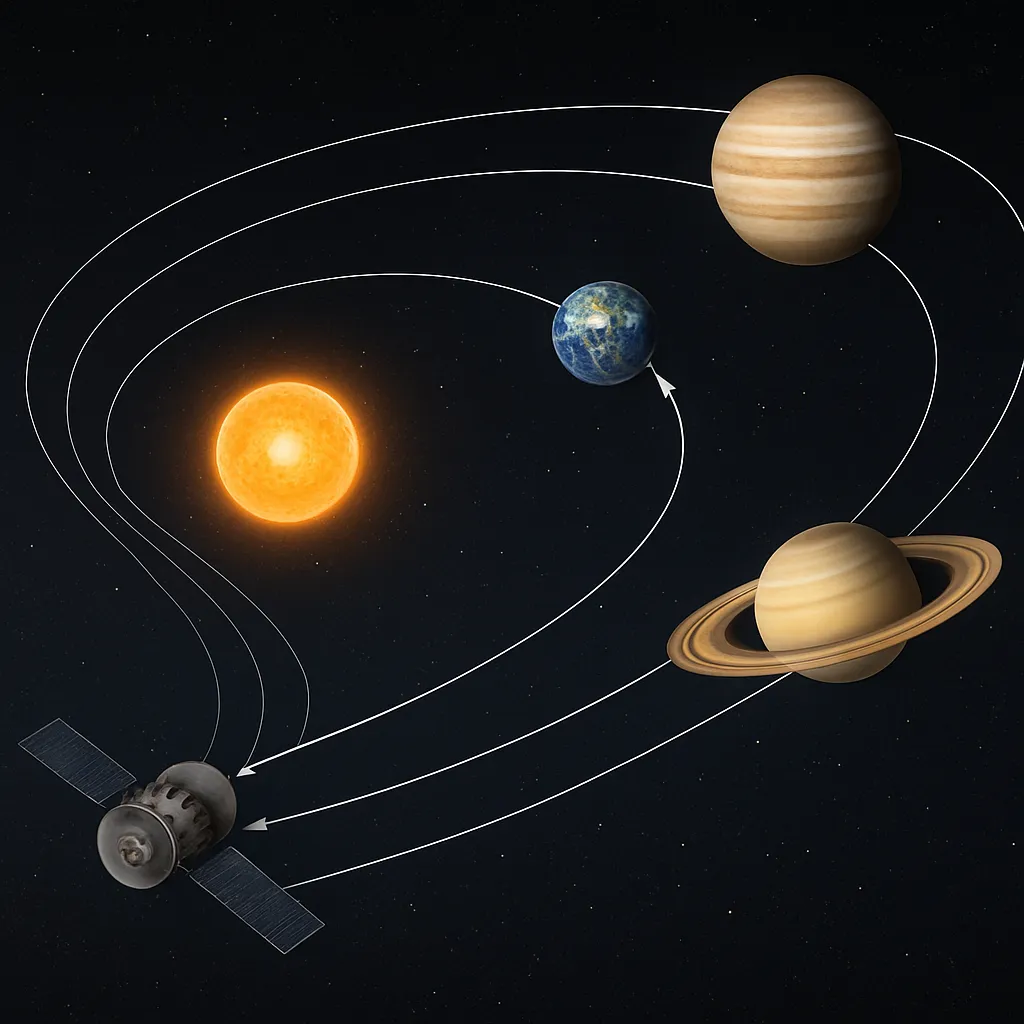
Gravity assists, often referred to as gravitational slingshots, enable spacecraft to gain or lose velocity without burning extra fuel, relying instead on the natural motion of planetary bodies. By carefully planning a close approach, mission designers can transfer momentum between a planet and a spacecraft, effectively accelerating or decelerating the vehicle. This ingenious technique underlies many of humanity’s most ambitious ventures into the solar system, turning what would otherwise be impossible journeys into feasible expeditions.
Fundamental Principles of Gravity Assists
At its core, a gravity assist maneuver exploits the relative motion between a planet and a spacecraft. When a spacecraft approaches a planet, it falls into the planet’s gravitational well, gaining speed as it draws nearer. If it passes behind the planet (relative to the planet’s orbital path around the Sun), it can leave with a greater heliocentric velocity than it arrived with—essentially stealing a tiny fraction of the planet’s orbital energy.
This process follows the laws of orbital mechanics, in particular the conservation of energy and momentum. In a reference frame centered on the planet, the spacecraft’s speed remains constant (neglecting atmospheric drag and other perturbations), but its direction changes. When transformed back into a Sun-centered frame, this change in direction translates into a net boost in speed if the timing and geometry are correct.
Key parameters include the approach trajectory’s periapsis distance (the closest point to the planet), the planet’s own orbital velocity, and the angle of deflection. A deeper plunge into the gravitational field yields a larger deflection angle but poses greater navigational risks. Mission planners must strike a balance between maximizing the energy boost and ensuring the spacecraft avoids the planet’s atmosphere or radiation belts.
Designing Optimal Trajectories
Crafting a flight path that incorporates gravity assists is a complex dance of celestial mechanics. Engineers begin by selecting candidate planets whose orbital positions align with mission goals. For missions to the outer solar system, common choices include Venus, Earth, Mars, and the gas giants, each offering unique advantages in terms of orbital velocity and gravity well depth.
Advanced simulations solve the patched-conic approximation, breaking the journey into segments where each planetary encounter is treated separately. By optimizing these segments together, mission designers determine the ideal sequence of flybys. For example, to reach Saturn efficiently, a spacecraft might first swing by Venus to pick up speed inward, then Earth or Mars for additional boosts outward, before heading to Jupiter and finally Saturn.
Beyond initial planning, course correction maneuvers are critical. Small thruster burns adjust the spacecraft’s path by mere fractions of a degree, setting up precise flybys months or years in advance. Even a millimeter-per-second change can translate into thousands of kilometers’ difference at the point of rendezvous, making mid-course navigation one of the most challenging aspects of long-duration space missions.
Landmark Missions Featuring Gravity Assists
Several iconic missions have relied on gravity assists to push the boundaries of exploration:
- Voyager 1 and 2 used a rare alignment of the outer planets in the late 1970s, performing successive flybys of Jupiter and Saturn (and for Voyager 2, also Uranus and Neptune), gaining the speed needed to escape the solar system.
- Galileo looped back to Earth twice after launch, each flyby boosting its speed and enabling a successful insertion into Jupiter orbit in 1995.
- Cassini performed two Venus flybys, one Earth encounter, and a Jupiter assist, gathering vital data on each planet en route to its tour of the Saturnian system.
- Messenger navigated multiple Venus and Mercury assist passes to gradually tighten its orbit around Mercury, overcoming the Sun’s strong gravitational pull.
In each case, the cumulative effect of carefully timed assists allowed missions to carry heavier scientific payloads and extend their operational lifetimes beyond what purely chemical propulsion would permit.
Future Prospects and Emerging Techniques
Looking ahead, gravity assist remains a cornerstone of mission design. Proposals for missions to the outermost reaches of the solar system and even interstellar precursors rely on flybys of Jupiter, Saturn, or potentially yet-to-be-discovered dwarf planets. As launch costs fall and propulsion technology advances, planners explore creative combinations of solar sails or electric propulsion with classic gravity assists for unprecedented speed gains.
Another frontier involves aerogravity assists, where a spacecraft dips into a planet’s upper atmosphere to enhance the maneuver. By harnessing both aerodynamic lift and gravitational pull, spacecraft could achieve greater trajectory bends while conserving onboard propellant—a method studied for potential missions to Titan or Venus.
On the simulation side, improvements in high-performance computing and artificial intelligence enable automated trajectory optimization, exploring millions of flyby combinations to find routes that minimize time, risk, or fuel consumption. These tools will be vital for missions targeting small bodies like asteroids or comet nuclei, where traditional gravity assists may be supplemented by low-thrust spirals around the Sun.
In the decades to come, gravity assists will continue to be an elegant solution to the tyranny of distance in space. By weaving together the motions of heavenly bodies, human engineers have transformed planets into cosmic accelerators, unlocking pathways that stretch from the inner solar system to the interstellar void.