


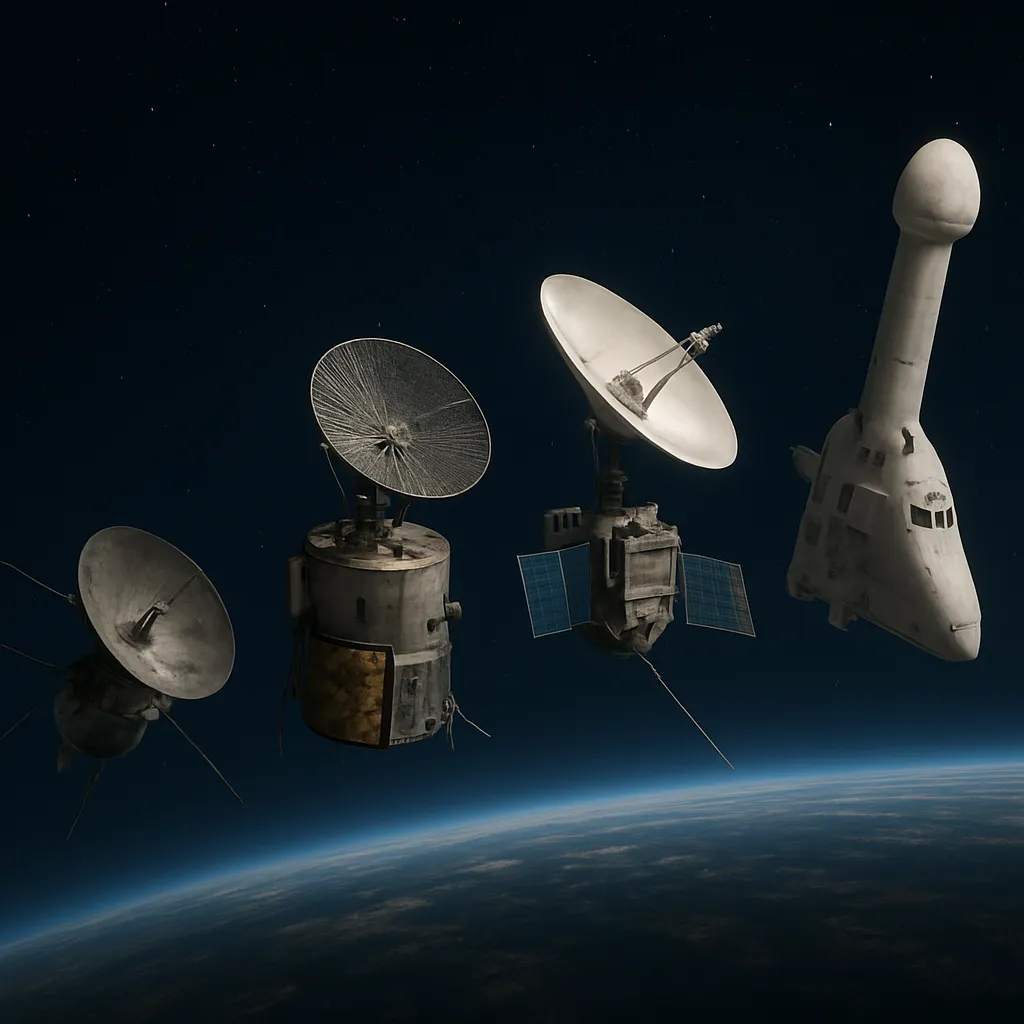
The exploration of space has been closely intertwined with the development of ever more sophisticated communication technologies. From the very first radio signals transmitted to orbiting satellites, to the promise of deep-space laser links and interplanetary networks, spacecraft communication has evolved into a complex web of systems designed to overcome the vast distances and harsh conditions of the cosmos. This article examines the key milestones, technological breakthroughs, and emerging trends that define the evolution of these vital systems.
Early Radio Beginnings
The inception of spacecraft communication can be traced back to simple radio transmitters and receivers. Early missions relied on low-frequency signals and relatively basic hardware to relay telemetry and voice messages. The Soviet Sputnik program and the United States’ Explorer missions of the late 1950s demonstrated that data could be sent from an object in orbit back to Earth. These pioneering flights laid the groundwork for continuous command and control.
Basic Telemetry and Tracking
At the heart of early tracking systems was the transmission of sensor data known as telemetry. Instruments aboard the spacecraft measured parameters such as temperature, battery voltage, and cosmic radiation levels. This raw data was encoded into analog signals and broadcast to terrestrial receivers. Ground stations used directional antennas to capture these weak signals, often struggling with interference and limited range.
The Role of Ground Networks
During this era, the establishment of global tracking networks became essential. A handful of radio dishes in the Soviet Union and the United States evolved into more organized schemes. Early ground stations operated on bands like 136 MHz and 400 MHz, offering only modest data rates but sufficient for voice and basic scientific telemetry. Cooperation between multiple nations’ facilities set the stage for international collaboration in space exploration.
Advancements During the Space Race
As geopolitical competition intensified, so too did efforts to improve data throughput and link reliability. Innovations in modulation techniques, higher-frequency operation, and sophisticated error handling enabled spacecraft to transmit ever-greater volumes of scientific and engineering information.
Moving to Higher Frequencies
The shift from VHF to microwave frequencies dramatically enhanced available bandwidth. By operating in the S-band (2–4 GHz) and later in the Ka-band (26.5–40 GHz), missions achieved higher data rates and better resistance to ground-based interference. These bands, however, introduced new challenges such as atmospheric attenuation and the need for more precise pointing of spacecraft antennas.
Error Correction and Digital Modulation
Analog links gave way to digital schemes optimized for noisy channels. Forward error correction, convolutional coding, and Reed–Solomon codes became standard tools in the spacecraft communication toolbox. Engineers designed robust modulation formats like Phase-Shift Keying (PSK) and Quadrature Phase-Shift Keying (QPSK). Combined with powerful error detection routines, these techniques ensured that even faint signals from deep probes could be recovered with high integrity.
Deep Space Network and International Collaboration
One of the single greatest achievements in spacecraft communication infrastructure has been the formation of the Deep Space Network (DSN). Operated by NASA, the DSN consists of three complexes located in California (USA), Madrid (Spain), and Canberra (Australia). This triad ensures continuous coverage as Earth rotates, allowing communication with missions throughout the solar system.
Global Ground Station Alliances
- NASA’s Deep Space Network (DSN)
- ESA’s ESTRACK facilities in Europe
- JAXA’s Usuda Deep Space Center in Japan
- ISRO’s Indian Deep Space Network
These networks rely on large parabolic dishes, cryogenically cooled receivers, and state-of-the-art digital processors to maintain links with distant spacecraft. The coordination between agencies has fostered cost sharing and technical standards that benefit all participants.
Modern Onboard Architectures
Contemporary spacecraft integrate advanced communication subsystems that emphasize flexibility, efficiency, and resilience. Developments in hardware miniaturization and software-defined radios have produced transponders capable of supporting multiple bands and dynamic protocols.
Software-Defined Radios and Reconfigurability
Software-defined radios (SDRs) have revolutionized the way spacecraft handle communications. By using programmable field-programmable gate arrays (FPGAs) and digital signal processors (DSPs), modern transceivers can switch between frequency bands and modulation schemes through software updates. This adaptability extends mission lifespans by allowing systems to overcome unforeseen interference or to embrace new communication standards.
High-Gain and Phased Array Antennas
High-gain parabolic reflectors remain a staple for deep-space missions, providing narrow beams and high link budgets. In parallel, phased array antennas offer agile beam steering without mechanical gimbals. These flat-panel arrays can form multiple simultaneous beams, enabling a single spacecraft to communicate with different ground stations or relay satellites.
Optical and Laser Communication
Looking to the future, optical links promise data rates orders of magnitude higher than conventional radio systems. By employing coherent or pulse-based laser technology, missions can transmit large volumes of imagery, scientific readings, and telemetry at gigabit per second speeds.
Benefits and Challenges
- Minimal spectrum congestion compared to RF bands
- High directivity reduces interference and eavesdropping
- Atmospheric absorption and cloud cover pose significant hurdles
- Precision pointing and tracking requirements are exacting
Researchers are developing hybrid architectures that combine RF for robust, low-rate control links with high-speed laser channels for bulk data downlinks. Recent demonstrations in Earth orbit have confirmed the viability of space-to-ground and space-to-space optical communications.
Emerging Trends and Future Directions
The next frontier of spacecraft communication extends beyond mere point-to-point links. Visionaries are designing an interplanetary internet—an asynchronous, delay-tolerant network that can route data across multiple nodes, including satellites, planetary bases, and deep-space relays. Key enablers include:
- Delay Tolerant Networking (DTN) protocols
- Autonomous routing and dynamic link management
- Miniaturized relay satellites and CubeSat constellations
- Exploration of quantum communication for secure key distribution
These technologies aim to support human missions to Mars, scientific expeditions to the outer planets, and real-time collaboration between crews and mission control. The fusion of artificial intelligence with communication systems may allow spacecraft to negotiate bandwidth, prioritize critical data, and recover from failures without ground intervention.
Conclusion of Technological Trajectory
The evolution of spacecraft communication systems reflects humanity’s relentless drive to push boundaries. Each generation of technology has built upon the lessons of its predecessors, resulting in networks capable of spanning billions of kilometers. As we set our sights on distant worlds and permanent off-Earth outposts, continued innovation in RF, optical, and quantum domains will be indispensable for maintaining the vital link between explorers and their home planet.