
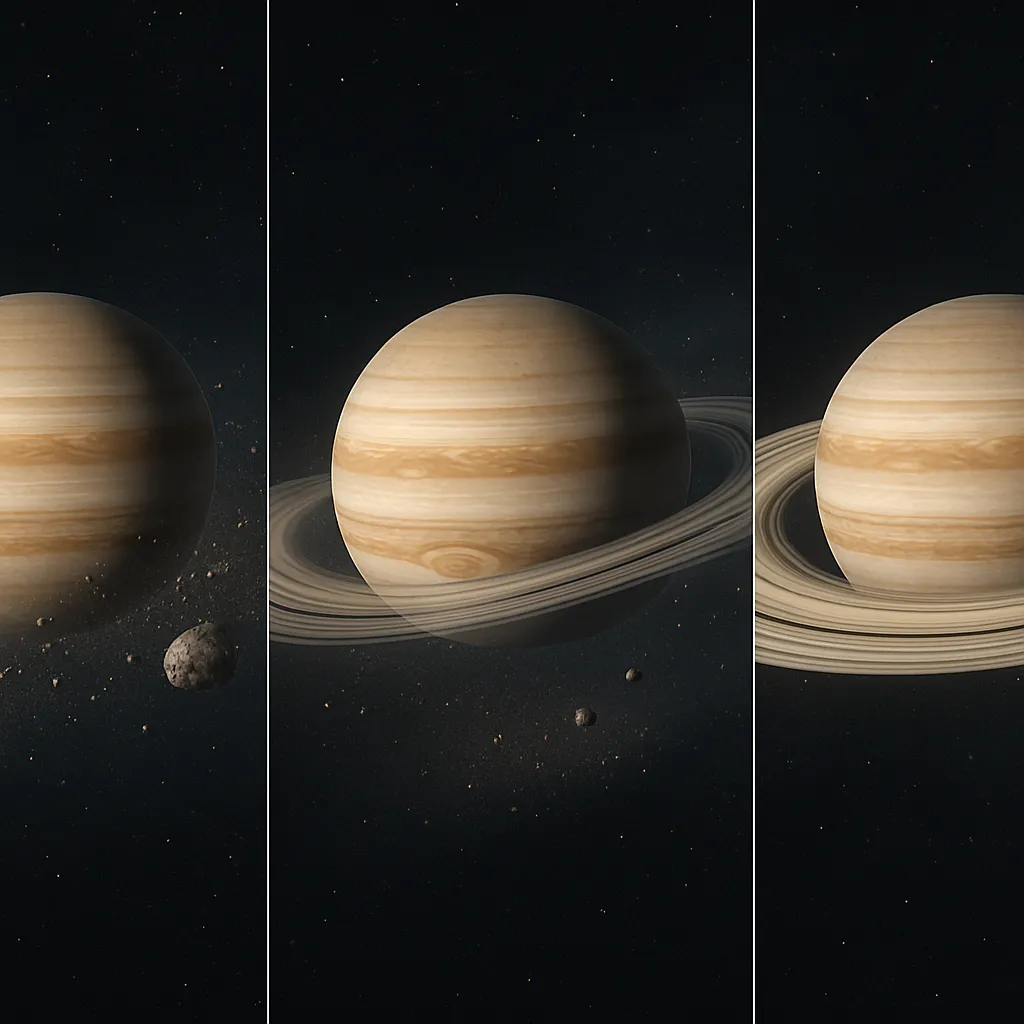
Planetary rings stand out as some of the most captivating features in our solar system. Surrounding the giant planets with their dazzling arrays of ice and dust, these rings offer insights into the interplay of gravity, collisions, and tidal forces. From the majestic rings of Saturn to the faint halos around the ice giants, each system records a unique chapter in planetary history.
Origins and Formation Mechanisms
One of the central questions in planetary science is how rings form around their host planets. Two primary scenarios have been proposed:
- Disruption of a satellite that strayed within the Roche limit of its planet
- Residual material left over from the protoplanetary disk that failed to coalesce into larger bodies
When a moon or small body ventures too close, the tidal forces can exceed its self-gravity, tearing it apart in a dramatic event. The fragments then spread along the original orbit, creating a disk of debris. Alternatively, during the planet’s formation, leftover particles may have remained in orbit, never accumulating into full-sized moons. Over millions of years, these grains can collide gently and settle into flattened, ring-like structures.
Composition and Structure of Ring Systems
Each planetary ring exhibits a unique signature based on its composition, density, and dynamic interactions. The most heavily studied example, Saturn’s rings, consists predominantly of water ice with traces of rock and dust. Other systems, such as those around Uranus and Neptune, contain darker, more carbon-rich material.
- Saturn: Bright, icy rings labeled A, B, and C with fine divisions like the Cassini Division
- Jupiter: Faint, dusty rings composed mostly of micrometer-sized grains
- Uranus and Neptune: Narrow, dark rings with clumps and arcs hinting at ongoing processes
Within these rings, density waves and bending waves propagate like ripples in a pond, driven by gravitational interactions with orbiting moons. Spiral density patterns, visible in high-resolution images, reveal the hand of resonance as moons periodically tug on ring particles.
Dynamic Processes and Evolution
Rings are not static features; they evolve on timescales ranging from days to millions of years. Several key processes shape their appearance and fate:
Resonances and Shepherd Moons
Certain tiny satellites, known as shepherd moons, orbit near ring edges. Their gravitational pulls confine ring particles, maintaining sharp boundaries and sculpting narrow ringlets. For example, the moons Prometheus and Pandora guard Saturn’s F ring. At specific orbital resonances, particles can either be trapped in stable configurations or ejected into new orbits, leading to gaps and density enhancements.
Collisions, Aggregation, and Fragmentation
In the dense regions of rings, frequent collisions between icy grains lead to energy dissipation, driving the disk toward a thin, flat shape. Some collisions are gentle enough to allow temporary accretion, forming transient clumps that may disperse under tidal shear. Violent impacts, however, can shatter larger aggregates, replenishing the population of fine dust.
Electrostatic and Non-Gravitational Effects
Micrometer-scale grains are influenced by sunlight and the planet’s magnetosphere. Photoelectron emission and plasma interactions can charge particles, causing them to levitate above the ring plane or migrate radially. These subtle forces become significant in tenuous rings like Jupiter’s gossamer rings, where non-gravitational effects rival gravitational ones.
Observational Insights and Spacecraft Contributions
Major breakthroughs in understanding ring dynamics have come from spacecraft missions and Earth-based telescopes. The Cassini mission, which orbited Saturn from 2004 to 2017, provided an unprecedented wealth of data:
- High-resolution imaging of intricate structures such as propeller-shaped gaps
- Gravity measurements revealing mass distribution within the rings
- Spectral analysis of ice purity and organic contaminants
Ground-based observatories and the Hubble Space Telescope continue to monitor changes in ring brightness and structure, while upcoming infrared and radio instruments aim to probe particle sizes and thermal properties with greater precision.
Long-Term Evolution and Fate
Planetary rings are, by nature, transient. Over cosmic timescales, they may coalesce into new moons, fall into the planet, or disperse into space. Key factors influencing their longevity include:
- Micrometeoroid bombardment that grinds down icy particles
- Viscous spreading caused by interparticle collisions
- Interactions with passing comets or asteroids that inject fresh material
Models suggest that Saturn’s dense B ring could persist for tens to hundreds of millions of years, while its outermost, less massive rings might dissipate more rapidly. The balance between loss mechanisms and replenishment events determines each system’s lifecycle.
Future Directions in Ring Research
As technology advances, researchers plan to deploy next-generation probes and adaptive optics systems to study ring phenomena at finer scales. Key objectives include:
- Mapping particle size distributions down to sub-millimeter scales
- Detecting transient clumps and understanding their stability
- Exploring the role of magnetic and electrostatic forces in shaping tenuous rings
Interdisciplinary studies, combining celestial mechanics, plasma physics, and materials science, promise to unlock new secrets. By unraveling ring evolution, scientists gain a deeper understanding of disk processes that also govern planet formation around young stars.