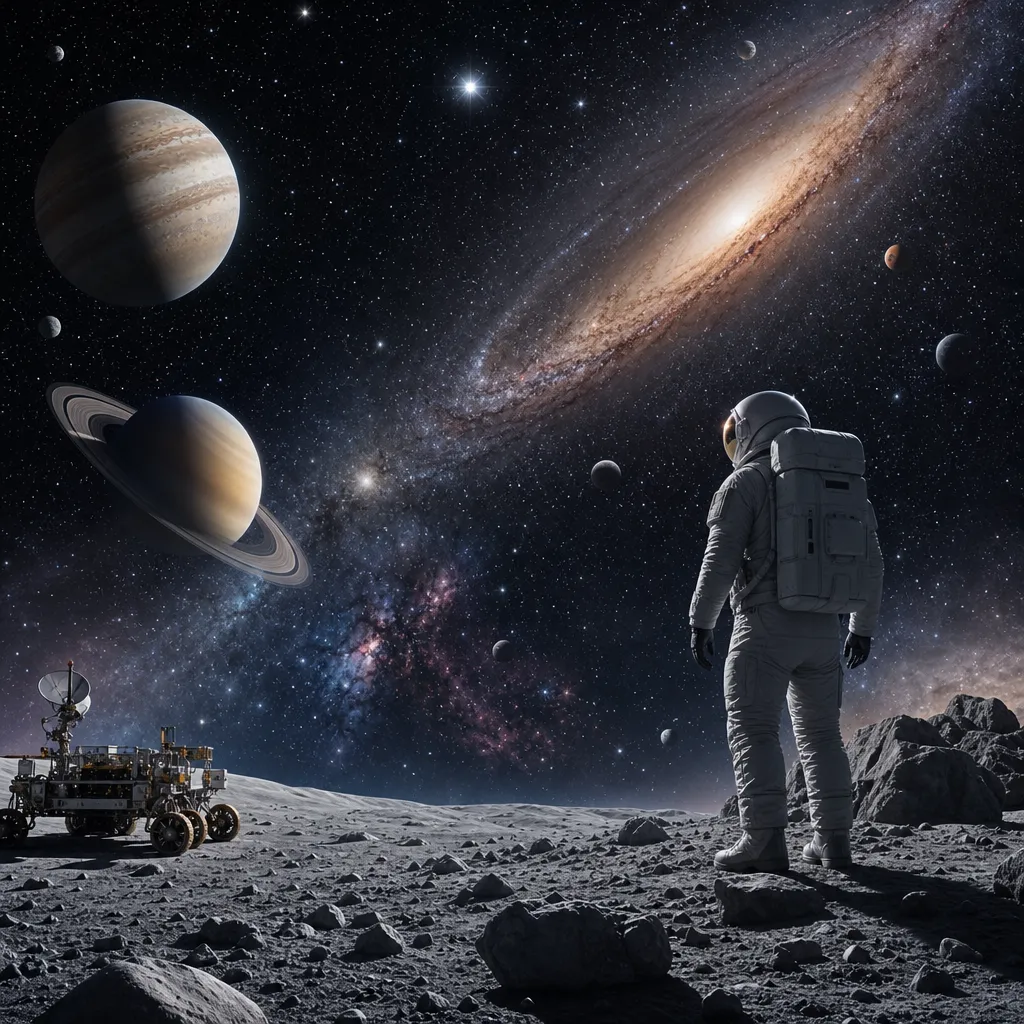
Space is the vast physical realm beyond Earth’s atmosphere, but in science it is more than “empty nothingness.” It contains matter, radiation, magnetic fields, and the structure of spacetime itself. Space begins gradually rather than at a perfectly sharp boundary, and on the largest scales it includes everything from the region around Earth to galaxies, intergalactic gas, and the expanding universe. Understanding what space is means combining astronomy, physics, and exploration to study both what fills it and the geometry in which cosmic events occur.
In everyday language, “space” often means the dark sky beyond our planet. In physics, it can mean the three-dimensional arena in which objects exist and move, while in modern relativity it is inseparable from time as part of spacetime. In practice, scientists study space as an environment: a near-vacuum shaped by gravity, light, particles, and cosmic history.
What scientists mean by space
Space is not a single thing with one simple definition. In astronomy and spaceflight, it usually means the region above Earth’s atmosphere where aircraft can no longer fly in the normal aerodynamic sense and where satellites and spacecraft operate. In physics, space is the extension in which distances and positions can be defined. In cosmology, space is the large-scale fabric that can expand, curve, and carry galaxies farther apart over time.
One common reference point is the Kármán line, often placed at 100 kilometers above sea level. It is a useful convention for spaceflight records, but it is not a hard physical wall. Earth’s atmosphere thins gradually, and traces of it extend much higher. Low Earth orbit still contains enough extremely thin gas to slow satellites over time.
So when people ask “What is space?” the most accurate answer is that it is a dynamic physical environment, mostly very empty by everyday standards, yet far from truly empty.
Is space empty?
Space is often described as a vacuum, and compared with Earth’s atmosphere it is. But it is not perfectly empty. Even the regions between planets contain sparse atoms, charged particles from the Sun, dust grains, and electromagnetic radiation. Between stars there is interstellar gas and dust. Between galaxies there is still thin matter and radiation, and on the largest scales the universe is filled with relic light from the Big Bang known as the cosmic microwave background.
Quantum physics adds another layer. In modern field theory, what appears to be empty space still has physical properties. Fields such as the electromagnetic field exist everywhere, and quantum fluctuations mean that “vacuum” does not mean complete nothingness in the philosophical sense.
This distinction matters because many important cosmic processes happen in extremely low-density environments. Stars form from thin interstellar clouds. Planetary atmospheres escape into space. Solar particles travel through interplanetary space and affect satellites, astronauts, and planetary magnetospheres.
| Region | What it contains | Why it matters |
|---|---|---|
| Near-Earth space | Very thin upper atmosphere, radiation belts, plasma, satellites, debris | Crucial for communications, navigation, human spaceflight, and space weather studies |
| Interplanetary space | Solar wind, magnetic fields, dust, small bodies, spacecraft | Links the Sun to planets and shapes the heliosphere |
| Interstellar space | Thin gas, dust, cosmic rays, magnetic fields | Raw material for star and planet formation |
| Intergalactic space | Extremely diffuse gas, radiation, dark matter’s gravitational influence | Important for understanding cosmic structure and evolution |
Space as an environment shaped by physics
The main forces and processes that shape space are gravity, electromagnetism, nuclear processes inside stars, and the expansion of the universe. Gravity gathers matter into planets, stars, galaxies, and clusters of galaxies. Electromagnetism governs light, magnetic fields, and the behavior of charged particles in plasmas, which are common in space. Nuclear fusion in stars produces energy and creates many of the chemical elements that later spread through space.
Space is also an environment of extremes. Temperatures can be misleading there because a near-vacuum does not transfer heat the way air does. A sunlit spacecraft can become very hot, while shaded surfaces become very cold. Radiation from the Sun and from more distant cosmic sources can damage electronics and living tissue. Micrometeoroids and orbital debris can strike at high speed.
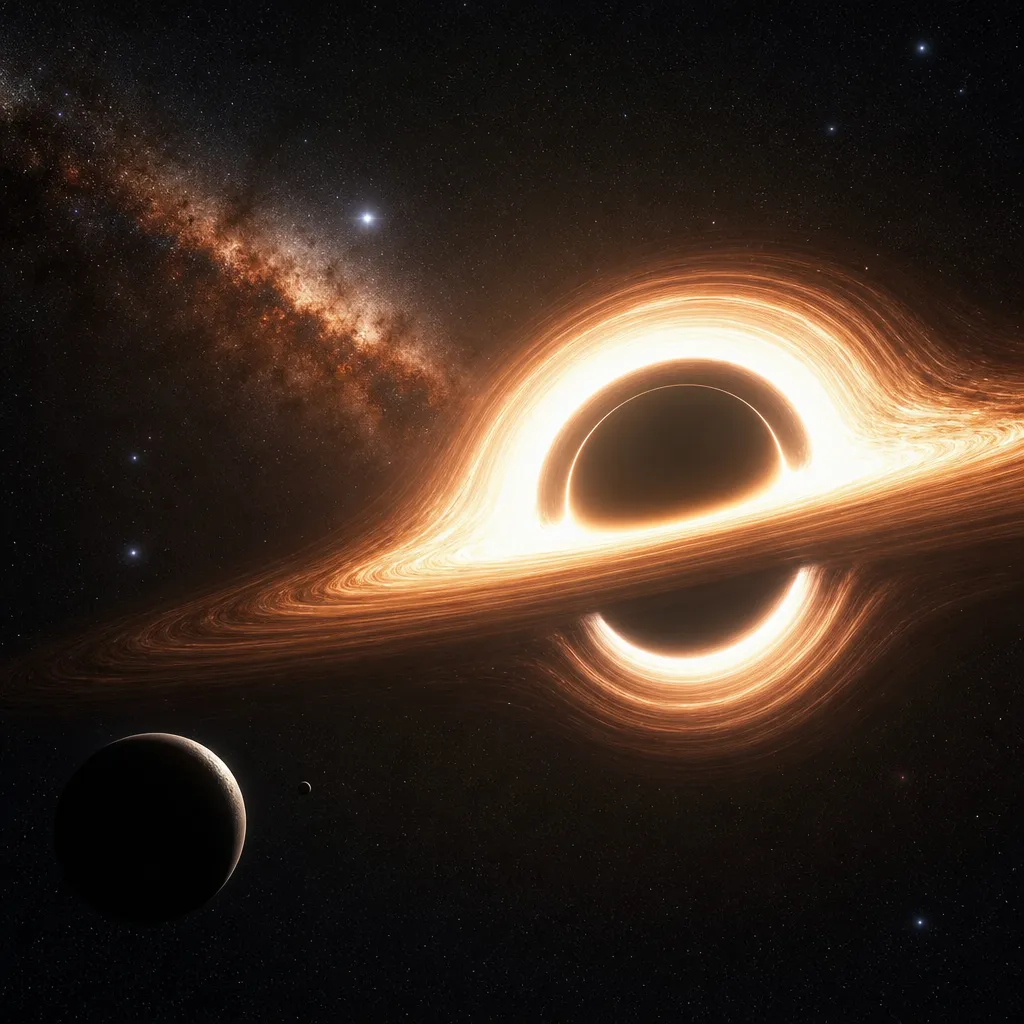
On the largest scales, general relativity describes gravity not simply as a force but as the curvature of spacetime caused by mass and energy. This idea explains the motion of planets, the bending of light near massive objects, black holes, and the expansion history of the universe. It is one of the reasons space is understood not only as emptiness but as a physical structure with measurable properties.
Where space begins and what lies beyond Earth
Earth does not end abruptly at the top of the blue sky. Its atmosphere fades through layers, from the troposphere where weather happens up through the stratosphere, mesosphere, thermosphere, and exosphere. Above these regions, particles become so sparse that collisions are rare and orbital motion becomes more important than normal atmospheric flight.
Beyond Earth is cislunar space, the region stretching outward toward the Moon. Beyond that lies the broader Solar System: planets, moons, asteroids, comets, dwarf planets, and the stream of particles flowing from the Sun. The Sun’s influence extends far beyond Pluto in a bubble called the heliosphere. At its outer boundary, the solar wind gives way to the surrounding interstellar medium.
Past our Solar System is the Milky Way galaxy, one among hundreds of billions of galaxies in the observable universe. Space therefore exists on many scales, from a few hundred kilometers above Earth to cosmic distances so large that light takes billions of years to cross them.
How we know what space is like
Scientists know about space through a combination of direct measurement, remote observation, laboratory physics, and computer modeling. Different methods reveal different parts of the picture.
Telescopes detect light and other electromagnetic radiation across the spectrum, from radio waves to gamma rays. Spectroscopy shows what distant objects are made of, how hot they are, how fast they are moving, and sometimes what magnetic fields affect them. Spacecraft carry instruments that directly sample particles, fields, dust, and radiation in space environments.
Satellites orbiting Earth measure the upper atmosphere, plasma environment, and radiation belts. Planetary probes study conditions around other worlds. Missions such as the Voyager spacecraft have sampled the outer heliosphere and provided evidence that they crossed into interstellar space. Astronauts and robotic landers add direct observations from the Moon and other destinations.
Scientists also use basic physics tested on Earth. The behavior of gases, plasmas, radiation, and gravity can be modeled mathematically, then checked against observations. When several independent methods agree, confidence increases. Where data are incomplete, conclusions remain provisional.
| Method | What it measures | What it tells us about space |
|---|---|---|
| Optical and radio telescopes | Light from stars, galaxies, gas, and dust | Structure, composition, motion, and history of cosmic objects |
| Spectroscopy | Wavelength patterns in light | Chemical elements, temperatures, velocities, and physical conditions |
| Spacecraft instruments | Particles, magnetic fields, dust, radiation | Direct sampling of the space environment |
| Gravity measurements | Orbital motion and mass effects | Mass distribution, planetary structure, dark matter evidence |
| Theoretical models and simulations | Predicted behavior under known physics | How space environments evolve when direct observation is limited |
Why space matters
Space matters scientifically because it is the setting in which the universe evolves. By studying it, researchers learn how stars form, how planets emerge, how galaxies change, and how the cosmos itself has expanded over time. Space also preserves evidence of origins. Meteorites, lunar samples, and primitive asteroids contain clues to the early Solar System.
Space matters practically as well. Satellites in near-Earth space support navigation, communications, weather forecasting, climate monitoring, disaster response, and scientific observation. Space weather can disrupt power systems, aviation, and space infrastructure. The behavior of the upper atmosphere affects orbital drag and satellite lifetimes.
For human exploration, space is both an opportunity and a hazard. Microgravity changes the human body. Radiation exposure remains a major challenge for long missions. Engineers must design spacecraft that can operate in vacuum, manage heat without air, and survive energetic particles and impacts.
Space, spacetime, and the expanding universe
Modern cosmology goes beyond the idea of space as a fixed empty stage. Observations show that the universe is expanding, meaning that on large scales the distance between galaxies tends to increase over time. This is not simply galaxies moving through static emptiness; rather, the large-scale geometry of space itself evolves.
Evidence for expansion comes from the redshift of distant galaxies and from the cosmic microwave background. General relativity provides the framework used to describe this behavior. According to current cosmology, ordinary matter is only part of the universe’s total contents. Dark matter is inferred from gravitational effects, and dark energy is inferred from the observed accelerated expansion of the universe.
These are well-supported scientific ideas in the sense that multiple lines of evidence point to them. However, the underlying nature of dark matter and dark energy remains unknown. Scientists can describe their effects much better than their fundamental identity.
What remains uncertain
Some aspects of space are well established. Space is a low-density physical environment. Spacetime can curve. The universe expands. Interplanetary and interstellar space contain gas, dust, radiation, and magnetic fields. Yet major questions remain open.
Physics does not yet have a complete theory that unifies general relativity with quantum mechanics. Researchers do not know what happened in the very earliest moments of the universe with full certainty. Inflation is a leading explanation for several observed features of the cosmos, but details remain under investigation. The true nature of dark matter and dark energy is still unresolved.
Even closer to home, there are open questions about the detailed behavior of the heliosphere, how planetary atmospheres evolve into space, how often extreme space weather events occur, and how best to manage the growing problem of orbital debris. Space is therefore not just a destination; it is an active field of research with both mature knowledge and genuine uncertainty.
FAQ
Does space have a clear boundary above Earth?
Not in a strict physical sense. Earth’s atmosphere becomes thinner gradually, so there is no single natural edge. The Kármán line is a widely used convention, not an abrupt wall.
Is space completely empty?
No. It is extremely sparse compared with Earth’s atmosphere, but it still contains particles, dust, radiation, magnetic fields, and quantum fields.
Why is space dark if the universe contains so many stars?
The night sky is dark mainly because the universe has a finite age and is expanding. Light from many distant regions has not had enough time to reach us, and expansion also stretches light to longer wavelengths.
How do scientists measure conditions in space?
They use telescopes, spectroscopy, radar, satellites, planetary probes, and direct particle and field detectors on spacecraft. Computer models help interpret data where direct sampling is limited.
Is outer space cold?
Space is often described as cold, but temperature in a vacuum is more complicated than in air. Objects in space gain and lose heat mainly through radiation, so sunlit and shaded surfaces can have very different temperatures.
Why does near-Earth space matter in everyday life?
It is where many satellites orbit. These systems support navigation, communications, weather monitoring, Earth observation, and parts of the global economy.
Can humans travel beyond the Solar System?
Not with current crewed technology. Robotic spacecraft have reached interstellar space after leaving the heliosphere, but human interstellar travel remains far beyond present capabilities.
What is the biggest unknown about space?
There is no single biggest unknown, but major open questions include the nature of dark matter, the nature of dark energy, and how gravity behaves at the quantum level.
Sources
- NASA Solar System Exploration
- European Space Agency, Space Environment and Space Weather information
- National Aeronautics and Space Administration, Hubble and cosmology educational resources