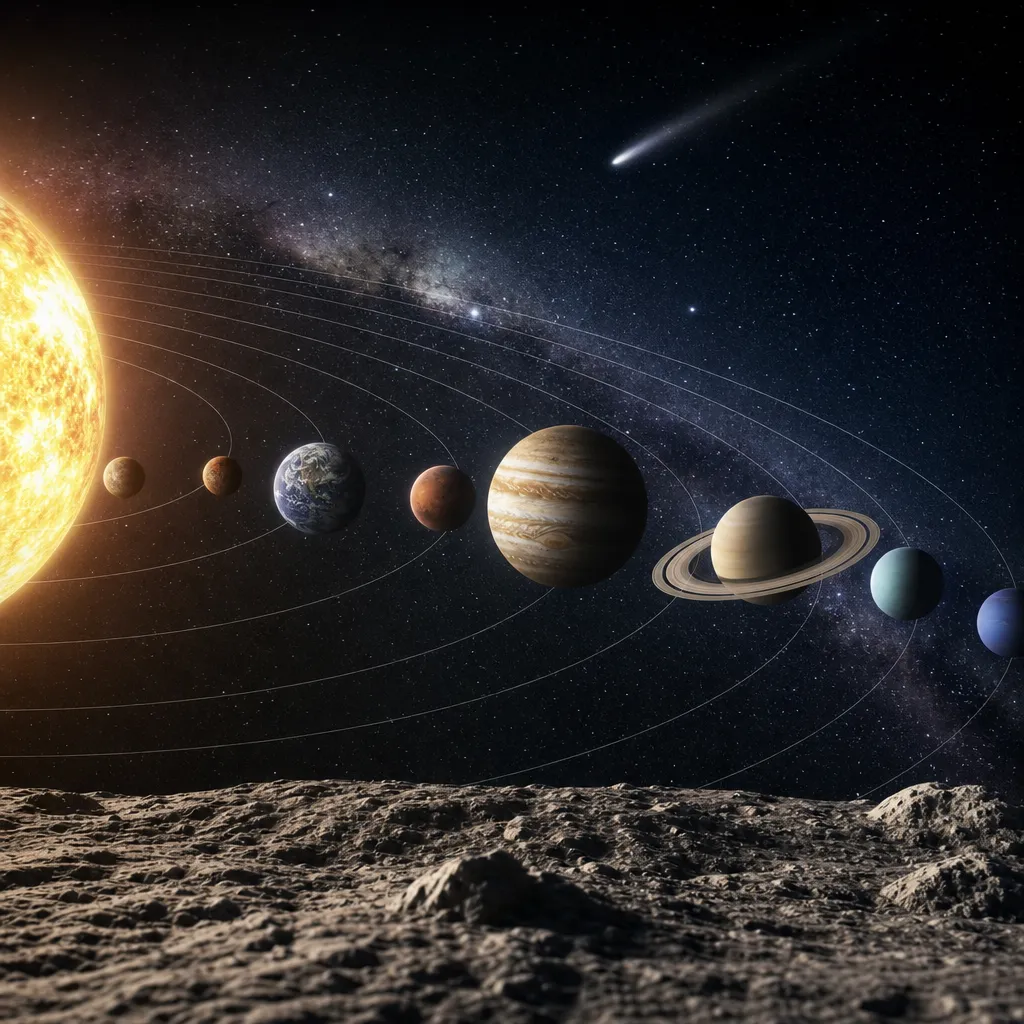
The Solar System is the planetary system centered on the Sun, a middle-aged star whose gravity holds together planets, dwarf planets, moons, asteroids, comets, dust, and gas. It formed about 4.6 billion years ago from a collapsing cloud of gas and dust, and its present structure preserves a record of that early history. Studying it helps scientists understand how planets form, why Earth became habitable, how planetary climates evolve, and how common similar systems may be elsewhere in the galaxy. It is also the only planetary system humans can explore directly with spacecraft, samples, and in the case of the Moon, human missions.
Far from being a simple lineup of worlds, the Solar System is a dynamic environment shaped by gravity, radiation, magnetic fields, collisions, and the solar wind. The inner region contains small rocky planets, while the outer region is dominated by giant planets and vast populations of icy bodies. Many details are well established through observation and measurement, but important questions remain open, including how giant planets migrated early in Solar System history and how water and organic material were distributed to young worlds.
What the Solar System Includes
The Sun contains almost all of the Solar System’s mass and is the source of nearly all its light and heat. Orbiting it are eight recognized planets: Mercury, Venus, Earth, and Mars in the inner Solar System, followed by Jupiter, Saturn, Uranus, and Neptune in the outer Solar System. Between Mars and Jupiter lies the main asteroid belt, while beyond Neptune are icy populations including the Kuiper Belt, where Pluto and other dwarf planets reside.
The Solar System also includes moons, planetary rings, comets, meteoroids, interplanetary dust, and the extended heliosphere, a vast bubble formed by the solar wind pushing outward into interstellar space. Some objects follow nearly circular orbits close to the plane in which the planets move, while others, especially many comets, travel on elongated and tilted paths.
| Region or Class | What It Contains | Why It Matters |
|---|---|---|
| Sun | Star, source of gravity, light, heat, and solar wind | Controls the system’s dynamics and space environment |
| Inner planets | Rocky worlds with solid surfaces | Key to understanding terrestrial planet formation and habitability |
| Asteroid belt | Rocky and metallic bodies, including Ceres | Preserves primitive material from early Solar System history |
| Outer planets | Gas giants and ice giants with complex atmospheres and ring systems | Shaped the system’s architecture and host many diverse moons |
| Kuiper Belt and beyond | Icy dwarf planets, comets, and small bodies | Provides clues to the outer Solar System’s formation and evolution |
How the Solar System Formed
The leading scientific model is the solar nebula theory. In this picture, a cold molecular cloud collapsed under gravity, possibly triggered by a nearby disturbance such as a shock wave from stellar activity. As the cloud contracted, it spun faster and flattened into a rotating disk. Most material fell toward the center and formed the Sun, while the remaining gas and dust in the disk began to stick together.
Small grains collided and formed larger aggregates. Over time these built up into kilometer-scale planetesimals, which then merged into protoplanets through repeated impacts and gravitational attraction. Closer to the Sun, temperatures were too high for volatile compounds such as water ice to remain stable, so rocky planets formed there. Farther out, ices could survive, allowing giant planets to build large cores and capture thick envelopes of gas, especially Jupiter and Saturn.
This broad framework is strongly supported, but not every detail is settled. Scientists still debate exactly how quickly giant planets formed, how much they migrated from their birthplaces, and how strongly early instabilities rearranged smaller bodies. These questions matter because planetary migration affects asteroid populations, impact histories, and the delivery of water and organics to inner planets.
The Main Families of Worlds
The four inner planets are called terrestrial planets because they are primarily rocky. Mercury is small and heavily cratered, Venus has a dense carbon-dioxide atmosphere and extreme surface heat, Earth has liquid surface water and active plate tectonics, and Mars preserves evidence of a wetter past.
Jupiter and Saturn are often called gas giants. They are dominated by hydrogen and helium, though they likely contain deeper cores and complex internal layers. Uranus and Neptune are usually described as ice giants because a larger fraction of their interiors consists of heavier materials such as water, ammonia, and methane in high-pressure forms.
Moons are a major part of the Solar System’s diversity. Some, like Earth’s Moon, are large enough to be geologically important worlds in their own right. Others, such as Europa, Enceladus, and Titan, are central to modern astrobiology because they may contain environments where chemistry relevant to life can occur.
Why Orbits, Gravity, and Motion Matter
Gravity is the basic organizing force of the Solar System. Every planet follows an orbit around the Sun because its forward motion and the Sun’s gravitational pull continually balance into curved paths. Most planets orbit in the same direction and roughly the same plane because they formed from the same rotating disk.
But the Solar System is not static. Planets tug on one another, moons interact with their parent planets, and resonances can stabilize or destabilize orbits over long timescales. Neptune’s gravitational influence helps structure parts of the Kuiper Belt. Jupiter strongly affects asteroid paths and can redirect comets inward. Tidal forces can heat moons internally, as seen dramatically at Jupiter’s moon Io and likely in subsurface oceans on Europa and Enceladus.
These orbital relationships are not just mathematical details. They help explain why some regions are crowded with objects, why others are depleted, and why impacts occur. They also allow scientists to reconstruct past events by tracing how bodies could have moved over billions of years.
| Physical Process | What It Does | Example in the Solar System |
|---|---|---|
| Gravity | Keeps planets and smaller bodies in orbit | Earth orbiting the Sun |
| Orbital resonance | Creates repeating gravitational interactions | Some moons and Kuiper Belt objects in stable orbital patterns |
| Tidal heating | Warms interiors through flexing | Io’s volcanism; suspected oceans in Europa and Enceladus |
| Solar radiation | Heats surfaces and atmospheres; drives comet activity | Comet tails forming near the Sun |
| Magnetic fields and solar wind | Shape space weather and planetary magnetospheres | Auroras at Earth and Jupiter |
Small Bodies: Asteroids, Comets, and Dwarf Planets
Small bodies are essential to understanding Solar System history because many are leftovers from planet formation. Asteroids are mostly rocky or metallic objects, with many concentrated in the main belt between Mars and Jupiter. Some are primitive and rich in carbon-bearing material, while others appear to be fragments of larger bodies that partially melted or differentiated early on.
Comets are rich in ice and dust. When they approach the Sun, heating causes volatile material to sublimate, releasing gas and dust that form a glowing coma and tails. One tail is shaped largely by the solar wind and points away from the Sun; the dust tail tends to follow the comet’s orbit more closely.
Dwarf planets occupy an important category because they are large enough to become rounded by their own gravity but have not cleared their orbital neighborhoods. Pluto, Eris, Haumea, Makemake, and Ceres are recognized examples. Their geology and compositions show that “small” does not mean simple. Ceres has evidence of water-related processes, and Pluto, seen up close by NASA’s New Horizons mission, turned out to be geologically diverse.
How Scientists Know What We Know
Knowledge of the Solar System comes from many kinds of evidence. Ground-based and space-based telescopes measure brightness, spectra, positions, motions, and temperatures of planets and small bodies. Spectroscopy reveals atmospheric gases, surface minerals, ices, and organic compounds by analyzing how matter absorbs and emits light.
Spacecraft have transformed the field. Orbiters map surfaces, magnetic fields, atmospheres, and gravity. Landers and rovers directly study rocks, soil, chemistry, weather, and local geology. Flyby missions provide close observations of distant targets that would otherwise appear as unresolved points of light.
Scientists also use samples. Meteorites provide laboratory access to ancient Solar System material, though they must be interpreted carefully because they come from bodies with their own histories. Apollo lunar samples fundamentally changed understanding of the Moon’s origin and evolution. More recently, sample-return missions have expanded this approach by bringing back material from specific asteroids.
Computer simulations and laboratory experiments are equally important. Researchers model disk evolution, impacts, tides, orbital resonances, atmospheric escape, and interior chemistry. These models are constrained by observations. They are not direct proof by themselves, but they test whether proposed explanations can reproduce the Solar System we see.
Why the Solar System Matters
The Solar System is the benchmark for planetary science. Every exoplanet discovery is interpreted partly through comparison with the worlds around our own star. By studying the climates of Venus, Earth, and Mars together, scientists learn how atmospheres can diverge dramatically even among neighboring rocky planets.
It also provides insight into habitability. Earth is the only known world with life, but potential habitats may exist elsewhere in subsurface oceans or chemically active environments. Studying these places does not prove life exists there; rather, it helps define the conditions under which life might arise or survive.
The Solar System also matters practically. Solar activity affects satellites, communications, navigation, and astronaut safety. Near-Earth asteroids pose impact risk, which is low in everyday experience but important over long timescales. Tracking them is part of planetary defense, a field grounded in observation and orbital mechanics rather than speculation.
Major Discoveries from Space Exploration
Since the start of the space age, robotic exploration has revealed a far more active and varied Solar System than earlier generations imagined. Mariner, Viking, Galileo, Cassini-Huygens, Juno, New Horizons, Mars orbiters and rovers, and many other missions have mapped planets, entered atmospheres, landed on surfaces, and studied magnetic fields and chemistry in detail.
Key findings include evidence that Mars once had rivers, lakes, and a thicker atmosphere; the discovery of active plumes at Enceladus; the confirmation of complex organic chemistry at Titan; and recognition that giant planets are meteorologically dynamic worlds. Missions to asteroids and comets have shown that even small bodies can preserve intricate records of the Solar System’s formation.
Human exploration has so far reached only the Moon, but those missions demonstrated that direct fieldwork and returned samples can reshape science. Future missions to the Moon, Mars, icy moons, and primitive asteroids are expected to deepen this picture if they succeed.
What Remains Uncertain
Several major questions are still open. Scientists are still refining how and when the giant planets migrated, how much that migration reshaped the small-body populations, and how water reached Earth. There is strong evidence for water-rich materials in the early Solar System, but the exact balance of delivery pathways remains under study.
Another active area concerns potentially habitable environments beyond Earth. There is compelling evidence that some icy moons contain subsurface oceans, but whether those environments have all the ingredients and energy sources needed for life is not yet known. No confirmed evidence of life has been found elsewhere in the Solar System.
Even basic inventories remain incomplete. Many small distant bodies are still undiscovered, and the outermost structure of the Solar System is difficult to map. The idea of an additional large, distant planet has been proposed to explain some orbital patterns among remote objects, but this remains a hypothesis, not an established discovery.
Frequently Asked Questions
How old is the Solar System?
The best current estimate is about 4.6 billion years. This age comes mainly from radiometric dating of meteorites, which preserve some of the oldest known solid material formed in the Solar System.
How do scientists know how the Solar System formed?
They combine evidence from meteorites, telescope observations of young star systems with disks, spacecraft studies of planets and small bodies, and computer models of gravitational and chemical evolution. The broad disk-formation picture is strongly supported, while finer details remain under investigation.
Why are the inner planets rocky and the outer planets giant?
Temperature in the early solar disk played a major role. Close to the young Sun, only rock and metal could remain solid easily, while farther out, ices could also condense, allowing much larger planetary cores to form and, in some cases, capture large amounts of gas.
Can the Solar System be seen from Earth without a telescope?
Yes, several planets are visible to the naked eye, including Mercury, Venus, Mars, Jupiter, and Saturn. The Moon is, of course, easily visible, and comets occasionally become bright enough to see without optical aid.
Is Pluto still part of the Solar System?
Yes. Pluto is part of the Solar System, but it is classified as a dwarf planet rather than one of the eight planets. Its reclassification reflects how astronomers define planetary categories, not its importance.
Is there life elsewhere in the Solar System?
There is no confirmed evidence of life beyond Earth. Some worlds, especially Mars and icy moons such as Europa and Enceladus, are considered promising places to investigate past or present habitability.
What is the biggest danger in the Solar System to Earth?
In the long term, large asteroid or comet impacts are among the natural hazards scientists monitor carefully. In daily technological terms, solar storms can also be disruptive because they affect satellites, power systems, and communications.
What missions are studying the Solar System now?
Many are active, including missions at Mars, Jupiter, and the Moon, as well as solar observatories and asteroid investigations. The specific set changes over time as missions begin, extend, or end, but robotic exploration remains the main way scientists study the Solar System directly.
Sources
- NASA Solar System Exploration
- European Space Agency, Solar System and Exploration
- Encyclopaedia Britannica, Solar System