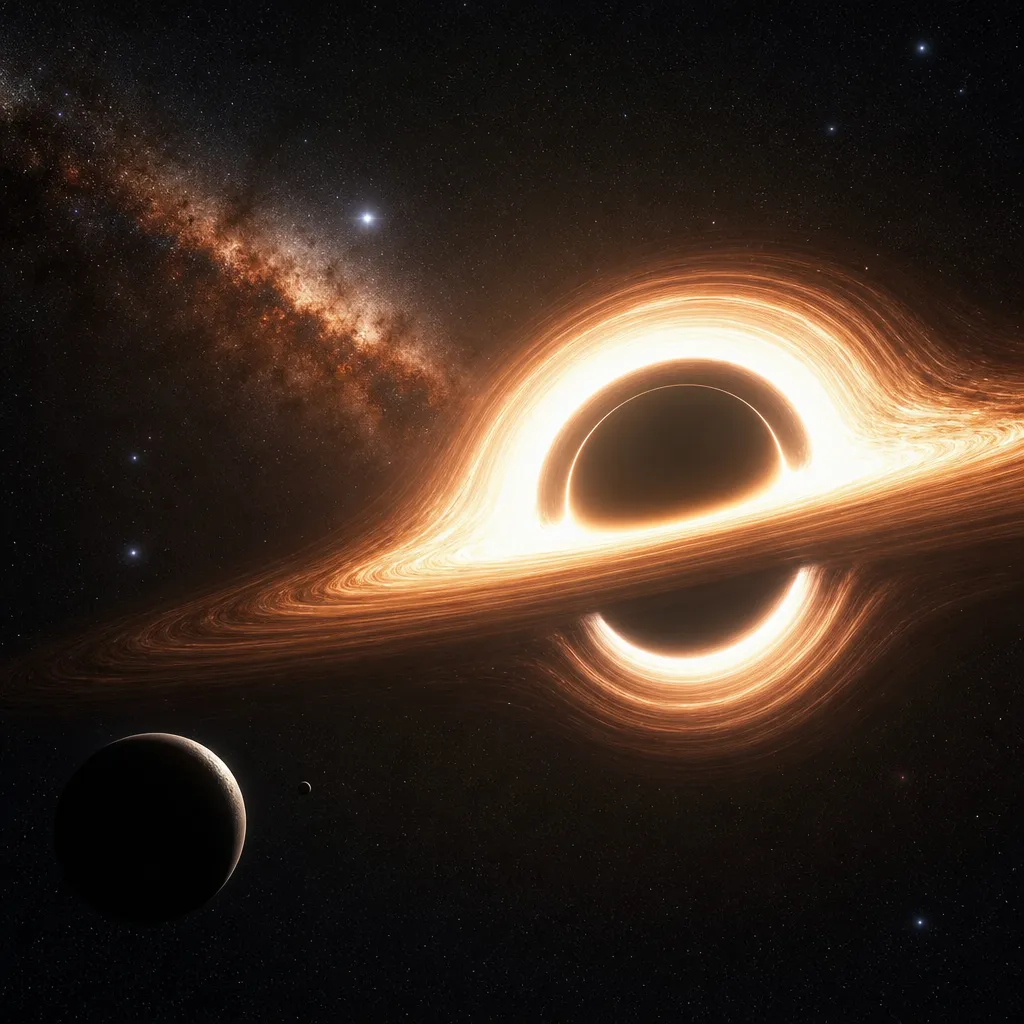

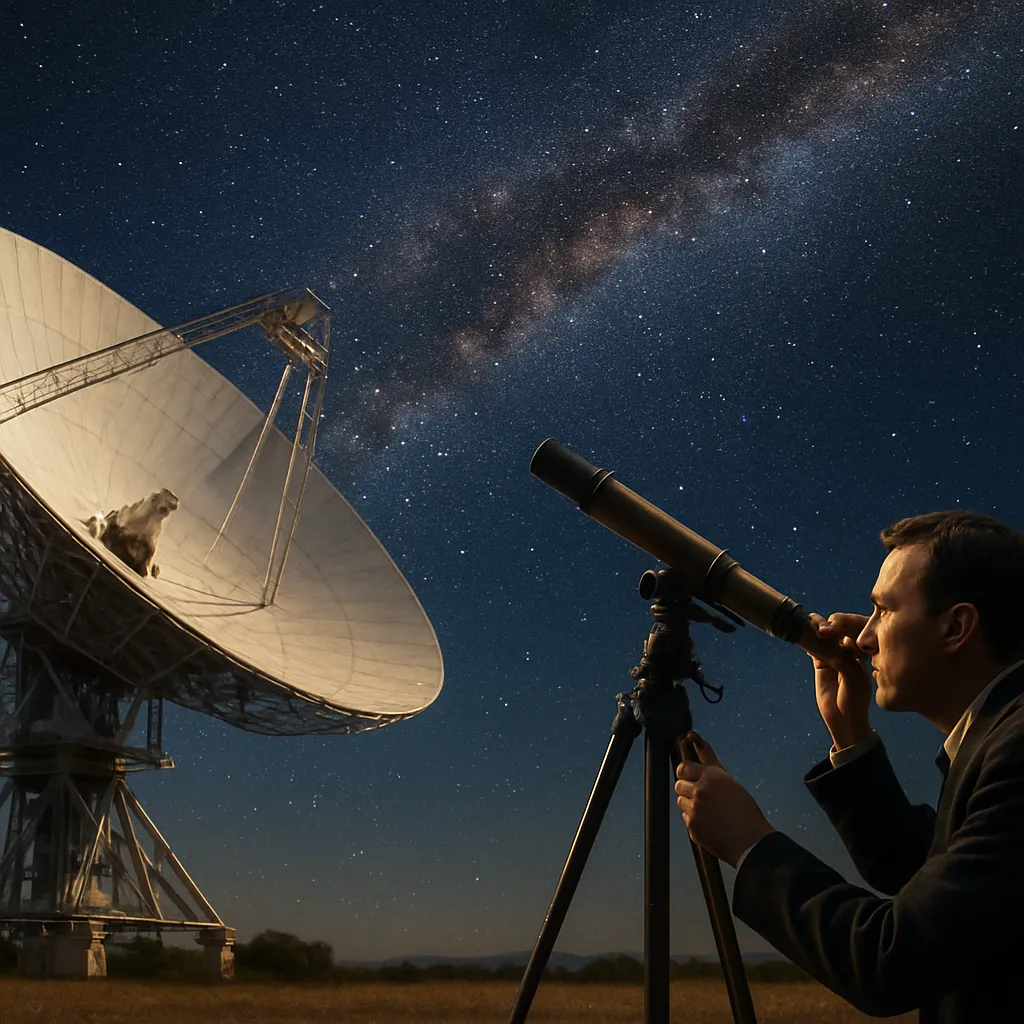
The Fascinating History of Radio Astronomy reveals how humanity learned to listen to the **universe** in wavelengths far beyond the visible spectrum. From the first serendipitous detections to today’s massive arrays, radio astronomy has unlocked secrets of **galaxies**, **pulsars**, and the **cosmic microwave background**. This exploration of invisible **signals** has transformed our understanding of **black holes**, **quasars**, and the very fabric of space-time.
The Beginnings of Radio Astronomy
Early Experiments and Serendipity
The origins of radio astronomy can be traced back to the 1930s when Karl Jansky, an engineer at Bell Telephone Laboratories, stumbled upon an unexplained hiss in his antenna. This hiss, later identified as coming from the center of our **Milky Way**, marked the first detection of cosmic radio waves. Around the same time, Grote Reber, an amateur radio enthusiast, built the first purpose-built radio telescope in his backyard. Reber’s dish, though primitive by modern standards, demonstrated that radio astronomy could open a new window on the **universe**.
- Karl Jansky’s rotating antenna at Holmdel, New Jersey
- Grote Reber’s 9-meter dish in Wheaton, Illinois
- Initial identification of galactic radio emission
Landmark Discoveries that Shaped the Field
Cosmic Microwave Background Radiation
In 1965, Arno Penzias and Robert Wilson detected an omnipresent background noise at 7.35 cm wavelength using a horn antenna. This **discovery** provided decisive evidence for the Big Bang theory, confirming predictions about the **cosmic microwave background**. Their work earned them the Nobel Prize and cemented radio astronomy’s role in cosmology.
Discovery of Pulsars
In 1967, Jocelyn Bell Burnell and Antony Hewish identified regular pulsing signals at 1.337 seconds intervals. These **pulsars**, rotating neutron stars emitting beams of radio waves, revealed the existence of ultra-dense stellar remnants. Pulsars have since become precise cosmic clocks, enabling tests of general relativity and probing the interstellar medium.
- Importance of **pulsars** in astrophysics
- Testing theories of gravity and space-time
- Mapping the structure of our galaxy
Technological Innovations and Methods
Development of Large Dishes and Arrays
The drive for greater sensitivity and resolution led to construction of colossal single dishes such as the Arecibo Observatory and the Effelsberg Telescope. Meanwhile, the concept of **interferometry**—combining signals from multiple antennas—ushered in radio interferometers like the Very Large Array (VLA) and the Atacama Large Millimeter/submillimeter Array (ALMA). These networks achieve effective apertures spanning kilometers, providing unprecedented detail in radio images.
Advances in Receiver and Computing Technology
Modern radio telescopes rely on low-noise receivers cooled to cryogenic temperatures, capturing faint cosmic signals with minimal interference. Digital backends and high-speed **computing** systems perform real-time correlation and imaging. Techniques such as aperture synthesis and bandwidth synthesis enable astronomers to reconstruct detailed maps of distant **galaxies** and molecular clouds.
- Cryogenic amplifiers for ultra-sensitive detection
- High-speed digital signal processing
- Adaptive algorithms to mitigate terrestrial interference
Major Radio Astronomy Facilities
Iconic Observatories Around the World
From the **Arecibo** dish in Puerto Rico to the giant FAST telescope in China, radio astronomy infrastructure spans the globe. The Square Kilometre Array (SKA), currently under construction in South Africa and Australia, will be the largest astronomical project ever built. With a combined collecting area of one million square meters, the SKA promises transformative sensitivity for studies of **dark energy**, galaxy evolution, and the search for extraterrestrial intelligence (SETI).
Space-Based Radio Telescopes
Space missions like the Russian Spektr-R (RadioAstron) and proposals for lunar far-side observatories aim to escape Earth’s ionosphere and radio-frequency interference. Operating in space offers pristine conditions to detect the faintest **cosmic signals**, from the dark ages of the early universe to explosive transient events such as fast radio bursts (FRBs).
- Advantages of space-based platforms
- Challenges in deployment and maintenance
- Future prospects for lunar and deep-space arrays
Revolutionary Discoveries and Ongoing Research
Fast Radio Bursts and Transients
Fast radio bursts (FRBs) are millisecond flashes of radio emission of unknown origin. First spotted in 2007, FRBs have since been detected in large numbers, some repeating on irregular schedules. Their study may unveil new astrophysical phenomena and test the physics of extreme environments.
Mapping Neutral Hydrogen
Neutral hydrogen emits a characteristic 21-centimeter line, enabling astronomers to map the distribution of matter across cosmic scales. Surveys such as the HI4PI and WALLABY project reveal the large-scale structure of the **universe**, track galaxy evolution, and probe the influence of **dark matter**.
- Role of 21-cm hydrogen line in cosmology
- Techniques for large-area sky surveys
- Insights into galaxy formation processes
Future Prospects and Emerging Frontiers
Next-Generation Radio Arrays
Projects like SKA Phase 2 and the Hydrogen Epoch of Reionization Array (HERA) aim to peer into the very first billion years after the Big Bang. By detecting signals from the cosmic dawn and epoch of reionization, radio astronomers hope to unravel how the first stars and galaxies formed.
Synergies with Multi-Messenger Astronomy
Radio observations complement gravitational-wave detectors, neutrino observatories, and optical telescopes. When combined, these **multi-messenger** approaches yield a holistic picture of cataclysmic events like neutron-star mergers, gamma-ray bursts, and black hole collisions.
- Coordinated observations across the electromagnetic spectrum
- Real-time alerts for transient phenomena
- Enhanced understanding of high-energy astrophysics
Impact on Science and Society
Radio astronomy’s breakthroughs have reshaped cosmology and fundamental physics. Precise timing of **pulsars** tests general relativity, while surveys of radio galaxies inform models of large-scale structure. Beyond science, radio observatories foster international collaboration, inspire technological spinoffs in communications, and ignite public fascination with the **cosmos**.