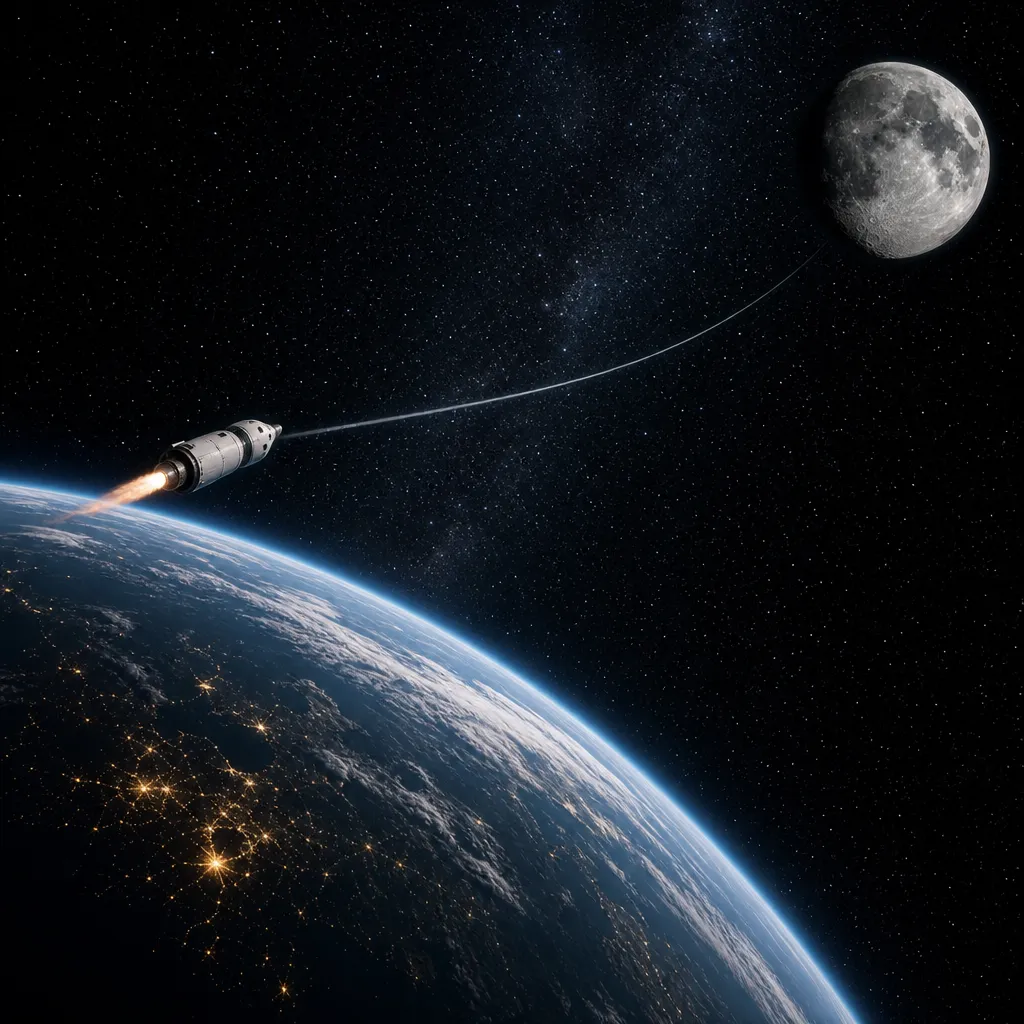
The Moon is, on average, about 384,400 kilometers (238,855 miles) from Earth. That is the center-to-center distance, but the real distance changes constantly because the Moon follows an elliptical orbit rather than a perfect circle. At its closest point, called perigee, it can be about 363,300 kilometers away, and at its farthest, called apogee, about 405,500 kilometers away. So the short answer is simple, but the scientifically accurate answer is that the Moon is always moving, and its distance is always changing.
This changing distance affects how large the Moon looks in the sky, how strong its tides are, and even how long radio signals take to travel between Earth and spacecraft near the Moon. It also matters for lunar missions, telescope measurements, and tests of gravity. Because the Moon is our nearest large neighbor in space, measuring its distance has been one of astronomy’s oldest and most important problems.
What does “distance to the Moon” really mean?
When scientists say the Moon is about 384,400 kilometers from Earth, they usually mean the average distance between Earth’s center and the Moon’s center. This is important because both Earth and the Moon are large bodies, not points in space. If you measured from Earth’s surface instead, the number would be smaller by roughly one Earth radius, depending on where an observer stands.
The Moon’s orbit is not a fixed circle. It is an ellipse shaped by Earth’s gravity, the Moon’s motion, and smaller gravitational effects from the Sun and planets. That means the Earth-Moon distance varies over the course of each orbit, which takes about 27.3 days relative to the stars.
This is why some full Moons appear slightly larger than others. Popularly, a close full Moon is often called a “supermoon,” though that is not a formal scientific term. The effect is real, but modest: the Moon appears somewhat larger and brighter near perigee than near apogee.
| Term | Meaning | Why it matters |
|---|---|---|
| Average distance | About 384,400 km from Earth’s center to the Moon’s center | Standard reference value used in astronomy and spaceflight |
| Perigee | Moon’s closest point to Earth in its orbit | Moon appears slightly larger; tides can be somewhat stronger |
| Apogee | Moon’s farthest point from Earth in its orbit | Moon appears slightly smaller; signal travel time is slightly longer |
| Center-to-center distance | Measurement between the centers of Earth and the Moon | Scientifically consistent way to compare orbital distances |
Why the distance changes
The Moon stays in orbit because Earth’s gravity pulls it inward while the Moon’s motion carries it forward. The result is a curved path around Earth. If gravity alone acted on a stationary Moon, it would fall straight down. If the Moon moved without gravity, it would fly off in a straight line. An orbit is the balance between those two behaviors.
But the Moon’s orbit is not simple. The Sun also exerts a strong gravitational pull on the Earth-Moon system, and that changes the shape and orientation of the Moon’s orbit over time. The orbit is tilted relative to Earth’s path around the Sun, and it slowly rotates. These effects create cycles in the Moon’s position, distance, and apparent motion across the sky.
Earth and the Moon also orbit a shared center of mass, called the barycenter, although that point lies inside Earth because Earth is much more massive. This shared motion slightly complicates precise calculations, especially when navigators send spacecraft to lunar orbit or plan landings.
So the Moon’s distance is not just changing from day to day. It also changes in ways that depend on longer orbital cycles. Modern celestial mechanics can model these variations extremely well, but they must include many subtle effects.
How ancient and early modern astronomers estimated it
Long before spacecraft, astronomers found clever ways to estimate how far away the Moon is. One classic method used geometry during lunar eclipses. By comparing the size of Earth’s shadow on the Moon with the Moon’s apparent size, early astronomers could infer a rough distance in units of Earth’s diameter.
Another method used parallax. If observers at different places on Earth measure the Moon’s position against background stars at the same time, the Moon appears in slightly different directions. That tiny shift reveals its distance. The closer an object is, the larger its parallax appears.
These methods were powerful, but limited by the precision of naked-eye or early telescopic measurements. Even so, they established a correct basic picture: the Moon is much farther away than clouds or planets seen in folklore, yet vastly closer than the stars.
By the 17th to 19th centuries, improved telescopes, better maps of Earth, and more accurate clocks made lunar distance measurements much more reliable. This was important not only for astronomy, but also for navigation and for understanding gravity after Isaac Newton’s work showed that the same force governing falling objects on Earth also governs the Moon’s orbit.
How scientists measure the Moon’s distance today
The most precise direct method is lunar laser ranging. During the Apollo missions, astronauts placed retroreflector arrays on the Moon. Soviet Lunokhod rovers also carried reflectors. A retroreflector is designed to bounce light back toward its source.
Scientists on Earth fire short laser pulses at these reflectors and measure how long the light takes to return. Because light travels at a known speed, the round-trip time gives an extraordinarily precise distance. The principle is simple: distance equals speed multiplied by time, divided by two for the outward and return journey.
This is not easy in practice. The returning signal is extremely faint because the beam spreads out, the Moon is far away, and Earth’s atmosphere can interfere. Yet the method works so well that the Earth-Moon distance can be measured to very high precision.
Other methods also contribute. Radar was used before and during the early space age by bouncing radio waves off the Moon. Spacecraft tracking provides another route: by carefully monitoring a spacecraft’s motion under gravity, engineers can infer the Moon’s position and Earth-Moon geometry. Astronomers also use long-established dynamical models that combine many kinds of observations.
| Method | How it works | Strengths | Limits |
|---|---|---|---|
| Parallax | Compare the Moon’s apparent position from different places on Earth | Works from Earth without spacecraft | Precision depends on observation quality |
| Lunar eclipse geometry | Use Earth’s shadow and the Moon’s apparent size | Historically important | Less precise than modern methods |
| Radar ranging | Bounce radio waves off the Moon and time the echo | Direct physical measurement | Less precise than laser ranging |
| Lunar laser ranging | Bounce laser pulses off reflectors on the Moon | Most precise direct method | Requires specialized equipment and clear conditions |
| Spacecraft tracking | Infer geometry from spacecraft motion and radio links | Essential for mission navigation | Depends on accurate models of gravity and motion |
The Moon is slowly moving away
One of the most important results from lunar laser ranging is that the Moon is gradually receding from Earth at a rate of about 3.8 centimeters per year. This is established science, supported by long-term measurements and by our understanding of tides.
The cause is tidal interaction. The Moon’s gravity raises tides on Earth, especially in the oceans. Because Earth rotates faster than the Moon orbits, the tidal bulge is carried slightly ahead of the Earth-Moon line. That offset bulge exerts a gravitational pull on the Moon, transferring angular momentum from Earth’s rotation to the Moon’s orbit.
The result is twofold: Earth’s rotation slows very slightly, making days longer over geologic time, and the Moon moves into a slightly higher orbit. This process has been operating for a very long time, though not at exactly the same rate throughout Earth’s history because ocean shapes, continents, and climate have changed.
This does not mean the Moon will drift away indefinitely in a simple linear way. The long-term evolution of the Earth-Moon system depends on changing tidal conditions and, on extremely long timescales, the future evolution of the Sun and Earth. But the present recession is well measured.
Why the Moon’s distance matters
The distance to the Moon is not a trivial number. It affects both everyday phenomena and major scientific work.
For people on Earth, it influences tides. The Moon’s changing distance alters tidal strength because gravity weakens with distance. The Sun also contributes, which is why spring tides and neap tides depend on the relative positions of Earth, Moon, and Sun.
For astronomy and physics, the Earth-Moon system is a natural laboratory. Precise distance measurements allow tests of aspects of Einstein’s general relativity and of how gravity behaves over time. So far, these tests support current gravitational theory very well.
For space exploration, the Moon’s distance determines flight time, energy requirements, communications delays, and navigation strategies. Apollo missions took several days to reach the Moon. Future robotic and human missions also depend on precise orbital knowledge for insertion into lunar orbit, landing, ascent, and return trajectories.
The distance also helps define the broader scale of the Solar System in education and public understanding. The Moon is close enough to visit with current technology, yet far enough that travel remains difficult, expensive, and dangerous if something goes wrong.
How long does it take to get there?
There is no single travel time to the Moon. It depends on the spacecraft, mission design, propulsion, and destination orbit or landing site.
Apollo missions took roughly three days to reach the Moon on fast translunar trajectories. Some robotic spacecraft have reached the Moon faster, while others have taken much longer by using fuel-saving paths. For example, missions may use low-energy transfer orbits that reduce fuel demands at the cost of time.
Communications are much faster than spacecraft. Light and radio signals take about 1.28 seconds to travel one way over the Moon’s average distance. Because of the orbital variation, the exact time changes slightly.
This delay is short enough for near-real-time conversation, but still noticeable. It is also important for teleoperation, navigation, and measuring the lunar distance itself through radio and laser timing.
What remains uncertain?
The Moon’s distance itself is not one of astronomy’s great unknowns. It is measured extremely well. The main uncertainties lie instead in the fine details of the Earth-Moon system and its history.
Scientists continue to refine models of the Moon’s orbit, interior, and rotation. The Moon does not move as a perfectly rigid body. It undergoes small oscillations called librations, and its internal structure affects how it responds to gravitational forces. Laser ranging helps constrain properties such as the size and state of the lunar core, but some details remain under study.
Another active area is Earth’s tidal history. We know tides drive lunar recession today, but reconstructing the rate over billions of years is harder because Earth’s oceans and continents have changed dramatically. Geological evidence, fossil growth patterns, and dynamical models all help, but the ancient rate was not constant.
There are also practical uncertainties for exploration. Precise surface navigation near the Moon still requires better local maps, improved tracking, and reliable reference frames, especially for future sustained human operations. These are engineering and geodetic challenges rather than uncertainty about the average Earth-Moon distance itself.
FAQ
Is the Moon always the same distance from Earth?
No. Its orbit is elliptical, so the distance changes continuously between perigee and apogee.
How far is the Moon in miles and kilometers?
The average distance is about 384,400 kilometers, or 238,855 miles, measured from Earth’s center to the Moon’s center.
How do scientists know the Moon’s distance so precisely?
The most precise method is lunar laser ranging, which measures the travel time of laser pulses reflected back from devices placed on the Moon by Apollo astronauts and Lunokhod rovers.
How long does light take to reach the Moon?
At the average distance, light takes about 1.28 seconds to travel one way from Earth to the Moon.
Is the Moon getting farther away?
Yes. Measurements show it is receding from Earth by about 3.8 centimeters per year because of tidal interactions between Earth and the Moon.
Does the Moon’s distance affect tides?
Yes. A closer Moon exerts a stronger gravitational influence, which can contribute to stronger tides, though the Sun’s gravity and the alignment of the Earth-Moon-Sun system also matter.
Could humans travel to the Moon again?
Yes. Human travel to the Moon is technologically achievable, as shown by Apollo, and current programs are designed to return astronauts there if mission plans and hardware succeed.
Sources
- NASA Solar System Exploration: Moon
- NASA Space Place: What Is the Moon?
- Jet Propulsion Laboratory: Lunar Laser Ranging