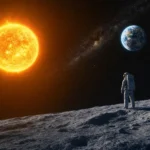
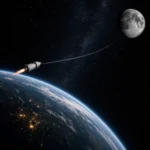
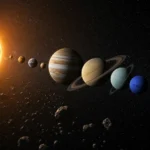
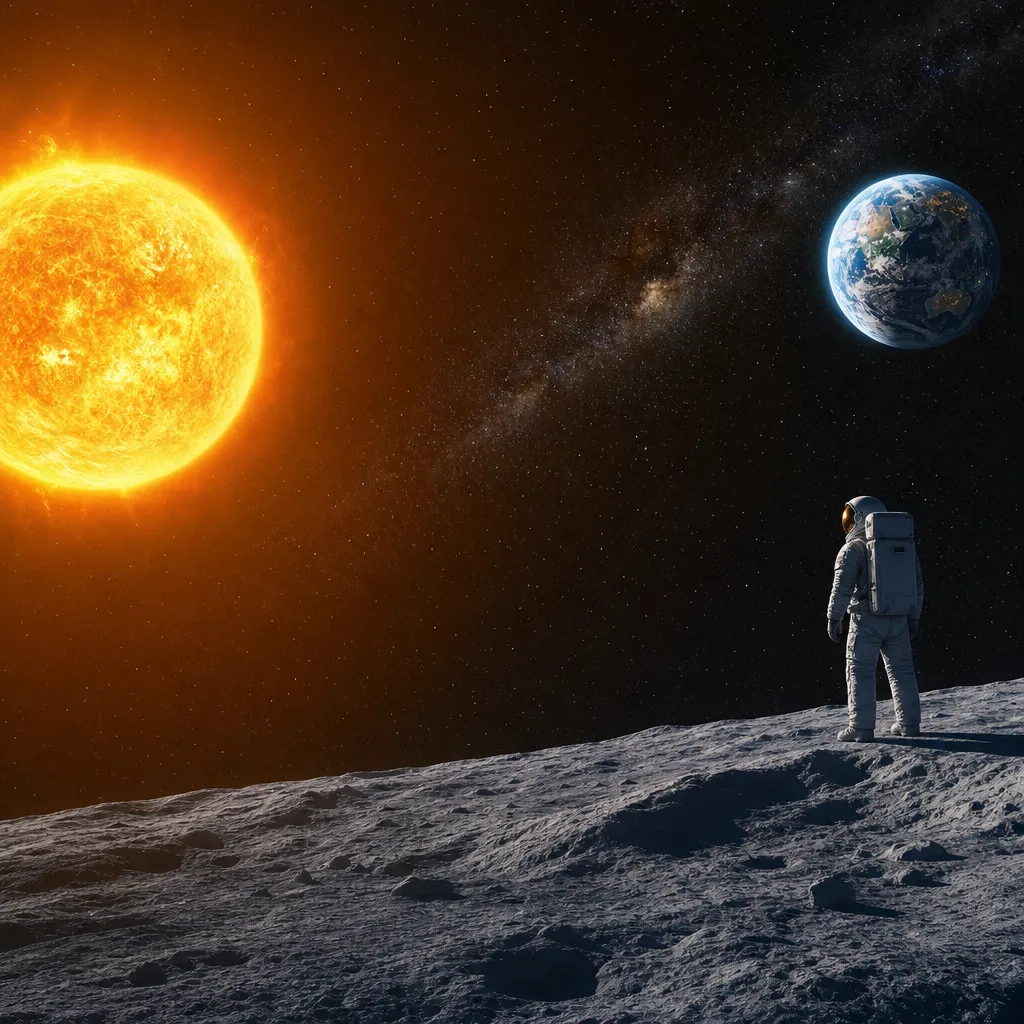
The Sun is, on average, about 149.6 million kilometers from Earth, or about 93 million miles. Astronomers call this average distance 1 astronomical unit, usually shortened to 1 AU. That number answers the question simply, but the real story is richer: Earth’s distance from the Sun changes slightly over the year, measuring it took centuries of observation, and the result became one of the foundation stones of modern astronomy. Knowing how far away the Sun is helps scientists understand the scale of the Solar System, the energy reaching Earth, and the motions of planets and spacecraft.
What “distance to the Sun” really means
When people ask how far away the Sun is, they usually mean the average Earth-Sun distance. Earth does not travel around the Sun in a perfect circle. Its orbit is slightly elliptical, so the distance changes during the year.
At perihelion, around early January, Earth is closest to the Sun, at about 147.1 million kilometers. At aphelion, around early July, it is farthest away, at about 152.1 million kilometers. The variation is small compared with the total distance, which is why 1 AU is such a useful standard.
The Sun itself is a star at the center of the Solar System, and all the planets orbit because of its gravity. The average Earth-Sun distance is not just one measurement among many; it is the baseline that organizes much of planetary science. Distances to other planets, the sizes of orbits, and many spacecraft trajectories are often expressed in astronomical units.
| Term | Meaning | Why it matters |
|---|---|---|
| Astronomical unit (AU) | The defined average Earth-Sun distance | Standard unit for Solar System distances |
| Perihelion | Earth’s closest point to the Sun in its orbit | Shows that the distance changes through the year |
| Aphelion | Earth’s farthest point from the Sun in its orbit | Helps define the range of seasonal distance variation |
| Light-time | Time sunlight takes to travel from the Sun to Earth | Connects distance to the speed of light |
How long does sunlight take to reach Earth?
Because light travels at a finite speed, distance can be described in time as well as kilometers. Sunlight takes about 8 minutes 20 seconds to reach Earth. So when you look at the Sun, with proper protection or through scientific instruments, you are seeing it as it was a little more than eight minutes ago.
This light-travel time matters in both science and engineering. Spacecraft communications, solar storm warnings, and solar observations all depend on the fact that signals and radiation do not arrive instantly. It also gives a more intuitive sense of scale. The Sun may feel close compared with other stars, but it is still far enough away that even light needs minutes to cross the gap.
Why the distance changes but the seasons are not caused by it
A common misconception is that seasons happen because Earth moves closer to or farther from the Sun. In fact, the seasons are caused mainly by Earth’s axial tilt, not its changing distance. Earth’s rotation axis is tilted by about 23.5 degrees relative to its orbital plane, so different hemispheres receive different amounts of direct sunlight at different times of year.
The distance change does slightly affect the amount of solar energy Earth receives. Earth gets a bit more sunlight at perihelion than at aphelion. But this effect is modest compared with the seasonal effect of axial tilt. In fact, Earth is closest to the Sun during Northern Hemisphere winter, which shows clearly that distance is not the main cause of summer and winter.
How scientists first figured it out
Measuring the Earth-Sun distance was one of the great achievements of early astronomy. Ancient astronomers understood that the Sun was far away, but they could not measure its distance accurately with the tools available to them. The problem was difficult because the Sun is bright, far, and not a solid object that can simply be ranged like a nearby target.
After Nicolaus Copernicus placed the Sun near the center of the planetary system in the 16th century, astronomers could determine the relative sizes of planetary orbits more clearly. Johannes Kepler’s laws of planetary motion then described how planets move around the Sun. But those laws gave the Solar System’s scale only in proportions. To know the actual distance in kilometers, scientists needed at least one absolute measurement.
One historic method used transits of Venus. During a transit, Venus passes across the face of the Sun as seen from Earth. Observers at different locations on Earth see the path of Venus shifted slightly because of parallax. By timing and comparing the event from widely separated sites, astronomers could estimate the Earth-Sun distance.
These efforts were especially important in the 18th and 19th centuries. They were difficult and not perfectly precise, but they steadily improved the known scale of the Solar System. The modern value became much more accurate in the 20th century with radar and spacecraft tracking.
How we measure it today
Today, the distance to the Sun is known with very high precision. Scientists do not rely on one method alone. Instead, they combine orbital mechanics, radar ranging, spacecraft telemetry, and highly accurate timekeeping.
One key advance was radar ranging to planets, especially Venus. Radio waves can be sent from Earth, bounced off another planet, and received back on Earth. The round-trip travel time, together with the speed of light, gives the distance very accurately. Once planetary distances are known in real units, the scale of the Solar System can be tied down.
Spacecraft tracking made the picture even stronger. Missions traveling through the Solar System are monitored by radio signals. Engineers measure how long signals take to travel and how their frequency shifts because of motion. Those data help refine planetary orbits and the value of the astronomical unit.
In modern astronomy, the AU is actually defined very precisely rather than left as a quantity that must be remeasured from scratch each time. That definition helps standardize calculations across planetary science, celestial mechanics, and spacecraft navigation.
| Method | How it works | What it tells scientists |
|---|---|---|
| Planetary motion analysis | Uses orbital laws and gravitational modeling | Relative structure and scale of the Solar System |
| Transit observations | Measures parallax from different places on Earth | Historical estimates of the Earth-Sun distance |
| Radar ranging | Times radio echoes from planets | Highly accurate distances in physical units |
| Spacecraft tracking | Uses radio timing and Doppler measurements | Refined orbits and navigation-scale precision |
Why this measurement matters
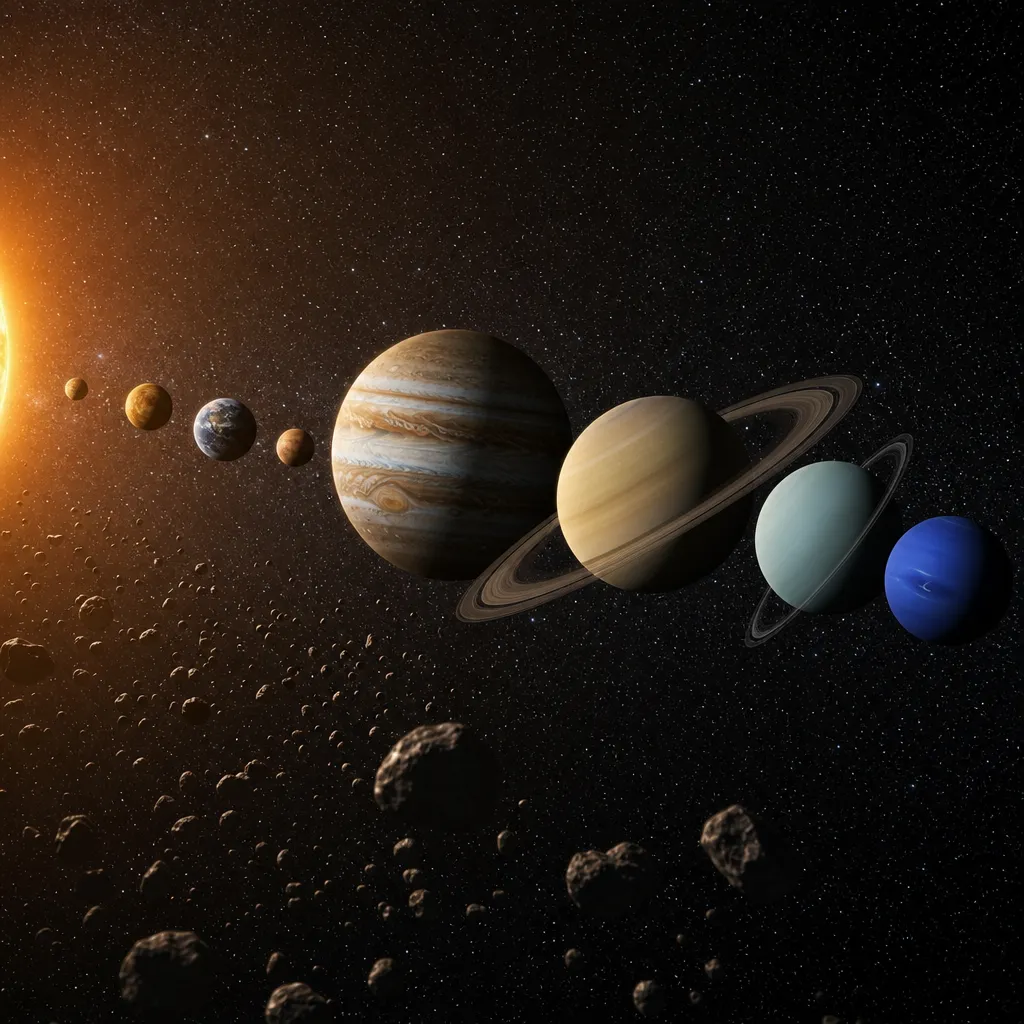
The Earth-Sun distance matters because it sets the size scale of our planetary neighborhood. Once 1 AU is known, the orbits of Mars, Jupiter, asteroids, and many spacecraft can be expressed in consistent, physically meaningful terms. It is one of the anchor points of celestial measurement.
It also matters for energy balance. The amount of solar radiation reaching Earth depends strongly on distance. That affects climate science, satellite design, solar power systems in space, and models of planetary atmospheres. Even small differences in distance can matter when scientists calculate how much energy planets receive.
Beyond the Solar System, the AU is useful for comparing other planetary systems. Astronomers often describe exoplanet orbits in astronomical units because it provides an intuitive comparison with Earth’s orbit. Saying that a planet orbits at 1 AU around a Sun-like star immediately suggests something about its environment, though habitability depends on many other factors as well.
How far is the Sun compared with other space distances?
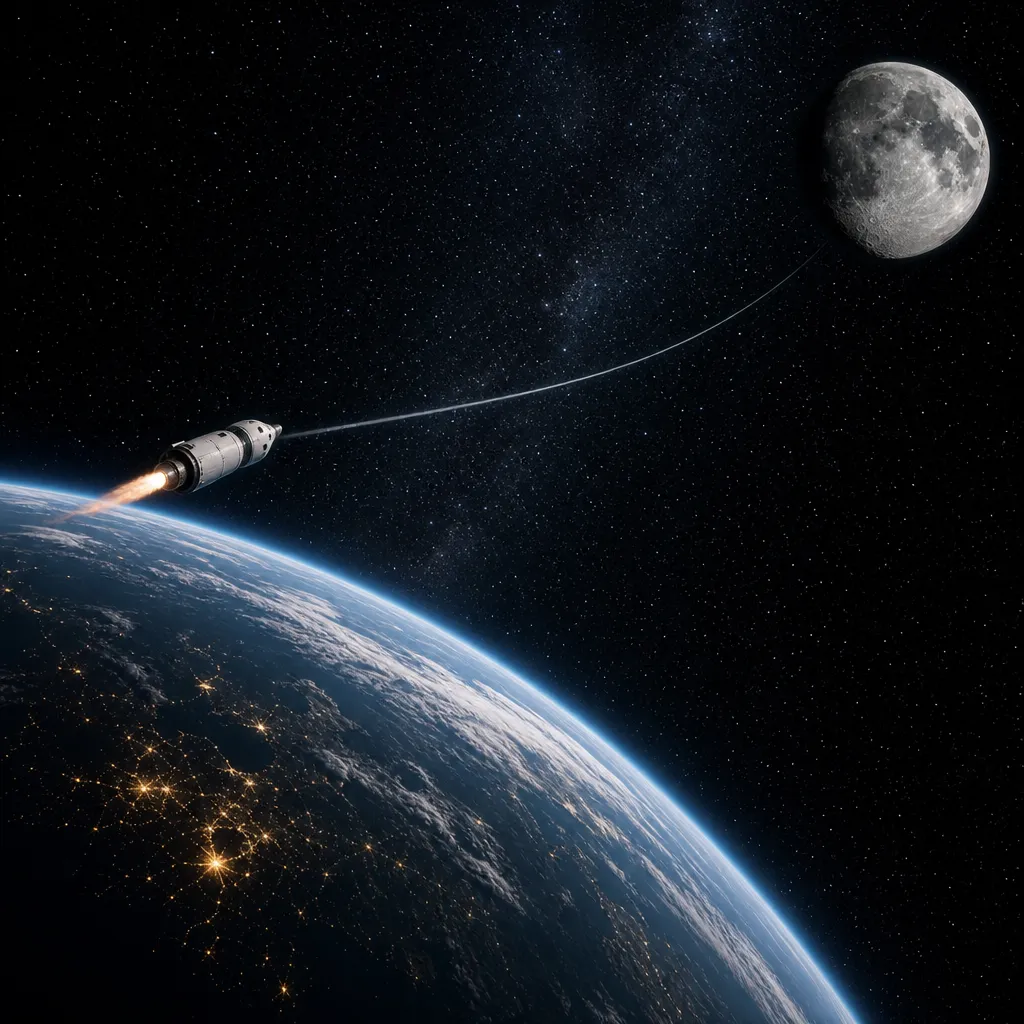
In everyday terms, the Sun is immensely distant. Compared with human travel distances, 149.6 million kilometers is enormous. Yet in cosmic terms, it is nearby. The Moon is about 384,400 kilometers away on average, so the Sun is roughly 389 times farther from Earth than the Moon is.
The outer planets are much farther. Neptune orbits at about 30 AU from the Sun, and the Kuiper Belt extends beyond that. The nearest star system, Alpha Centauri, is more than 4 light-years away, vastly farther than the Sun. So the Sun sits in an interesting middle ground: far enough to remind us how large the Solar System is, but close enough that we can study it in extraordinary detail.
Can humans or spacecraft go to the Sun?
No spacecraft can land on the Sun, because the Sun is not a solid surface and its temperatures and radiation are extreme. Even approaching it is a major engineering challenge. The difficulty is not only heat. Spacecraft near the Sun must also withstand intense sunlight, charged particles, and demanding navigational conditions.
NASA’s Parker Solar Probe is the best example of how close we can currently get. Rather than going to the Sun’s visible surface, it travels through the Sun’s outer atmosphere, the corona, making repeated close passes. Its heat shield and trajectory were designed specifically for this environment. The mission is not measuring the Earth-Sun distance as its main goal, but it depends on extremely precise knowledge of Solar System distances and orbital motion.
For human travel, the Sun is not a destination in any practical sense. The temperatures, radiation, and lack of a surface make direct exploration impossible with foreseeable crewed technology. Human missions instead focus on planets, moons, and orbital environments where survival and operations are at least conceivable.
What remains uncertain?
The basic Earth-Sun distance is not one of astronomy’s major uncertainties anymore. The AU is known and defined with high precision, and Earth’s orbit is tracked extremely well. For practical purposes in education, science, and navigation, the value is secure.
What remains scientifically active are related questions: how the Sun’s energy output varies, how solar activity affects Earth, how the Sun’s outer atmosphere is heated, and how conditions close to the Sun influence space weather. In other words, the distance is well known, but the Sun itself remains a rich subject of research.
Scientists also continually improve ephemerides, the detailed tables and models that describe the positions and motions of Solar System bodies. These refinements matter for spacecraft navigation, tests of gravity, and precision astronomy. So while the headline distance is settled, the wider system of measurements around it is always being polished.
FAQ
How far is the Sun from Earth right now?
It depends on the date, because Earth’s orbit is slightly elliptical. The distance varies between about 147.1 million kilometers and 152.1 million kilometers over the course of a year.
What is 1 astronomical unit?
One astronomical unit is the standard distance based on the average separation between Earth and the Sun. It is defined as exactly 149,597,870,700 meters.
How long does light from the Sun take to reach Earth?
About 8 minutes 20 seconds. That means any sunlight reaching Earth left the Sun a little over eight minutes earlier.
How do scientists know the distance so accurately?
They use several methods, including orbital mechanics, radar ranging to planets, and spacecraft tracking. These methods are tied to precise measurements of time and the speed of light.
Does Earth being closer to the Sun cause summer?
No. The seasons are caused mainly by Earth’s axial tilt. In fact, Earth is closest to the Sun during early January, when it is winter in the Northern Hemisphere.
Can the distance to the Sun change over very long timescales?
Yes, but only very slowly. Planetary orbits evolve because of gravitational interactions and solar mass loss, but these are long-term effects and do not change the familiar value of 1 AU for everyday use.
Why is knowing the Sun’s distance important for astronomy?
It sets the scale of the Solar System, helps scientists calculate planetary orbits, supports spacecraft navigation, and provides a standard unit for comparing other planetary systems.
Could a spacecraft ever reach the Sun itself?
Spacecraft can approach the Sun and pass through its outer atmosphere, as Parker Solar Probe does, but they cannot land on it. The Sun has no solid surface, and its environment is far too extreme.
Sources
- NASA Solar System Exploration
- International Astronomical Union, Resolution B2 on the re-definition of the astronomical unit of length
- NASA Goddard Space Flight Center, Parker Solar Probe mission materials