


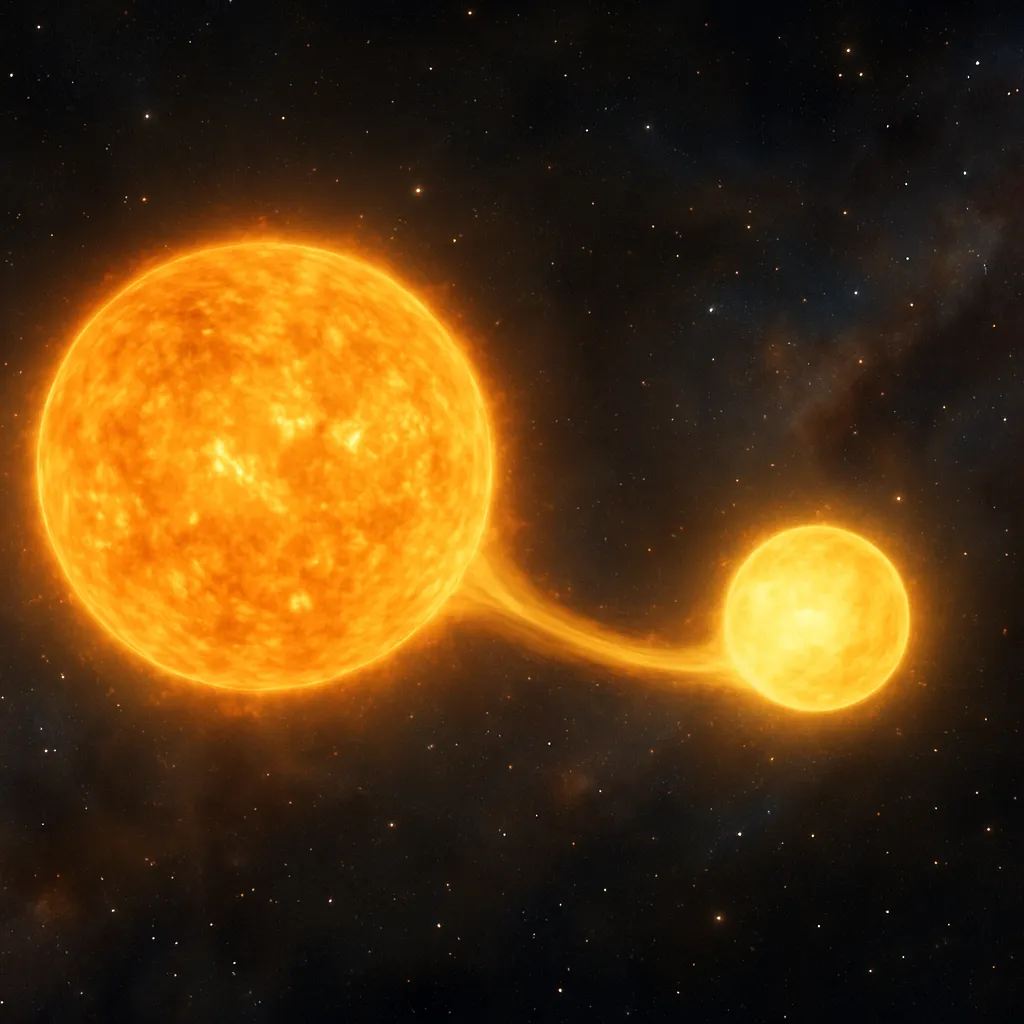
The cosmos is adorned with countless stellar pairs locked in a gravitational embrace, revealing complex dynamics that shape the fate of galaxies. These systems, where two stars orbit a common center of mass, unlock secrets about stellar births, interactions, and ultimate demise. Exploring these celestial duets opens a window into phenomena ranging from gentle tidal forces to cataclysmic explosions, highlighting the intricate dance of light and gravity across cosmic time.
The Nature of Binary Star Systems
At its core, a binary star system consists of two stars bound by the force of gravity, circling around a mutual barycenter. Approximately half of all stars in the Milky Way belong to such pairs, underscoring their significance in understanding stellar demographics. The mutual orbit can vary from a few hours to millennia, depending on the initial conditions of formation and subsequent interactions.
Definition and Prevalence
- Binary systems range from wide pairs separated by thousands of astronomical units to contact binaries sharing common envelopes.
- The fraction of binaries changes with stellar mass: massive stars more often come with companions, while red dwarfs tend to be solitary.
- Surveys utilizing adaptive optics and space telescopes have refined estimates of binary fractions across different environments.
Dynamic Interactions
As components revolve, tidal forces can synchronize their rotation, drive mass transfer, or even lead to mergers. These processes profoundly influence the future evolution of each star, altering luminosity, composition, and eventual fate. In close pairs, Roche lobe overflow can strip gas from one star to another, fueling exotic phenomena like X-ray emission and accretion disks.
Classification and Types
Binary systems are categorized based on observational signatures and physical separation. Each class offers unique insight into stellar physics and the mechanisms by which these pairs form and evolve.
Visual Binaries
These are resolved into two distinct points of light through telescopes. Their separation is large enough—often several arcseconds—to track relative motion over decades. Analysis of orbital parameters yields direct measurements of stellar mass and distance.
Spectroscopic Binaries
In tighter systems, Doppler shifts in spectral lines betray the presence of a companion. Single- and double-lined spectroscopic binaries reveal the velocity curves of one or both stars. High-resolution spectroscopy allows determination of orbital period, eccentricity, and individual masses through radial velocity measurements.
Eclipsing Binaries
When the orbital plane aligns edge-on to Earth, mutual eclipses cause periodic dips in brightness. Analysis of light curves provides precise radii, masses, and temperature ratios, making these systems benchmarks for testing stellar models.
Astrometric Binaries
One star’s wobble on the sky betrays an unseen companion. Space missions like Gaia detect minute positional changes, enabling discovery of low-mass or dark companions, including white dwarfs, neutron stars, or exoplanets.
Close and Contact Binaries
- In close binaries, tidal forces can distort stellar shapes into ellipsoids, affecting brightness variations.
- Contact binaries share a common envelope, with gas flowing between both stars, leading to rapid angular momentum loss.
- These tight systems often end in mergers, producing luminous red novae or triggering gravitational wave events.
Life Cycle and Evolution
The journey of binary stars is entwined with phases of accretion, mass exchange, and dramatic endpoints. Their synchronized destiny often diverges from solitary stars, giving rise to phenomena unattainable by single stars alone.
Mass Transfer and Accretion
When one star expands into a giant, its outer layers may overflow the Roche lobe, spilling material onto its companion. This accretion process can rejuvenate the recipient star, increase its spin, or form an accretion disk that emits powerful X-rays.
Common Envelope Phase
In some scenarios, both stars plunge into a shared envelope. Friction causes orbital shrinkage, ultimately ejecting the envelope and leaving a tight pair, often composed of compact objects. This phase is crucial for forming close double white dwarfs or neutron star binaries.
Cataclysmic Endpoints
- Type Ia supernova: When a white dwarf in a binary accretes enough mass from a companion, it may approach the Chandrasekhar limit, igniting runaway carbon fusion and exploding.
- Neutron star mergers: Two neutron stars spiraling inward release gravitational waves, as observed in kilonova events, forging heavy elements like gold and platinum.
- Pulsar formation: In high-mass binaries, a supernova explosion of one star leaves behind a neutron star that can become a radio or X-ray pulsar in a binary orbit.
Observational Techniques
Advances in instrumentation have revolutionized our ability to probe binary systems, from ground-based telescopes to spaceborne observatories. Combining multiple methods yields comprehensive insights into their properties and dynamics.
Photometry
High-precision light curves from missions such as Kepler and TESS detect eclipses, ellipsoidal variations, and flares. Time-series photometry uncovers exoplanets in binary systems and refines orbital inclinations.
Spectroscopy
Radial velocity studies measure Doppler shifts with sub-meter-per-second accuracy, revealing low-mass companions and enabling full orbital solutions. Spectropolarimetry can detect magnetic fields influenced by binary interactions.
Interferometry
Techniques like optical long-baseline interferometry resolve binaries with milliarcsecond precision. VLTI and CHARA array observations directly map orbits, offer surface imaging, and measure stellar diameters.
Astrometry
- Gaia’s microarcsecond precision exposes subtle wobbles from unseen companions.
- Proper motion anomalies help identify binaries with compact remnants.
Exotic Phenomena in Binary Systems
Some binary configurations lead to spectacular cosmic fireworks and ongoing mysteries:
- X-ray binaries: A neutron star or black hole accreting from a normal star produces intense X-ray emission and relativistic jets.
- Microquasars: Scaled-down analogs of quasars in our galaxy, they display superluminal jet motions observable in radio wavelengths.
- Gravitational wave sources: Compact-object binaries emit ripples in spacetime detected by LIGO/Virgo, offering a new window on the Universe.
- Blue stragglers: Stars rejuvenated by mass transfer appear younger than their cluster peers, challenging conventional age estimates.