

The prospect of humanity establishing a foothold beyond Earth’s atmosphere has evolved from science fiction into an achievable ambition. As we set our sights on Mars, the Moon, and perhaps the icy moons of Jupiter, architects and engineers are reimagining the built environment for the cosmos. The Future of Space Architecture explores the intersection of technology, biology, and design in creating sustainable habitats that will support life in the most unforgiving landscapes known.
Designing for Extreme Environments
Understanding Planetary Constraints
Each target celestial body presents unique challenges. Mars, for instance, offers lower gravity (~38% of Earth’s), thin carbon-dioxide atmosphere, and intense cosmic radiation. The Moon, while closer, endures extreme temperature cycles, micrometeorite impacts, and a lack of atmosphere.
- Gravity differences affect human physiology and structural loads.
- Radiation shielding must protect inhabitants from solar flares and galactic cosmic rays.
- Regolith properties define foundation stability and resource availability.
Thermal and Pressure Management
Habitats must maintain stable internal temperatures and pressures against vacuum or low-pressure exteriors. Advanced insulation materials, phase-change substances, and active heating/cooling loops are critical. These systems must be lightweight, power-efficient, and fail-safe.
Innovative Construction Techniques
In-Situ Resource Utilization (ISRU)
Bringing all materials from Earth is prohibitively expensive. ISRU strategies leverage local soil (regolith) for building blocks, shields, and radiation barriers. Robotic systems can mine, process, and 3D print structures using:
- 3D printing with cemented regolith composites.
- Sintering methods using concentrated solar energy.
- Extraction of water ice and minerals for construction binders.
Modular and Inflatable Modules
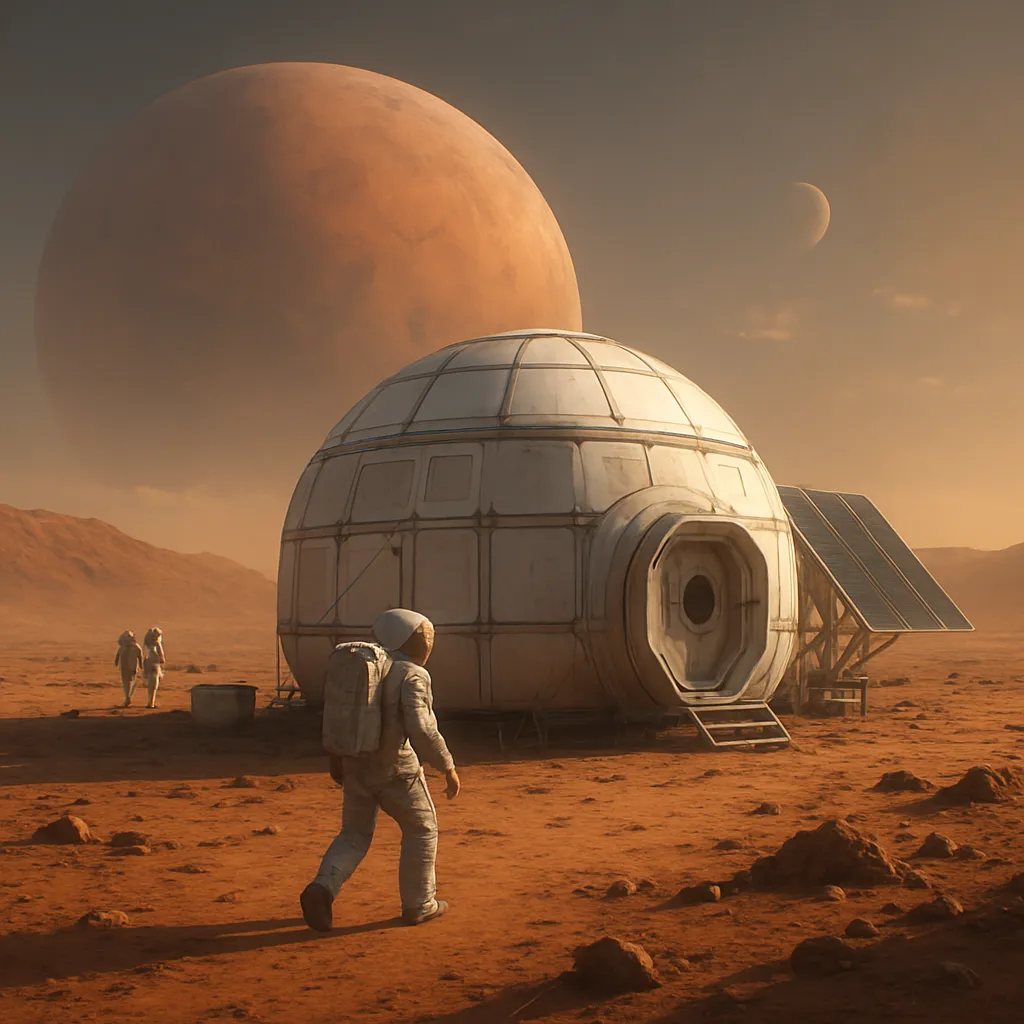
Pre-fabricated modules can be compactly stowed during launch, then inflated or unfolded on-site. These structures use inflatable modules with multi-layered fabric and metallic coatings, expanding interior volume while maintaining pressure integrity. Advantages include:
- Rapid deployment and reduced assembly time.
- Scalability: connecting multiple units into larger complexes.
- Lightweight transport mass.
Robotic Assembly and Autonomy
Human labor in hostile settings carries high risk. Robotics and autonomous drones can prepare the site, lay foundations, and assemble parts. Swarm robotics networks coordinate tasks like:
- Site leveling and compaction of regolith.
- Positioning solar arrays and modules.
- Performing routine inspections and repairs.
Sustainable Life Support and Autonomy
Closed-Loop Life Support Systems
Long-duration missions demand near-complete recycling of air, water, and waste. Closed-loop ecosystems incorporate:
- Water recycling with advanced filtration and UV sterilization.
- Oxygen generation through electrolysis and plant-based bioreactors.
- Waste processing via composting and microbial digestion.
Emerging biotechnologies could harness genetically engineered bacteria and algae to convert waste streams into food, fuel, and building materials.
Energy Generation and Storage
Reliable power is paramount. Hybrid energy systems combine:
- High-efficiency photovoltaic arrays tuned for local solar spectra.
- Compact nuclear reactors for continuous baseload power.
- Energy storage with advanced batteries and regenerative fuel cells.
Optimizing orientation, dust mitigation, and thermal regulation ensures maximal output and longevity.
Human Factors and Psychological Well-Being
Isolation, confinement, and monotony pose serious risks to crew morale and performance. Architects employ principles of biophilic design, using:
- Dynamic lighting that mimics Earth’s day-night cycle.
- Virtual windows and panoramic displays for psychological comfort.
- Modular communal spaces promoting social interaction and exercise.
Accommodation layouts must balance privacy and community, providing personal pods alongside group dining and leisure areas.
Emerging Frontiers and Future Prospects
Terraforming and Long-Term Expansion
While terraforming remains speculative, small-scale experiments may test atmospheric thickening or microbial seeding. Long-term visions include orbital ring structures, subsurface lava-tube colonies, and floating habitats in Venus’s upper atmosphere.
Interplanetary Transportation and Infrastructure
Efficient transit networks, including reusable rockets, space tugs, and propellant depots, will link Earth with off-world settlements. Hub stations at Lagrange points and Mars orbit could streamline cargo and personnel transfers.
The Role of Artificial Intelligence
AI systems will optimize resource use, predict maintenance needs, and adjust habitat conditions in real time. From autonomous airlocks to robotic gardening assistants, intelligent agents will become integral crew members.
Developing viable space architecture demands a multidisciplinary approach, uniting aerospace engineering, materials science, biology, and environmental psychology. As prototypes emerge on the Moon and Mars, each habitat will teach invaluable lessons—paving the way for humanity’s transformation into a truly interplanetary species.