

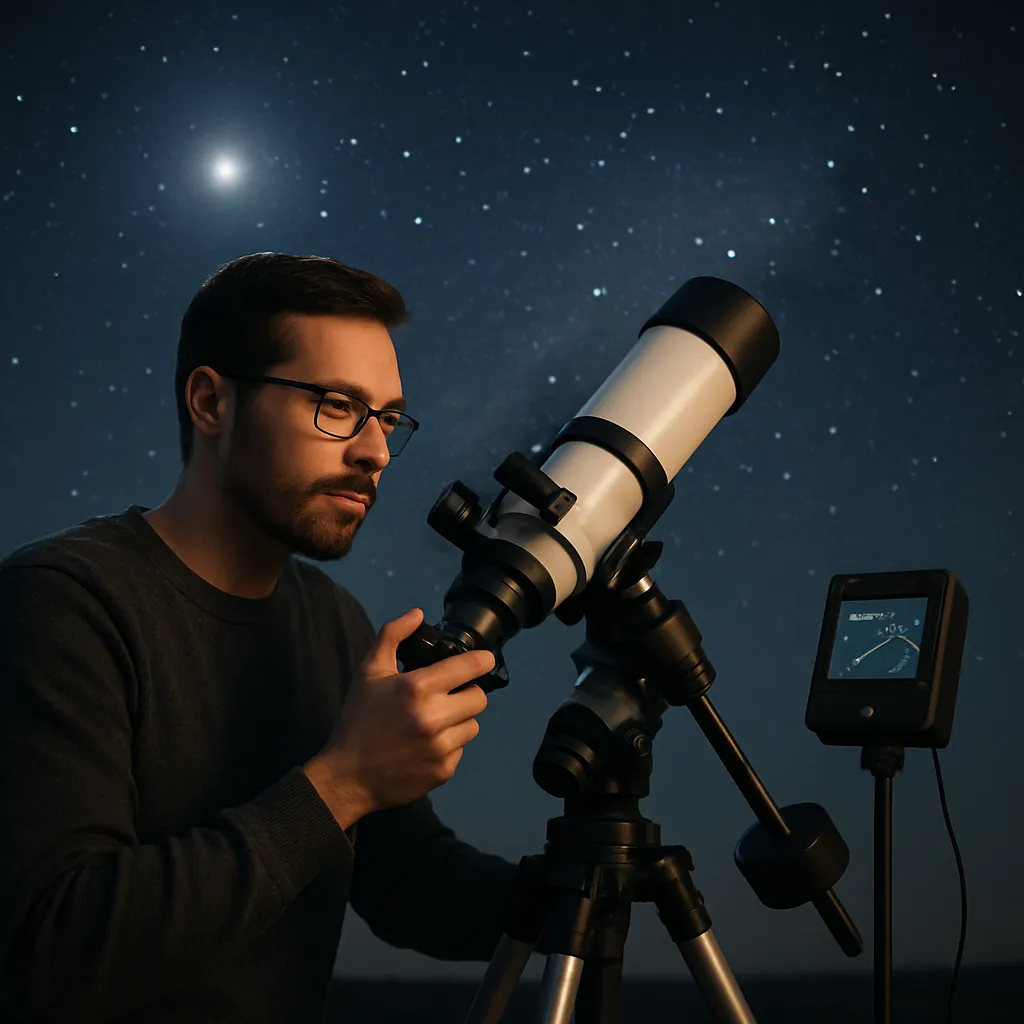
Measuring the light emitted by stars has been a cornerstone of **astronomical** research for centuries. By quantifying how bright a star appears from Earth, scientists gain insight into its distance, size, and energy output. The process involves a blend of careful observation, advanced technology, and rigorous **calibration** methods. This article explores the key techniques and concepts behind measuring stellar brightness.
Methods of Measuring Stellar Brightness
Visual Photometry
Early astronomers relied on human eyes and telescopes to compare the brightness of stars. Observers would assign magnitude values based on how stars contrasted with known references. While subjective, this method laid the groundwork for modern photometry and introduced the notion of stellar **magnitude** scales.
Photoelectric Photometry
The invention of the photoelectric cell allowed for more objective readings. Light from a star is focused through a filter onto a photoelectric tube. The tube converts photons into electrical current, which is measured to derive the star’s intensity. Photoelectric systems dramatically improved precision, reducing human error and enabling consistent long-term monitoring.
Charge-Coupled Devices (CCDs)
CCDs have revolutionized observational astronomy by providing high-sensitivity detectors. They consist of arrays of tiny light-sensitive pixels that accumulate charge proportional to the incident flux. Modern telescopes equipped with CCD cameras can capture faint objects and record accurate flux values across large fields of view. Key advantages include linear response over a wide dynamic range and digital output directly suitable for analysis.
Photometric Systems and Spectral Analysis
Different photometric systems define standard filters and bandpasses to isolate portions of the electromagnetic spectrum. By comparing measurements across multiple filters, astronomers can infer a star’s temperature, chemical composition, and interstellar extinction effects.
- UBV System: Ultraviolet (U), Blue (B), and Visual (V) filters introduced by Johnson and Morgan.
- Sloan Digital Sky Survey (SDSS): Five broad bands (u, g, r, i, z) optimized for CCD detectors.
- 2MASS System: Infrared filters J, H, and Ks for observations beyond optical wavelengths.
Color Indices
Color indices represent differences between magnitudes in two filters, such as (B–V). These indices correlate with a star’s **temperature** and can reveal reddening by dust. A redder color index often indicates cooler stars or significant interstellar absorption.
Spectrophotometry
Combining spectroscopy with photometry, spectrophotometry measures flux as a function of wavelength. Instruments split starlight into a continuous spectrum, allowing precise flux calibration across narrow bands. This approach refines our knowledge of stellar energy distributions and supports models of stellar atmospheres.
Calibration and Standardization
Accurate brightness measurements hinge on rigorous calibration procedures. Without consistent references, data from different nights, instruments, or observatories cannot be meaningfully compared.
Primary Standard Stars
Primary standards are stars with well-determined magnitudes across various filters. Observing these stars regularly allows astronomers to tie their measurements to an absolute scale. Examples include Vega (α Lyrae) and Sirius (α Canis Majoris).
Atmospheric Extinction Correction
The Earth’s atmosphere absorbs and scatters incoming light. Extinction coefficients vary with air mass, wavelength, and weather conditions. To correct for this effect, observers measure the brightness of standard stars at different altitudes and apply mathematical models to compensate for atmospheric losses.
- Determine atmospheric extinction curve for each night.
- Apply correction to raw instrumental magnitudes.
- Ensure that corrected values align with standard catalog magnitudes.
Flat-Fielding and Dark Current Subtraction
CCD images contain systematic noise due to pixel sensitivity variations (flat-field) and thermal electrons (dark current). Calibration frames—flat fields and dark frames—are taken before or after observations to characterize and remove these artifacts, ensuring accurate flux measurement.
Challenges and Future Prospects
Despite technological advances, several challenges persist in measuring stellar brightness with high fidelity.
Nonlinearity and Saturation
Bright stars can exceed a detector’s linear response range, causing saturation. Observers employ neutral density filters or shorter exposure times to prevent data loss. However, working at the extremes of dynamic range still demands careful planning.
Variable Stars
Intrinsic variability complicates brightness measurements. Pulsating stars, eclipsing binaries, and flaring sources exhibit changing luminosity on timescales from minutes to years. Monitoring campaigns require frequent observations and standardized procedures to capture these variations accurately.
Space-Based Observatories
Satellites such as Hubble, Kepler, and Gaia bypass atmospheric interference, offering unparalleled photometric stability. Space platforms enable continuous monitoring of thousands of stars, leading to discoveries of exoplanets, stellar oscillations, and cosmic distance calibrators.
- High-precision photometry down to micro-magnitude levels.
- All-sky surveys with uniform coverage.
- Cross-calibration with ground-based networks.
As detector technologies evolve and new missions launch, astronomers will refine measurements of stellar flux and magnitudes, unlocking deeper understanding of galactic structure, stellar evolution, and the cosmic distance ladder. Continuous innovation in calibration techniques, combined with global collaboration, ensures that our view of the Universe grows ever more precise.