

Since humanity first gazed upon the night sky, we have been captivated by its beauty and perplexed by its enigmas. Modern astronomy and astrophysics have uncovered remarkable truths about the universe, yet some of the greatest mysteries remain unresolved. From the unseen cosmic scaffolding of Dark Matter to the fleeting signals known as Fast Radio Bursts, these puzzles challenge our understanding of physics, space, and time. This article explores several of the most profound questions still awaiting answers.
Dark Matter and Dark Energy: The Invisible Components of the Cosmos
Observations of galactic rotation curves and the large-scale structure of the universe reveal that ordinary matter constitutes only a small fraction of the cosmic inventory. Approximately 27% of the universe is thought to be made of Dark Matter, a form of matter that neither emits nor absorbs light, yet exerts gravitational influence. Even more bewildering, about 68% of the cosmos is dominated by Dark Energy, a mysterious force driving the accelerated expansion of space. Despite decades of research, their true nature remains elusive.
- Particle candidates: Weakly Interacting Massive Particles (WIMPs) and axions have been proposed, but none have been definitively detected.
- Cosmic surveys: Projects like the Vera C. Rubin Observatory aim to map billions of galaxies to constrain the properties of these unseen components.
- Theoretical models: Modified gravity theories seek to explain observations without invoking dark substances, yet they face challenges fitting all data.
Resolving this mystery could revolutionize physics by revealing new particles or modifying Einstein’s theory of gravity. Future experiments, such as deep underground detectors and high-energy colliders, may finally expose the identity of the cosmic dark sector.
The Enigma of Black Holes
Event Horizon and Singularity
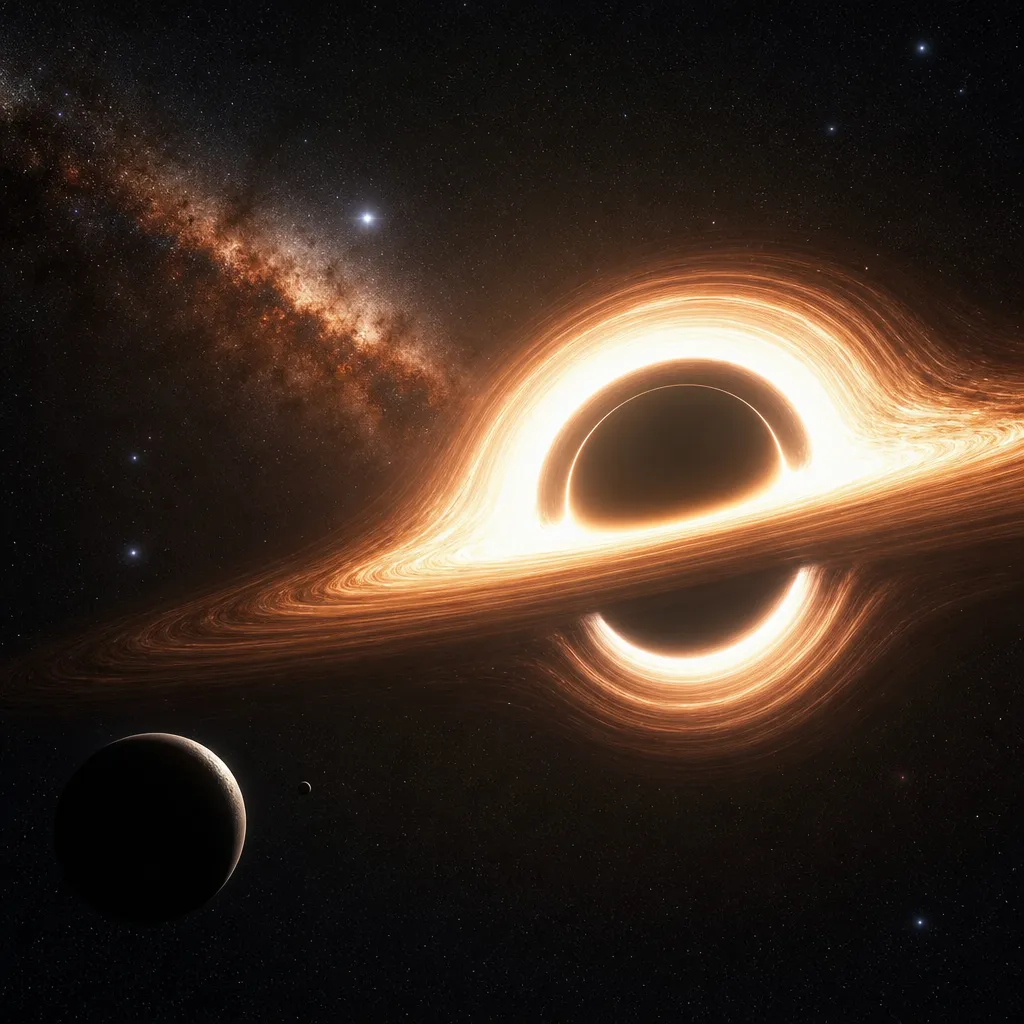
Black holes are regions of spacetime with gravitational pull so intense that nothing, not even light, can escape once crossing the event horizon. According to general relativity, matter collapsing within this boundary is crushed to a point of infinite density known as the singularity. Yet the concept of an actual infinity in nature conflicts with quantum mechanics, hinting at a deeper theory that merges gravity and quantum physics.
Hawking Radiation and the Information Paradox
In 1974, Stephen Hawking proposed that black holes emit thermal radiation—now called Hawking radiation—due to quantum effects near the event horizon. Over astronomical timescales, this process could cause a black hole to evaporate completely. However, if information about matter that falls in is lost forever, it violates quantum mechanics principles. This information paradox has spurred various hypotheses, including holographic duality and firewall scenarios, but remains unresolved.
Fast Radio Bursts: Cosmic Whispers
Discovered just over a decade ago, Fast Radio Bursts (FRBs) are millisecond-long pulses of radio waves originating from distant galaxies. Their extreme brightness and brief duration imply highly energetic and compact sources, yet the exact mechanisms remain uncertain. Some FRBs repeat, offering astronomers the chance to pinpoint their hosts and study their environments in detail.
- Potential progenitors: Models include magnetars, neutron star collisions, and even exotic objects like cosmic strings.
- Localization efforts: Facilities such as CHIME and ASKAP have localized several FRBs, linking them to diverse galactic environments.
- Multiwavelength studies: Observations across the electromagnetic spectrum aim to detect counterparts in X-ray and optical bands.
Understanding FRBs could open a new window on cosmology, providing probes of the intergalactic medium and the magnetic fields threading the cosmos.
The Fermi Paradox: Are We Alone?
Enrico Fermi’s famous question—“Where is everybody?”—highlights the contradiction between high estimates of extraterrestrial civilizations and the lack of evidence for their existence. Given the vast number of stars with exoplanets in habitable zones, one might expect signs of intelligent life. Yet we observe silence. This conundrum has generated numerous hypotheses:
- The Great Filter: A rare and critical step in evolution might prevent life from becoming spacefaring.
- Zoo hypothesis: Advanced civilizations may deliberately avoid contact to allow for natural development.
- Technological lifespan: Civilizations may self-destruct shortly after achieving radio technology.
New SETI initiatives and upcoming space telescopes will continue searching for technosignatures—laser pulses, megastructures, and artificial atmospheric chemicals—hoping to find an answer to this profound question.
Cosmic Inflation and the Birth of the Universe
The standard Big Bang model successfully describes the universe’s expansion, but it fails to explain its remarkable uniformity and flatness on large scales. Cosmic inflation proposes a brief epoch of exponential expansion in the first fraction of a second after the Big Bang, smoothing out irregularities and stretching quantum fluctuations into the seeds of galaxies. While inflation theory fits observational data—especially the cosmic microwave background anisotropies—its underlying physics remains speculative.
- Inflaton field: The hypothetical scalar field driving inflation has not been directly detected.
- Multiverse implications: Certain inflationary models predict a mosaic of “bubble universes,” each with different physical laws.
- Quantum gravity: A complete understanding of inflation likely requires a theory unifying general relativity and quantum mechanics.
Future measurements of primordial gravitational waves and high-precision maps of the cosmic microwave background may shed light on the inflationary epoch, bringing us closer to comprehending our cosmic origins.