



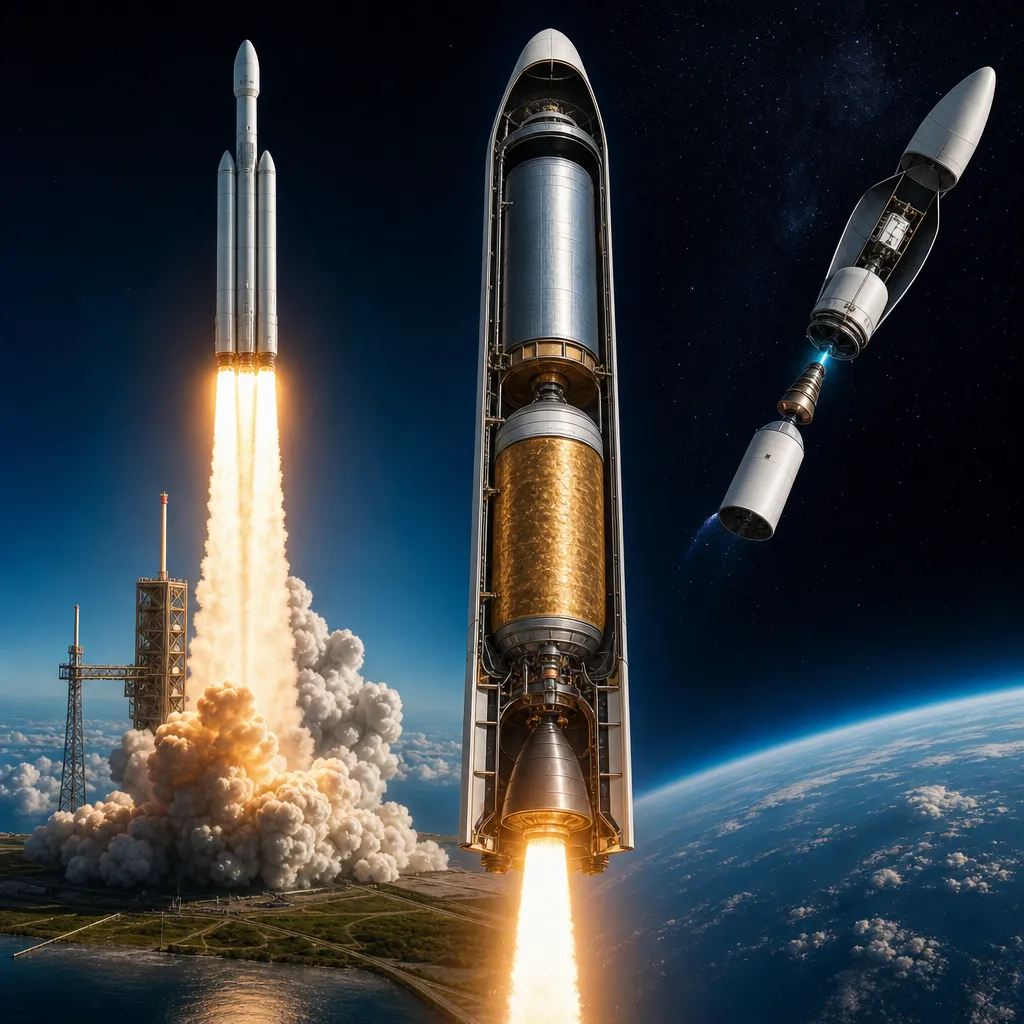
Rockets work by accelerating mass in one direction so the vehicle is pushed in the opposite direction. In practice, a rocket carries fuel and an oxidizer, burns them in a chamber, and expels the hot exhaust at very high speed through a nozzle. That outward jet produces thrust, allowing the rocket to rise from Earth, maneuver in space, or send payloads toward other worlds. Unlike airplanes, rockets do not need air to push against, which is why they can operate in the vacuum of space.
The basic idea is simple, but real rockets are sophisticated machines shaped by thermodynamics, fluid dynamics, materials science, guidance systems, and orbital mechanics. Their design must balance power, mass, stability, structural strength, and reliability. Understanding how rockets work explains not only launch vehicles, but also much of modern space exploration, from satellites and planetary probes to human spaceflight.
What a Rocket Is
A rocket is a vehicle or engine that produces thrust by ejecting mass. The key feature is that it carries its own reaction mass and, for most launch vehicles, its own oxidizer as well. That makes rockets independent of the surrounding atmosphere.
Rockets exist in many forms. Small solid motors are used in sounding rockets, missiles, and escape systems. Large multistage launch vehicles deliver satellites to orbit. Spacecraft in orbit may use smaller chemical thrusters, electric propulsion, or cold-gas systems for attitude control and orbital adjustments. The common principle is always the same: momentum is conserved.
The Core Physics: Newton’s Laws and Conservation of Momentum
The most direct explanation begins with Newton’s third law: for every action, there is an equal and opposite reaction. If a rocket throws exhaust gases backward, the rocket is pushed forward. Another equally important way to describe the same process is conservation of momentum. The total momentum of the rocket-plus-exhaust system remains consistent, so sending mass one way changes the motion of the remaining vehicle the other way.
Newton’s second law also matters. The acceleration of a rocket depends on the force acting on it and its mass. As fuel is burned, the rocket becomes lighter. That means the same thrust can produce greater acceleration later in flight, which is one reason rockets often accelerate strongly near the end of a stage burn.
One of the most important equations in astronautics is the Tsiolkovsky rocket equation, developed in the early days of spaceflight theory. It shows that a rocket’s achievable change in velocity depends on two things: how fast it can throw exhaust out the back, and the ratio between its fully fueled mass and its mass after propellant is used. This is why rockets are dominated by propellant tanks: getting large velocity changes requires carrying a great deal of mass just to expel it.
How Chemical Rockets Produce Thrust
Most launch rockets today are chemical rockets. They store chemical energy in propellants and release that energy through combustion. In a liquid rocket engine, fuel and oxidizer are pumped into a combustion chamber, where they react to form very hot, high-pressure gas. That gas is then accelerated through a nozzle, converting thermal energy and pressure into a fast exhaust jet.
In a solid rocket motor, the fuel and oxidizer are mixed together in a solid grain. Once ignited, the surface burns and produces hot gas continuously until the propellant is consumed. Solid motors are mechanically simpler than many liquid engines, but they are harder to throttle, shut down, or restart.
The exhaust speed is crucial. Faster exhaust generally means better performance, because the rocket gets more momentum change per unit mass of propellant. Engineers often describe this using specific impulse, a standard measure of rocket efficiency. It does not mean fuel economy in the ordinary sense; it means how effectively a rocket uses its propellant to generate thrust.
Main parts of a chemical rocket engine
- Propellant tanks: store fuel and oxidizer.
- Pumps or pressurization system: move propellants into the engine.
- Combustion chamber: where propellants react and produce hot gas.
- Nozzle: accelerates exhaust to high speed and directs it backward.
- Ignition system: starts combustion.
- Guidance and control systems: steer the vehicle and regulate flight.
| Concept | What it means | Why it matters |
|---|---|---|
| Thrust | Forward force produced by expelling exhaust | Determines whether the rocket can lift off and accelerate |
| Propellant | Fuel plus oxidizer, or a combined solid mixture | Provides the mass and energy needed for thrust |
| Specific impulse | Measure of how effectively a rocket uses propellant | Helps compare engine efficiency |
| Mass ratio | Relationship between fueled mass and empty mass | Strongly affects how much speed a rocket can gain |
| Nozzle expansion | Conversion of pressure and heat into exhaust velocity | A major source of rocket performance |
Why Rockets Need So Much Power
Launching from Earth is difficult because a rocket must fight gravity and atmospheric drag while also gaining enough speed to stay in orbit. Reaching space is not the main challenge by itself; reaching orbital velocity is. A suborbital rocket can go up and come back down, but an orbital launcher must accelerate sideways enough that it continually falls around Earth rather than straight back to the surface.
That demand for velocity is why launch vehicles are so large compared with the payloads they carry. Much of the liftoff mass is propellant. A rocket must also carry tanks, engines, plumbing, computers, avionics, heat shielding in some cases, and the payload itself. Every kilogram added to the vehicle makes the task harder, which is why aerospace engineering is intensely focused on saving mass.
Engineers also have to manage extreme conditions. Combustion chambers run at very high temperatures and pressures. Structures must survive vibration, aerodynamic loads, and changing acceleration. Guidance systems must keep the vehicle pointed correctly, because even small errors can grow quickly during ascent.
Stages, Steering, and Flight Control
Most orbital rockets use multiple stages. Each stage has its own engines and propellant. When a stage runs out of usable propellant, it is discarded so the rest of the vehicle no longer has to carry that empty mass. This greatly improves efficiency and is one of the central solutions to the mass-ratio problem.
Steering a rocket is another major challenge. During ascent, the vehicle must not simply point straight up. It follows a carefully designed trajectory that often begins with a vertical climb and then gradually tips over in a maneuver called a gravity turn. This allows the rocket to build the horizontal speed needed for orbit.
Rockets are steered in several ways:
- Gimbaled engines: the engine or nozzle pivots to redirect thrust.
- Control fins: useful in the atmosphere on some vehicles.
- Reaction control thrusters: small thrusters used especially in space.
- Differential thrust: varying thrust among multiple engines.
Modern launch vehicles use onboard computers, inertial measurement units, gyroscopes, accelerometers, and sometimes satellite navigation data to estimate position, velocity, and orientation. The guidance system compares the actual trajectory with the planned one and commands steering corrections in real time.
| Rocket type | How it works | Typical strengths | Typical limitations |
|---|---|---|---|
| Solid rocket | Burns a solid propellant grain containing fuel and oxidizer | Simplicity, long storage life, high thrust | Limited throttling and restart capability |
| Liquid rocket | Pumps liquid fuel and oxidizer into a combustion chamber | Throttle control, shutdown, restart, high performance | Greater mechanical complexity |
| Hybrid rocket | Uses propellants in different phases, often liquid oxidizer and solid fuel | Potential safety and design advantages | Less common, with performance and combustion trade-offs |
| Electric propulsion | Uses electrical energy to accelerate ions or plasma | Very high efficiency for spacecraft in space | Low thrust, not suitable for launch from Earth |
Why Rockets Can Work in Space
A common misconception is that rockets push against the ground or the air. They do not. A rocket works because it pushes on its own exhaust. Since the exhaust is expelled from the vehicle at high speed, the equal and opposite reaction accelerates the rocket.
This is why rockets function in a vacuum. In fact, many rocket engines perform better in space than near sea level because the surrounding air pressure is lower. Nozzle shape matters here: a nozzle designed for vacuum can allow the exhaust to expand more fully, improving efficiency. Some engines are therefore optimized for sea-level operation, while others are optimized for upper-atmosphere or spaceflight use.
Beyond Launch: Rockets and Spacecraft Propulsion
Not all rockets are giant boosters. Once in space, spacecraft often use smaller propulsion systems for attitude control, orbit raising, docking, station-keeping, landing, or interplanetary trajectory changes. These systems may be chemical, but they can also use non-chemical methods.
Electric propulsion, such as ion engines and Hall-effect thrusters, is especially important for deep-space missions and some satellites. These systems use electric fields to accelerate charged particles to very high exhaust speeds. The thrust is small compared with launch engines, but because propellant is used very efficiently, a spacecraft can gradually build up large changes in velocity over long periods.
This shows an important engineering trade-off: high thrust is essential for launch from Earth, while high efficiency can be more valuable once a spacecraft is already in orbit or in deep space.
How We Know Rockets Work
The science of rocketry is not based on guesswork. It is supported by classical mechanics, thermodynamics, laboratory testing, and more than a century of practical demonstration. Engineers measure chamber pressure, thrust, fuel flow, structural loads, vibration, and acceleration during test firings and actual flights.
Rocket performance can be predicted using well-established physical laws and then checked against experiments. Ground tests verify engines before launch. Wind tunnels and computational fluid dynamics help engineers understand aerodynamic forces. Telemetry during flight reveals how real vehicles behave under operational conditions.
Historical evidence is overwhelming. From early liquid-fueled rockets developed in the twentieth century to modern launch systems that routinely place satellites in orbit, the underlying principles repeatedly match observation. Space agencies and commercial launch providers depend on these principles every time they send cargo, crews, telescopes, or planetary probes into space.
Why Rockets Matter
Rockets are the enabling technology of the space age. Without them, there would be no satellites for communications, navigation, weather forecasting, or Earth observation. There would be no robotic exploration of the Moon, Mars, the outer planets, or the Sun. Human spaceflight, space stations, and many of the instruments used to study the universe all depend on rocketry.
They also have scientific value beyond transportation. Launch systems make it possible to put telescopes above Earth’s atmosphere, deploy probes into harsh environments, and return samples from other worlds. Each successful mission extends the reach of astronomy, planetary science, and Earth science.
At the same time, rockets shape policy, economics, and environmental discussions. Reusable launch systems aim to lower costs and increase flight rates, but engineering, safety, noise, emissions, and debris remain active areas of concern and research.
What Remains Challenging or Uncertain
The fundamentals of rockets are well established, but many engineering questions remain open. Better materials, more efficient engines, and safer operations are continuing goals. Reusability has advanced significantly, yet it still involves complex refurbishment, inspection, and recovery challenges.
There are also important trade-offs with no perfect solution. Propellant choice affects performance, handling safety, storage temperature, and environmental impact. Engine cycles differ in complexity and efficiency. Large reusable systems may reduce cost per launch, but only if operations and turnaround can be managed effectively.
Looking ahead, future propulsion concepts such as nuclear thermal propulsion or more advanced electric systems are being studied for deep-space missions. Some have been tested only partially or remain in development, so their eventual operational role is not yet certain. What is certain is that any future system must still obey the same core physics: momentum conservation, energy conversion, and the demands of mission design.
Why does a rocket need oxidizer?
Most rockets carry oxidizer because there is little or no oxygen available once they leave the lower atmosphere. Combustion requires both fuel and an oxidizing agent, so a space-capable rocket must bring both with it unless it uses a non-chemical propulsion system.
Why do rockets go sideways after launch?
They do this to build horizontal speed for orbit. Going straight up may reach high altitude, but orbit requires enough sideways velocity that the spacecraft continually falls around Earth instead of returning directly to the ground.
Can a rocket work without air?
Yes. A rocket does not need air to push against. It works by expelling exhaust mass, so it can produce thrust in a vacuum.
What is the difference between thrust and specific impulse?
Thrust is the force the engine produces at a given moment. Specific impulse describes how efficiently the engine uses propellant. A high-thrust engine is not automatically the most efficient one.
Why are most launch vehicles multistage?
Discarding empty tanks and engines removes dead weight. That allows the remaining stages to accelerate more effectively and makes orbit practical with current chemical propulsion.
How do scientists and engineers test rockets before flight?
They use engine test stands, structural tests, vibration tests, thermal tests, computer simulations, and aerodynamic studies. Flight telemetry then confirms how the vehicle performs in real conditions.
Are reusable rockets changing how spaceflight works?
Yes, especially in launch operations and cost strategy. Reuse can reduce the need to build a completely new first stage for every mission, but savings depend on recovery success, refurbishment demands, and launch cadence.
Could rockets take humans to Mars?
Rockets are essential for any human Mars mission. Chemical rockets are currently the practical choice for launch and major maneuvers, though future missions may also use in-space propulsion systems with different strengths.
Sources
- NASA Glenn Research Center, Beginner’s Guide to Rockets
- European Space Agency, Launchers
- NASA Space Place, What Is a Rocket?