

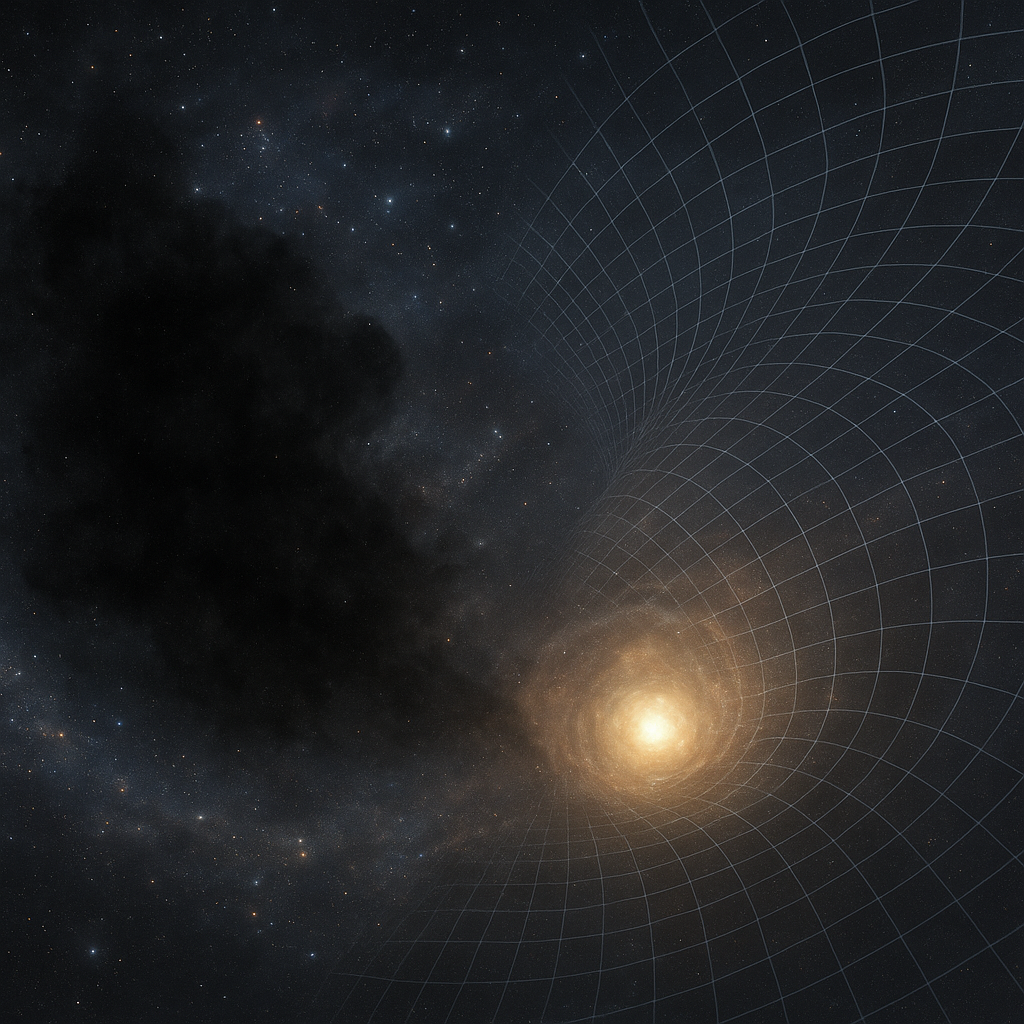
The universe stretches beyond the limits of our imagination, filled with phenomena that challenge our understanding of reality. Among the most compelling are the elusive components known as dark matter and dark energy. Although they make up roughly 95% of the cosmos, their true nature remains veiled in uncertainty. This article delves into the historical roots, observational evidence, and theoretical frameworks that aim to shed light on these profound mysteries of modern astrophysics.
Origins of the Invisible Cosmos
The idea that not all mass is visible arose in the early 20th century. Astronomers observed that the rotational speeds of spiral galaxies were far too high for the luminous matter alone to hold them together. If gravity were generated solely by stars and gas clouds, the outer regions of these galaxies would fling into intergalactic space. Instead, they remain bound in tight orbits, implying an unseen source of pull.
In 1933, Swiss astronomer Fritz Zwicky studied the Coma Cluster and discovered that the visible mass was insufficient to explain the cluster’s dynamics. He coined the term “dunkle Materie,” or dark matter, suggesting vast quantities of unknown mass. Since then, numerous observations—from galactic rotation curves to gravitational lensing—have confirmed that our cosmos is dominated by a hidden component, forming the scaffolding upon which stars and galaxies assemble.
Evidence for Dark Matter
Key Observational Signatures
- Galaxy Rotation Curves: Measurements of orbital velocities of stars at different radii within galaxies reveal flat or rising curves instead of the expected Keplerian decline.
- Gravitational Lensing: Massive clusters bend and distort the light from background objects more strongly than their luminous mass would suggest, indicating additional gravitational influence.
- Cosmic Microwave Background: Tiny temperature fluctuations in the relic radiation from the Big Bang display patterns that require cold, non-interacting matter to seed the growth of large-scale structure.
While the term “dark” does not imply something malevolent or active, it underscores our ignorance of its composition. Current theories propose candidates ranging from weakly interacting massive particles (WIMPs) to axions—ultra-light hypothetical bosons. Efforts to detect these particles involve direct-detection experiments running deep underground, attempts to produce them in particle accelerators, and indirect searches for their annihilation or decay products in space.
The Enigma of Dark Energy
In 1998, two independent teams studying distant Type Ia supernovae discovered that the universe’s expansion is accelerating. This unexpected finding implied the presence of a repulsive component, now labeled dark energy. Despite its profound implications, dark energy remains even more inscrutable than dark matter. It appears as a uniform field permeating all of space, exerting negative pressure that drives cosmic acceleration.
Possible Explanations
- Cosmological Constant (Λ): Originally introduced by Einstein, this constant represents a fixed energy density of the vacuum.
- Quintessence: A dynamic scalar field that evolves over time, potentially interacting weakly with other fields of the universe.
- Modified Gravity: Proposes alterations to General Relativity on the largest scales, eliminating the need for exotic energy components.
Despite rigorous observations by projects such as the Sloan Digital Sky Survey and the Dark Energy Survey, the precise mechanism fueling accelerated expansion eludes us. Upcoming missions like the Euclid satellite and the Nancy Grace Roman Space Telescope aim to map millions of galaxies across vast cosmic volumes, hoping to discern subtle deviations that may betray dark energy’s true identity.
Interplay Between Dark Components
Both dark matter and dark energy shape the universe’s fate. While dark matter clumps under gravity, forming cosmic webs of structure, dark energy drives relentless expansion, thinning out matter over time. Their competition determines whether the cosmos will collapse, coast, or accelerate forever.
- Structure Formation: Dark matter seeds initial overdensities that grow into galaxies and clusters.
- Cosmic Timeline: In the realm of the first billion years, dark matter dominated, enabling the birth of the earliest luminous objects. Billions of years later, dark energy took command, accelerating the universe’s growth.
- Ultimate Fate: The balance between these components dictates scenarios such as the Big Freeze, Big Rip, or a potential return to a contracting phase.
Observational Techniques and Future Prospects
Detecting the unseen requires ingenuity. From subterranean detectors to space telescopes, scientists employ multiple strategies to unveil the nature of dark phenomena.
Direct Searches for Dark Matter
Facilities like Xenon1T and LUX-ZEPLIN seek rare interactions between WIMPs and atomic nuclei. Any detection would revolutionize physics, opening a portal to a hidden particle sector beyond the Standard Model.
Mapping Dark Energy’s Influence
Surveys of millions of supernovae, galaxy clusters, and baryon acoustic oscillations trace the expansion history. Precise measurements of the Hubble constant at various redshifts could reveal tensions hinting at new physics.
Gravitational Wave Observatories
Detectors such as LIGO, Virgo, and the upcoming LISA mission can probe merging black holes and neutron stars, offering alternative pathways to test gravity on cosmic scales and to search for dark matter candidates like primordial black holes.
Challenges and Theoretical Frontiers
Despite revolutionary discoveries, we stand at a crossroads. Theoretical models proliferate, yet each faces challenges:
- Fine-Tuning: Why does the cosmological constant have an incredibly small but nonzero value?
- Coincidence Problem: Why are the densities of dark matter and dark energy of the same order of magnitude precisely today?
- Model Degeneracy: Different theories can reproduce current observations, making unique identification difficult.
Advances in high-performance computing, novel detection technologies, and international collaborations promise to push the boundaries of our knowledge. Whether we discover new forces, uncover hidden particles, or rewrite gravity’s laws, the journey to unravel the universe’s darkest secrets will redefine our place in the cosmic tapestry.