

In the quest to explore space, humanity has mastered the art of launching a rocket into the cosmos. At the heart of every launch lies the production of thrust sufficient to overcome Earth’s gravity and attain the necessary velocity to reach orbit or escape entirely. Understanding the interplay between Newton’s laws and the specifics of different propellants leads to innovations in chemical propulsion, advanced design of nozzles to optimize specific impulse, and the exploration of alternative systems like electromagnetic systems. This article delves into the underlying physics of thrust generation and the concept of escape velocity, framed by the broader context of orbital mechanics and future propulsion frontiers.
Fundamentals of Rocket Thrust
The principle of rocket thrust is rooted in Newton’s third law of motion: for every action, there is an equal and opposite reaction. When propellant mass is expelled at high speed through a rocket nozzle, the rocket experiences a force in the opposite direction. This reaction force, or thrust, is mathematically described by the thrust equation:
F = ṁ·ve + (pe – pa)·Ae
where ṁ is the mass flow rate of exhaust, ve is exhaust velocity, pe is exhaust pressure, pa is ambient pressure, and Ae is the nozzle exit area. In vacuum or high altitude, the pressure term often becomes negligible, making thrust primarily dependent on mass flow and exhaust speed.
Exhaust velocity is a critical parameter; it directly relates to the concept of specific impulse (Isp), which measures the efficiency of a rocket engine. Isp is defined as the thrust produced per unit weight flow of propellant and is usually expressed in seconds. High Isp means less propellant mass is required to achieve a given delta-v, a crucial advantage for interplanetary missions.
The nozzle design itself uses the principles of gas dynamics: convergent-divergent (De Laval) nozzles accelerate hot combustion products to supersonic speeds. Inside the converging section, subsonic flow accelerates toward the throat; past the throat, the flow becomes supersonic and continues to accelerate in the diverging section. Proper expansion matching ambient pressure is vital to maximize engine performance.
Chemical energy released in combustion transforms into thermal energy and then into kinetic energy of the exhaust. Typical liquid bipropellant engines burn fuels such as RP-1 (refined kerosene) with liquid oxygen, or cryogenic hydrogen with oxygen. Solid rocket motors bind oxidizer and fuel into a single grain, providing simplicity and reliability but lower Isp. Modern development also explores hybrid rockets, combining a liquid oxidizer with a solid fuel bed to balance performance and safety.
Mechanisms of Advanced Propulsion
Beyond conventional chemical systems, various techniques aim to push the boundaries of achievable performance, efficiency, and mission profiles.
Electric and Ion Thrusters
Electric propulsion devices accelerate ions to extreme velocities using electric fields, achieving Isp values far above chemical engines. In ion thrusters, xenon atoms are ionized in a discharge chamber and expelled through grids under a potential difference. Although low-thrust, they operate continuously for thousands of hours, making them ideal for deep-space missions where gradual acceleration suffices.
Hall-Effect Thrusters
Hall thrusters trap electrons in a magnetic field to ionize propellant and then accelerate ions through an electric field. These systems deliver higher thrust density than ion engines while maintaining high efficiency. They have been successfully deployed on communication satellites and are under consideration for interplanetary cargo transport.
Nuclear Thermal Propulsion
By heating a propellant like hydrogen in a nuclear reactor core, nuclear thermal rockets promise twice the Isp of the best chemical engines. The concept dates back to the NERVA program, which demonstrated ground tests in the 1960s. Challenges include reactor shielding, safety, and regulatory hurdles, but successful implementation could revolutionize crewed missions to Mars.
Electromagnetic Propulsion
Electrodynamic tethers, pulsed plasma thrusters, and magnetoplasmadynamic thrusters all exploit interactions between magnetic fields and charged particles. While many remain in experimental stages, they represent a shift toward using onboard electrical power—potentially from solar arrays or future compact reactors—to generate continuous thrust without carrying large quantities of chemical propellant.
Escape Velocity and Orbital Mechanics
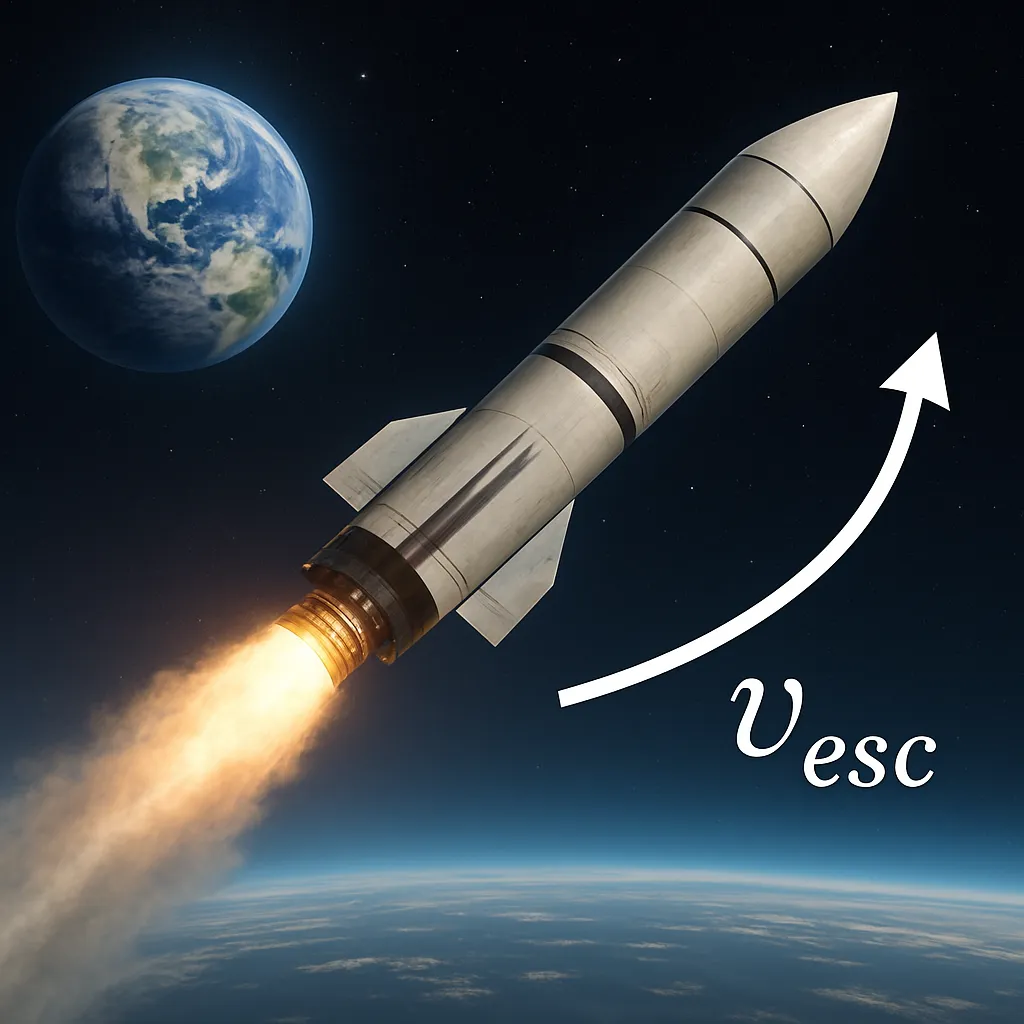
To break free from a planet’s gravitational well, a vehicle must reach or exceed the local escape velocity. Derived from conservation of energy, escape velocity vₑ at distance r from a body of mass M is:
vₑ = √(2GM / r)
where G is the gravitational constant. At Earth’s surface, this value is roughly 11.2 km/s. However, achieving escape does not always require a single continuous burn to that speed; multistage rockets and gravitational assists can reduce the onboard propellant needed.
Orbit insertion differs: circular orbital velocity v₀ is lower (≈7.9 km/s at low Earth orbit). Rather than reaching escape directly, rockets accelerate tangentially to enter a stable orbit. From that orbit, further burns (perigee kicks or trans-lunar injections) can incrementally raise apogee or shift trajectories toward other celestial bodies.
Gravity assists, also known as slingshot maneuvers, exploit the relative motion of planets. By passing close to a massive body, a spacecraft can gain or shed orbital energy, effectively altering its velocity vector without expending large propellant reserves. This technique enabled missions like Voyager, Cassini, and New Horizons to tour multiple outer planets.
Orbital mechanics hinges on two-body and patched-conic approximations. The Tsiolkovsky rocket equation governs how much propellant is needed to achieve a desired delta-v:
Δv = ve · ln(m₀ / mf)
where m₀ is initial mass (including propellant) and mf is final mass (after burn). High exhaust velocity thus directly reduces the propellant fraction and mission mass, a critical tradeoff in spacecraft design.
Challenges and Future Frontiers
As missions target Mars, outer planets, and even interstellar space, engineers face daunting challenges. The mass of propellant must be balanced against payload and structural needs. Thermal management within high-power electric or nuclear systems demands novel materials. Radiation protection for crew adds weight. Furthermore, in-space refueling or propellant depots could drastically reduce Earth-launched mass, but require robust infrastructure.
Emerging concepts like fusion propulsion hold the promise of Isp values in the tens of thousands of seconds by harnessing fusion reactions. Antimatter drives, while purely theoretical today, offer unparalleled energy density. Solar sails convert photon momentum into continuous, fuel-free thrust, potentially enabling decades-long voyages to the outer solar system.
On the nearer horizon, reusable launch vehicles have revolutionized lower-cost access to space. By recovering first stages vertically and refurbishing engines, companies have slashed per-kilogram launch expenses. These achievements pave the way for space tourism, on-orbit manufacturing, and large-scale orbital habitats.
Ultimately, progress in propulsion technology hinges on interdisciplinary breakthroughs—advanced materials, compact power sources, and autonomy to manage long-duration thrust profiles. As we refine our understanding of rocket performance and the cosmic landscape, each new engine, fuel, and maneuver brings us closer to realizing humanity’s aspirations among the stars.