
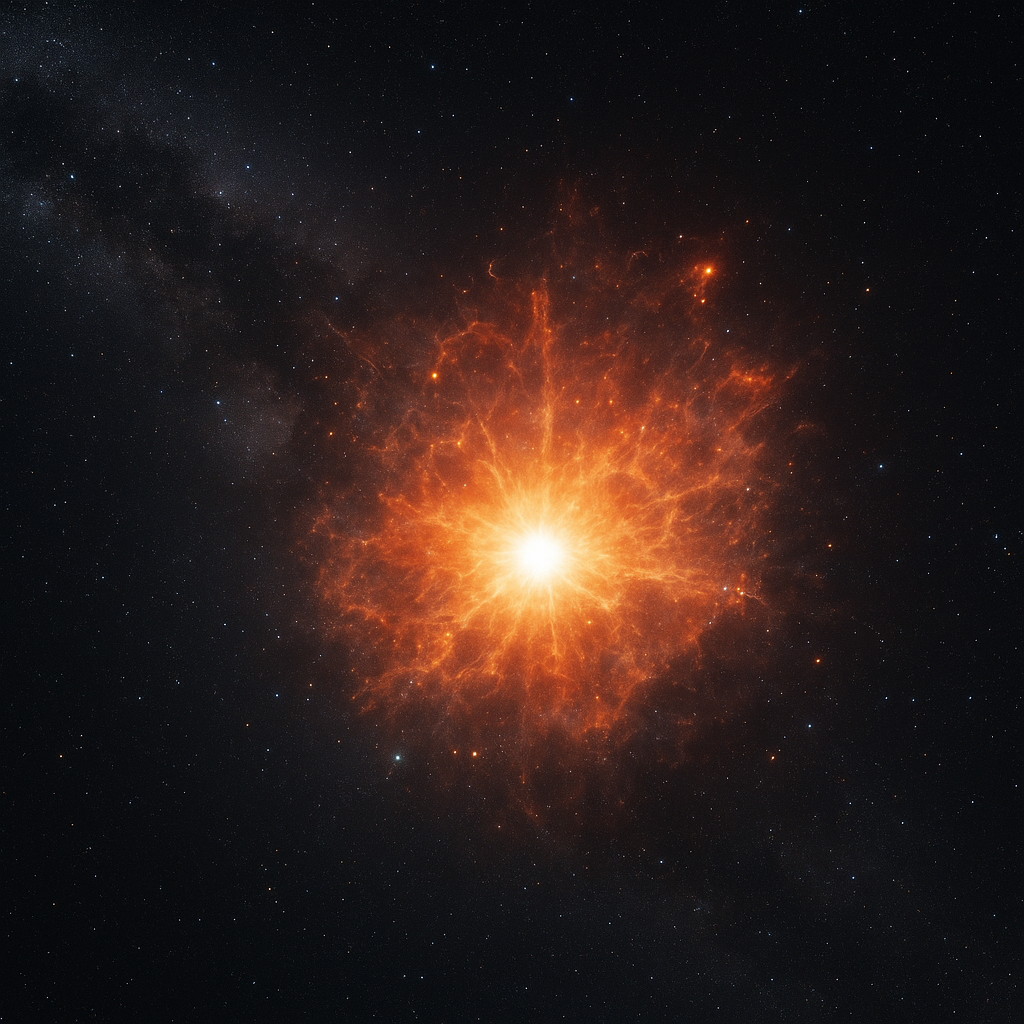
The cosmos is a dynamic tapestry of birth, death, and transformation. Few events capture the imagination as powerfully as a supernova, a colossal explosion that outshines entire galaxies and forges the very elements essential to life. This article delves into the nature of these cosmic detonations, explores why they matter to astronomers and humanity alike, and examines how modern science continues to unravel their secrets.
Understanding the Physics of a Supernova
A supernova marks the violent end of a star’s lifecycle when nuclear fusion in its core can no longer support the immense gravitational pressure. Two main pathways lead to this catastrophic finale:
Types of Stellar Explosions
- Core-Collapse Supernovae: Massive stars (above eight times the mass of our Sun) fuse lighter elements into heavier ones, culminating in an iron core. Iron fusion consumes energy rather than releasing it, causing the core to collapse under gravity in a fraction of a second. The rebound produces a shock wave that tears the star apart.
- Thermonuclear Supernovae: White dwarfs in binary systems can accrete matter from a companion star until they reach a critical mass (the Chandrasekhar limit). Runaway carbon fusion ignites violently, obliterating the dwarf in a uniform explosion.
Key Physical Processes
- Neutrino Emission: During core collapse, an immense burst of neutrinos carries away most of the energy, leaving behind a neutron star or black hole.
- Shock Wave Propagation: The newly formed shock wave traverses the stellar layers, heating and accelerating them to velocities of thousands of kilometers per second.
- Radioactive Decay: Unstable isotopes like nickel-56 produced in the explosion decay, powering the luminous light curve visible for weeks or months.
The Role of Supernovae in Cosmic Evolution
Beyond their spectacular brightness, supernovae play a fundamental role in shaping the universe:
Element Formation and Distribution
All the heavy elements beyond helium originate in stars. During a supernova, rapid neutron capture (the r-process) forges many of the heaviest nuclei. Later ejection into space seeds the interstellar medium with raw materials crucial for planet formation and biological molecules.
Enriching the Galactic Ecosystem
- Interstellar Medium Enrichment: Shock waves compress nearby gas clouds, triggering new waves of star formation.
- Cosmic Ray Acceleration: Charged particles accelerated by the expanding remnant contribute to high-energy cosmic rays that permeate the Milky Way.
- Feedback Mechanisms: Energy and momentum input from supernovae regulate star formation rates, influencing galaxy evolution on large scales.
Observational Techniques and Iconic Discoveries
A combination of ground- and space-based observatories has revolutionized our understanding of supernovae:
- Telescope Surveys: Wide-field optical surveys like Pan-STARRS and the Zwicky Transient Facility catch thousands of supernova explosions annually.
- X-ray and Gamma-ray Observations: Satellites such as Chandra and INTEGRAL detect high-energy photons from early shocks and radioactive decay.
- Neutrino Detectors: Instruments like Super-Kamiokande and IceCube aim to witness neutrino bursts before the optical peak, offering direct insight into core collapse.
- Gravitational Wave Facilities: LIGO and Virgo are poised to capture spacetime ripples from asymmetric collapses, opening a new window on the explosion mechanism.
Notable Historic Supernovae
- SN 1054: Recorded by Chinese astronomers, it created the Crab Nebula, a landmark for modern astrophysics.
- SN 1987A: The closest supernova in centuries, in the Large Magellanic Cloud, provided invaluable data on neutrino emission and nucleosynthesis.
- Type Ia Observations: Standardizable brightness curves are crucial for measuring cosmic expansion and dark energy.
Frontiers and Future Prospects
Ongoing and upcoming missions promise to deepen our knowledge of these stellar cataclysms:
- Large Synoptic Survey Telescope (LSST): Expected to detect millions of transients, including rare supernova subtypes.
- Next-generation Neutrino Observatories: Planned detectors aim for real-time alerts, correlating neutrinos and photons for a complete picture.
- High-Resolution Spectroscopy: Instruments on the James Webb Space Telescope will dissect elemental abundances in distant supernova remnants.
As we peer ever deeper into the universe, every supernova becomes a laboratory for extreme physics, guiding us toward a more comprehensive understanding of cosmic origins and destiny.