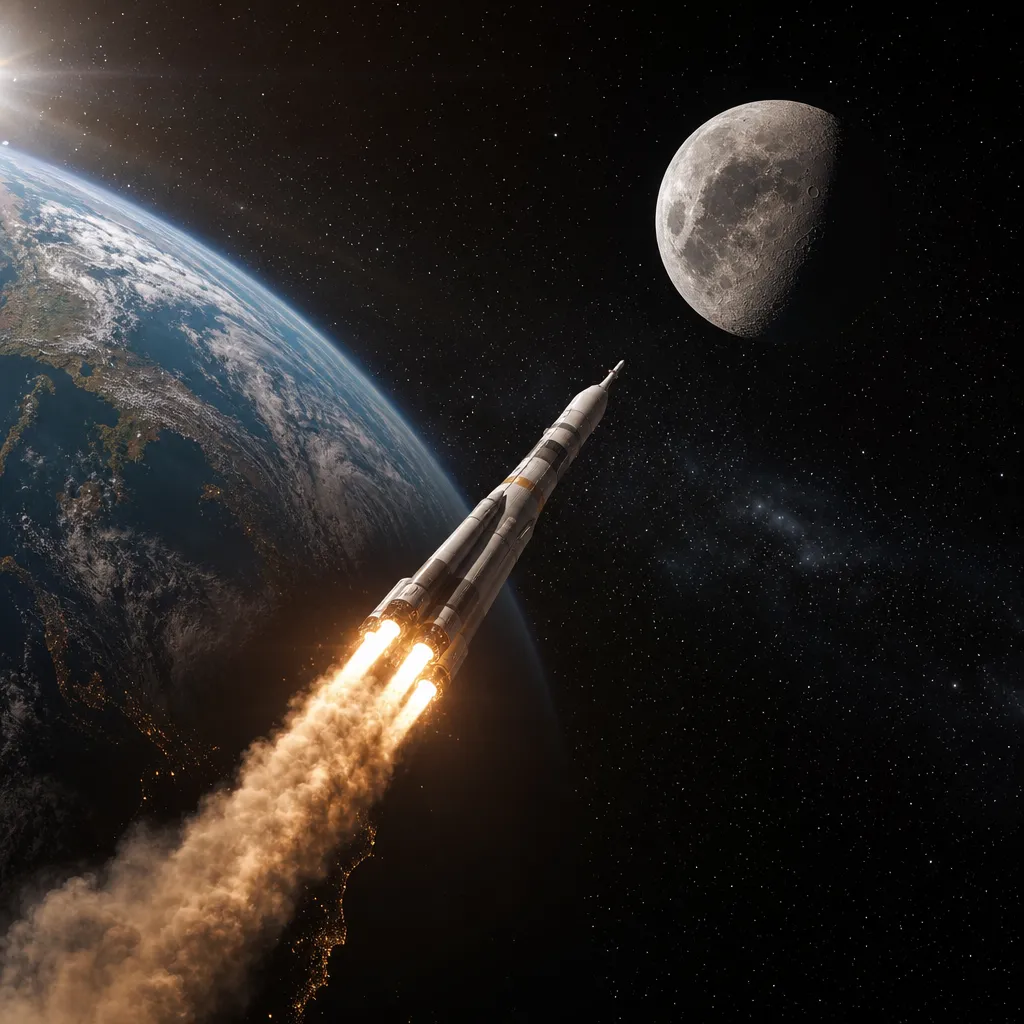
For most missions, getting to the Moon takes about three days. Apollo astronauts reached lunar vicinity in roughly 72 to 76 hours, while some robotic spacecraft have taken a bit less time and others have taken much longer, depending on their trajectory, propulsion, and mission goals. The Moon is close by planetary standards, but it is still far enough away that travel time is shaped more by orbital mechanics than by drawing a straight line from Earth to its surface. The real answer is therefore not a single number, but a range that depends on how a spacecraft is launched, how fast it travels, and whether it heads directly for a landing, orbit, or flyby.
The average distance from Earth to the Moon is about 384,400 kilometers, but the Moon follows an elliptical orbit, so that distance changes. A spacecraft must also escape most of Earth’s gravitational hold, enter a carefully planned path called a translunar trajectory, and then slow down if it wants to orbit or land. That is why “How long does it take?” is really a question about both distance and physics.
Why there is no single travel time
People often imagine space travel as if a spacecraft simply accelerates toward the Moon at a constant speed. In reality, missions are designed around fuel efficiency, rocket capability, crew safety, navigation accuracy, and the energy needed to arrive in the right place at the right time.
Apollo missions used a relatively fast path called a free-return or near-free-return translunar trajectory in the early phase of flight design. This kind of route could loop around the Moon and head back toward Earth if major engine burns were not completed as planned, adding a major safety advantage for crewed missions. That trajectory helped Apollo reach the Moon in about three days.
Robotic spacecraft can be more flexible. Some use powerful launch vehicles and direct trajectories to arrive quickly. Others save fuel by following lower-energy paths that take much longer. A mission can therefore reach the Moon in days, weeks, or even months.
The basic physics of a trip to the Moon
Travel to the Moon is governed by gravity and momentum. A spacecraft starts in Earth orbit or is placed on a path leaving Earth soon after launch. It then performs a major burn, often called translunar injection, to enter an elongated orbit that intersects the Moon’s orbit around Earth.
After that burn, the main engine may stay off for much of the coast phase. The spacecraft continues moving because of its existing velocity, while Earth’s gravity slows it compared with its initial departure speed. At the same time, as it approaches the Moon, the Moon’s gravity begins to dominate the final phase of the trip.
If the spacecraft is intended to land, one more key step is required: it must slow down relative to the Moon. Reaching the Moon is not enough; a lander must remove enough speed to enter lunar orbit or descend to the surface in a controlled way. That braking phase is one reason landing missions require more planning and propulsion than simple flybys.
The route is also three-dimensional. Launch timing must match the Moon’s motion so that the spacecraft and the Moon arrive at the same point in space at the same time. This is why mission planners rely on detailed orbital calculations rather than simply aiming at the Moon’s current position.
Typical travel times for different kinds of missions
Crewed and robotic missions have demonstrated a wide range of travel times. Apollo provides the best-known benchmark: roughly three days from launch to lunar arrival. That remains a useful rule of thumb for high-energy missions from Earth to the Moon.
Some modern robotic missions have had similar transit times. Others intentionally took longer routes. For example, the European Space Agency’s SMART-1 mission used solar-electric propulsion and spiraled outward gradually from Earth orbit, taking more than a year to reach the Moon. That was not because the Moon is far away, but because the spacecraft traded speed for much lower thrust and high efficiency.
NASA’s CAPSTONE mission also illustrated that a mission can take much longer by design. It used a ballistic lunar transfer, a fuel-saving trajectory that took several months before lunar orbit insertion. Such paths can reduce propulsion needs, but they are slower and operationally more complex.
| Mission type | Typical travel time | Why it varies |
|---|---|---|
| Apollo-style crewed mission | About 3 days | High-energy trajectory chosen for speed and mission safety |
| Direct robotic transfer | Often a few days | Depends on launch vehicle power and mission design |
| Low-energy or ballistic transfer | Weeks to months | Saves fuel by using more complex gravitational pathways |
| Solar-electric spiral transfer | Months to more than a year | Very efficient propulsion with low thrust |
What the Apollo missions showed
The Apollo program remains the most famous practical demonstration of human travel time to the Moon. Apollo 8, the first crewed mission to orbit the Moon, launched in December 1968 and reached lunar orbit in roughly three days. Apollo 11, which landed the first humans on the Moon in July 1969, followed a similar timescale.
These missions were launched by the Saturn V rocket, still one of the most powerful rockets ever flown. After reaching Earth orbit, the third stage reignited to send the spacecraft toward the Moon. During the coast period, astronauts performed navigation checks and midcourse corrections. Near the Moon, the spacecraft fired its engine to enter lunar orbit.
Apollo’s timeline was shaped by both engineering and medicine. A faster trip reduced the time astronauts spent in deep space radiation and microgravity, and it simplified life support requirements. It also reduced the number of opportunities for small navigation errors to grow into bigger problems.
The Moon landings therefore were not just historic achievements; they were also precise demonstrations of how quickly humans can reach another world when speed is prioritized and enough launch energy is available.
Why some missions take much longer
If a mission does not need to carry people, planners can accept slower routes to save mass and fuel. This is often a good trade. Rockets are limited by the amount of propellant they can lift, and every kilogram saved can be used for instruments, communications equipment, or extra operational margin.
Low-energy transfers make use of the gravitational relationship between Earth, the Moon, and sometimes even the Sun. Instead of heading straight in a fast arc, the spacecraft follows a more delicate path through regions where gravitational forces nearly balance in useful ways. These trajectories are mathematically sophisticated and can be highly efficient, but they demand patience.
Solar-electric propulsion takes this even further. Instead of one large chemical burn, an ion engine can produce a tiny thrust continuously for months. Over long periods, that gradual push can reshape the spacecraft’s orbit very efficiently. SMART-1 demonstrated this approach successfully on the way to the Moon.
So a slow trip does not mean a mission is less advanced. In some cases, the opposite is true: the mission is using more refined trajectory design or a more efficient propulsion system.
Distance, speed, and lunar orbit geometry
The Moon’s average distance of about 384,400 kilometers is often quoted, but actual mission distance is usually longer than that simple number suggests. A spacecraft does not depart from Earth’s center, nor does it travel in a perfectly straight line to the Moon’s center. It launches from Earth’s surface, enters orbit or a transfer path, and aims for a moving target.
The Moon’s orbit is also elliptical, so it is sometimes closer to Earth and sometimes farther away. When it is near perigee, the Earth-Moon distance is smaller; near apogee, it is larger. This changes travel time somewhat, though usually not by a dramatic amount compared with the larger effects from trajectory choice.
Another important detail is arrival condition. A fast flyby can reach lunar distance quickly, but an orbiter or lander must arrive with the right speed and direction. In mission design, the challenge is not just getting there fast, but getting there in a state the spacecraft can survive and use.
| Factor | Effect on travel time | Why it matters |
|---|---|---|
| Launch vehicle performance | Can shorten trip | Higher energy allows a faster translunar injection |
| Trajectory design | Can shorten or lengthen trip greatly | Direct routes favor speed; low-energy paths favor fuel savings |
| Mission objective | Changes arrival requirements | Landing and orbit insertion require controlled braking |
| Earth-Moon distance at the time | Changes trip modestly | The Moon is not always at the same distance from Earth |
| Propulsion type | Can lengthen trip substantially | Electric propulsion trades thrust for efficiency |
How scientists and engineers know this so precisely
Travel time to the Moon is not estimated loosely; it is measured and predicted with great precision. Mission teams use Newtonian mechanics, refined gravitational models, and continuous tracking data to plan and verify trajectories.
Spacecraft are tracked using radio signals sent between the spacecraft and ground stations. By measuring signal travel time and frequency shifts, engineers determine distance and velocity. This method, combined with radar, optical observations, and onboard inertial measurement systems, allows navigation to be updated throughout the mission.
The Apollo missions provided especially rich evidence because they involved detailed telemetry, crew reports, precise timelines, and later analysis. Modern missions add better computers, improved tracking networks, and extremely accurate atomic time standards.
We also know the Earth-Moon distance very well thanks to lunar laser ranging. Reflectors left on the Moon by Apollo astronauts and Soviet Lunokhod rovers allow scientists to bounce laser pulses off the lunar surface and measure the round-trip light travel time. This gives extraordinarily precise distance measurements and helps refine models of the Moon’s orbit.
Why the answer matters beyond curiosity
Knowing how long it takes to reach the Moon affects nearly every part of mission design. For human spaceflight, travel time influences food, water, oxygen, waste management, radiation exposure, and crew fatigue. For robotic missions, it affects operations, thermal control, communications planning, and the timing of scientific observations.
It also matters for emergency planning. A crewed spacecraft on a three-day journey is far beyond low Earth orbit but still relatively close compared with Mars missions. The Moon therefore serves as a crucial proving ground for deep-space navigation, habitation systems, and mission operations.
This is one reason renewed lunar exploration is scientifically and strategically important. Missions under NASA’s Artemis program are designed not only to return humans to the Moon, but also to build experience for longer journeys deeper into the Solar System. If humans are going to travel to Mars, understanding the operational realities of a multi-day trip to the Moon is an essential intermediate step.
What remains uncertain or mission-dependent
The basic physics is well established, and there is no real scientific uncertainty about whether the Moon can be reached in about three days with a high-energy trajectory. What remains variable is how future missions will choose to balance speed, cost, risk, payload mass, and propulsion technology.
For example, future commercial lunar missions may use a wider variety of launch vehicles and transfer strategies. Some may aim for rapid delivery; others may favor cheaper launches and slower transfers. New propulsion systems could also change typical travel times, especially for cargo.
For human missions, faster is not always automatically better. Higher-energy trajectories may require more powerful rockets or reduce payload mass. Slower routes may save fuel but increase time spent beyond Earth’s protective magnetosphere. These are engineering trade-offs, not unresolved mysteries.
So the short answer is stable, but the practical answer will continue to vary from mission to mission.
FAQ
How long did Apollo 11 take to get to the Moon?
Apollo 11 took about three days to reach lunar vicinity. That is why “around three days” is the most common answer for a fast crewed trip from Earth to the Moon.
What is the fastest possible trip to the Moon?
There is no single fixed minimum because it depends on rocket performance, spacecraft design, and acceptable risk. In general, a more energetic trajectory can shorten travel time, but at the cost of requiring more propulsion and tighter mission constraints.
Why can’t spacecraft just fly straight to the Moon?
Because both Earth and the Moon are moving, and gravity shapes the path continuously. Spacecraft must follow an orbit-like transfer trajectory that intersects the Moon’s position at the right time, then slow down if they want to orbit or land.
Do all lunar missions take about three days?
No. Some do, especially missions using direct chemical-propulsion transfers. Others take weeks or months because they use fuel-saving trajectories or low-thrust propulsion.
How do mission teams measure a spacecraft’s progress to the Moon?
They track radio signals between the spacecraft and Earth stations, measure Doppler shifts to determine velocity, and use onboard navigation systems plus trajectory models. This allows very precise estimates of position and arrival time.
Does the Moon being closer or farther away make a big difference?
It makes some difference, because the Moon’s orbit is elliptical. However, trajectory design and propulsion usually have a larger effect on total travel time than the changing Earth-Moon distance alone.
Could ordinary satellites in Earth orbit go to the Moon?
Not without major changes. Most Earth-orbiting satellites do not have the propulsion, guidance, thermal design, or communications systems needed for translunar travel and lunar operations.
Why is lunar travel time important for future exploration?
It affects crew safety, supplies, propulsion planning, communications, and mission architecture. The Moon is close enough for repeated missions but far enough to test systems needed for deeper human exploration.
Sources
- NASA, Apollo 11 Mission Overview
- European Space Agency, SMART-1
- NASA, CAPSTONE Mission