

The search for hidden oceans beyond Earth has transformed our understanding of planetary science and astrobiology. Beneath layers of ice and thick atmospheres, several moons in our solar system harbor vast reservoirs of liquid water or other exotic fluids. These concealed seas represent some of the most promising locations for discovering extraterrestrial life. Recent missions and advanced telescopes have provided tantalizing hints that conditions favorable to life may exist far from our home planet. This article examines the evidence and potential of the subsurface oceans on Europa, Titan’s hydrocarbon seas, Enceladus’s eruptive plumes, and other icy bodies that may support hidden biospheres.
Subsurface Oceans on Europa
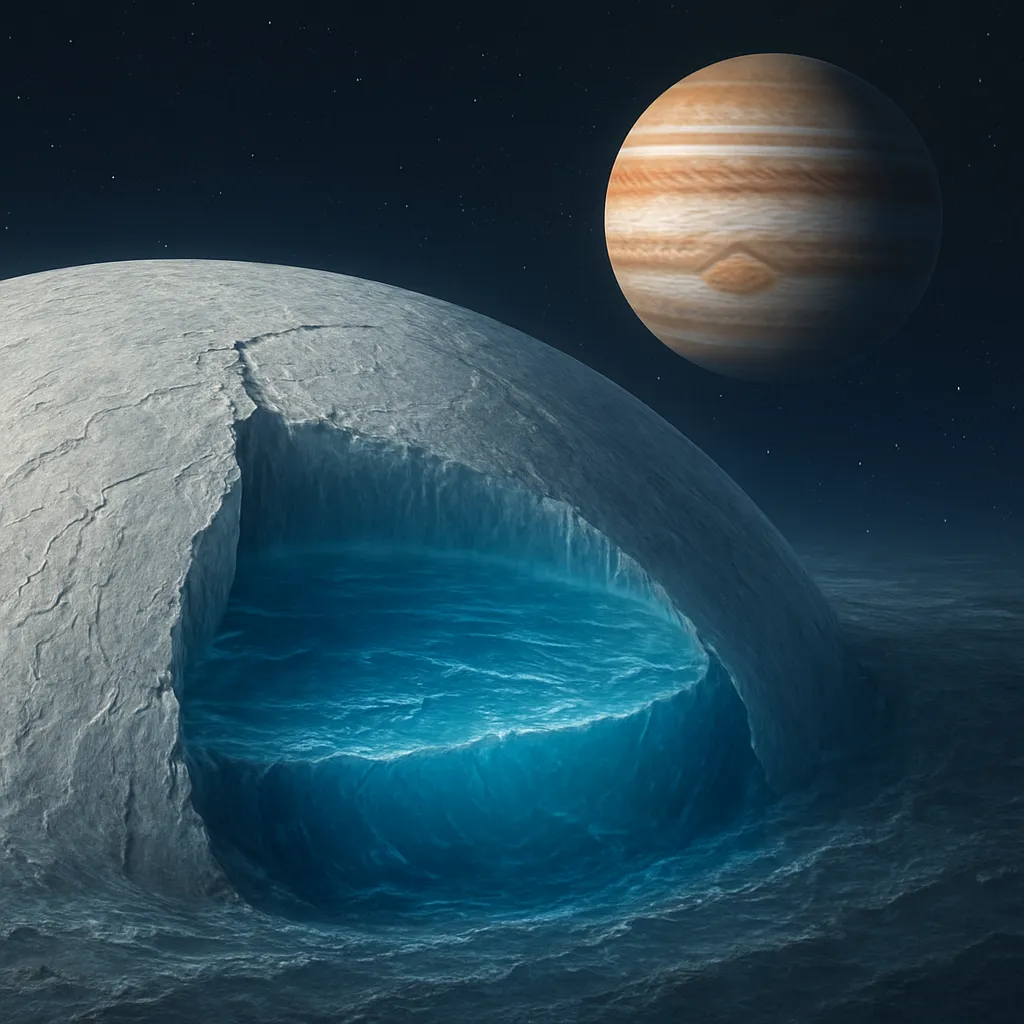
Jupiter’s moon Europa has long captivated scientists due to its smooth, fractured ice shell and signs of an underlying ocean. Europa’s surface is crisscrossed by dark lines where the ice crust has shifted, suggesting internal dynamics driven by hydrothermal vents on the seafloor. This environment could provide chemical energy sources similar to those that sustain life around Earth’s deep-ocean vents.
Ice Shell and Geological Activity
The thickness of Europa’s ice shell is estimated to range from a few kilometers to tens of kilometers. Tidal forces from Jupiter and neighboring moons generate heat that prevents complete freezing and may drive convective movements within the ice. Features such as chaos terrain—regions of disrupted, rotated ice plates—indicate episodes of melting and refreezing.
Potential for Life and Habitability
Europa’s ocean is believed to be in contact with a rocky mantle, allowing water–rock interactions that produce oxidants and minerals. These processes create chemical gradients, which on Earth support chemosynthetic microorganisms. The presence of oxidants like hydrogen peroxide and sulfates on the surface, delivered by Jupiter’s radiation, could be transported downward, offering additional ingredients for metabolic pathways.
- Ocean Depth: Estimated at 60–100 kilometers.
- Energy Sources: Tidal heating, radiolytic oxidants, and potential hydrothermal vents.
- Exploration Plans: NASA’s Europa Clipper mission, set to launch in the mid-2020s, will carry ice-penetrating radar and spectrometers.
Titan’s Exotic Seas and Cryovolcanism
Saturn’s largest moon, Titan, is unique in hosting stable liquids on its surface. Instead of water, these seas are composed of methane and ethane, forming lakes near the polar regions. Beneath the hydrocarbon veneer lies a potential water-ammonia ocean, hidden under a crust of ice and organic material.
The Methane Cycle
Just as Earth has a water cycle, Titan experiences evaporation, cloud formation, precipitation, and surface runoff—only with methane playing the role of water. Sunlight drives photochemical reactions in the upper atmosphere, creating complex organics that settle onto the surface. Seasonal changes can expand and contract the sizes of Titan’s largest seas, such as Kraken Mare and Ligeia Mare.
Evidence of Cryovolcanism and Subsurface Reservoirs
Observations from the Cassini mission revealed features resembling cryovolcanoes, where water–ammonia mixtures may erupt to the surface. These volcanoes could recycle materials between the interior ocean and the surface, distributing heat and organic-rich compounds. The existence of a subsurface water ocean at depths of around 50–100 kilometers is supported by gravitational data and studies of rotation.
- Largest Liquid Bodies: Kraken Mare (400,000 square kilometers), Ligeia Mare.
- Surface Temperature: Approximately minus 179 degrees Celsius.
- Mission Goals: The Dragonfly drone, scheduled for the 2030s, will explore Titan’s surface and atmospheric chemistry.
Enceladus and the Silent Plumes
Enceladus, another of Saturn’s moons, has become a focal point for exploration thanks to the geyser-like plumes emanating from fractures near its south pole. The Cassini spacecraft flew through these jets, sampling water vapor, ice grains, and organic molecules ejected from below the surface.
Plume Composition and Activity
The plumes on Enceladus contain water, salts, simple organics, and even molecular hydrogen. This mix indicates active hydrothermal reactions on the ocean floor, where hot water interacts with rock. The continuous outgassing suggests a warm, habitable environment beneath a thin ice shell.
Astrobiological Implications
Molecular hydrogen generated by water–rock interactions can serve as an energy source for microbes via chemosynthesis. The presence of silica nanoparticles in the plumes further points to high-temperature vent processes. Sampling these jets offers a low-cost method of studying the subsurface ocean without drilling through ice.
- Ice Shell Thickness: Approximately 20–25 kilometers.
- Plume Sources: “Tiger stripe” fractures at the south pole.
- Future Exploration: Concepts for landers or orbital probes aim to capture plume material for in-depth analysis.
Other Ocean Worlds: Ganymede, Callisto, and Dwarf Planets
Beyond the most famous icy moons, several other bodies may hide global oceans or localized reservoirs. Ganymede, the largest moon in the solar system, possesses its own magnetic field, hinting at a conductive, salt-rich ocean beneath the surface. Callisto may host a thinner ocean layer, while smaller bodies like Ceres, Pluto, and even Triton could harbor pockets of liquid water.
Ganymede’s Magnetic Field
Magnetic measurements by the Galileo spacecraft revealed that Ganymede’s subsurface ocean influences its magnetosphere. Tidal heating in Ganymede is less intense than on Europa, but a combination of radiogenic heating and residual heat from formation may maintain its liquid layer at depths around 150 kilometers below the crust.
Potential in the Kuiper Belt
Pluto and its moon Charon exhibit signs of past cryovolcanism and internal activity, though their oceans may have frozen over time. Cryovolcanic domes on Pluto’s surface suggest transport of subsurface materials upward. Similarly, Ceres shows evidence of brine-driven flows, with bright spots in Occator Crater linked to salt-rich cryomagmatic processes.
Key Features of Minor Ocean Worlds
- Ganymede: Intrinsic magnetosphere, ocean depth ~100–200 kilometers.
- Callisto: Heavily cratered, potential ocean interface with rock.
- Ceres: Brine-driven cryovolcanism, Occator’s bright salt deposits.
- Pluto: Nitrogen glaciers, possible ancient subsurface water reservoirs.
Technological Advances and Future Missions
Advances in spacecraft design, remote sensing, and robotic instrumentation pave the way for unprecedented studies of hidden ocean worlds. Techniques such as ice-penetrating radar, ultraviolet and infrared spectroscopy, and mass spectrometry will refine our knowledge of the composition, dynamics, and biology of these distant seas.
- Europa Clipper: Ice-penetrating radar, thermal imaging, and spectrometers to characterize Europa’s ice shell and ocean.
- Dragonfly: A rotorcraft that will sample Titan’s surface chemistry and assess prebiotic conditions.
- Enceladus Life Finder: Proposed mission to analyze plume particles for complex organics and biomarkers.
- JUICE (JUpiter ICy moons Explorer): ESA mission to study Ganymede, Europa, and Callisto’s oceans and magnetospheres.
The growing interest in icy ocean worlds underscores a broader shift in planetary exploration. By targeting environments once thought inhospitable, scientists hope to answer one of humanity’s most profound questions: Are we alone in the universe?