

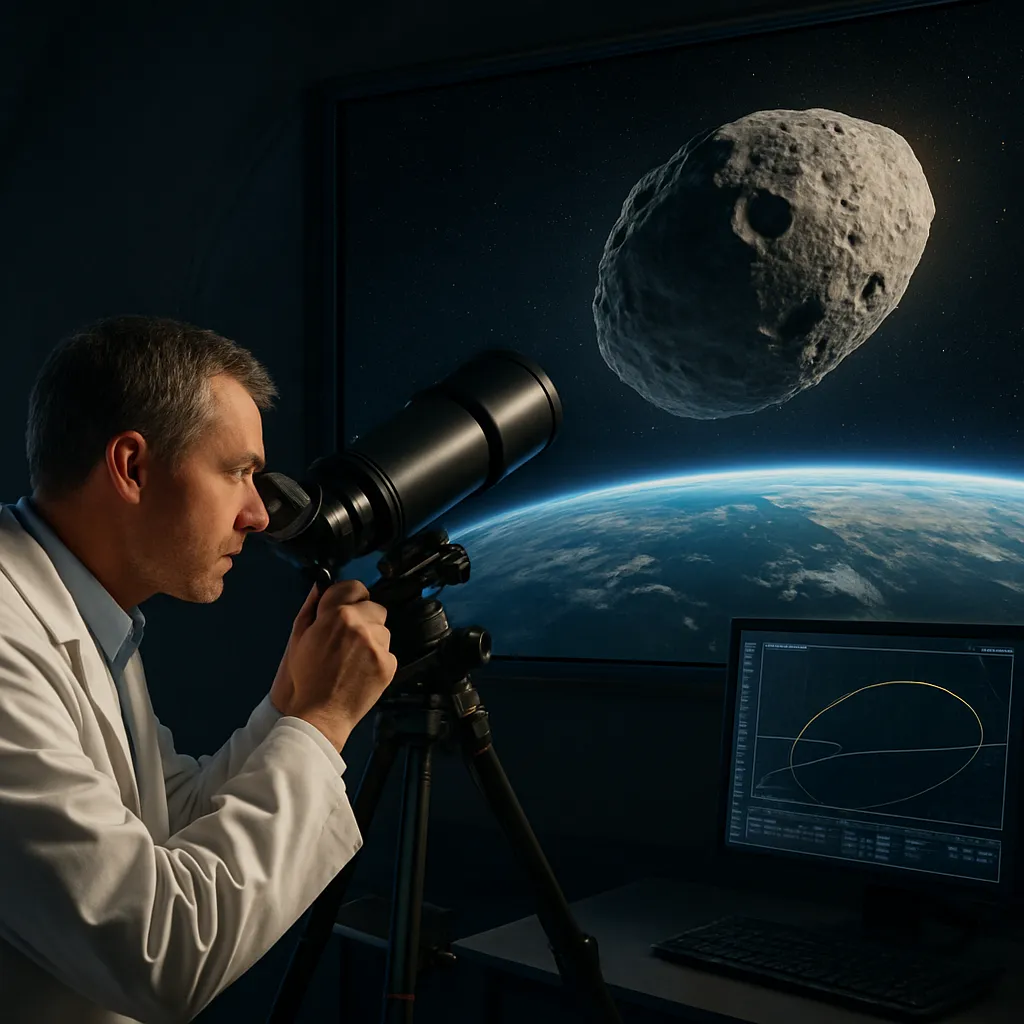
Near-Earth Objects represent a diverse population of comets and asteroids whose orbits bring them into close proximity with our planet. Tracking these bodies is vital to assess potential impact hazards and to unlock secrets about the formation of the solar system. Through a combination of ground-based facilities and spaceborne sensors, scientists have developed a multi-pronged approach to detect, monitor, and characterize NEOs with unprecedented precision.
Detection Techniques
Discovering an unknown NEO often begins with wide-field surveys that scan the skies nightly. Large-aperture systems capture rapid sequences of images, allowing astronomers to spot moving objects against a backdrop of stationary stars. Key observational methods include:
- Optical telescopes: These instruments capture visible-light signatures of NEOs. Automated image-differencing software flags moving points of light, which are then tracked over multiple nights to establish preliminary orbits.
- Infrared sensors: Many asteroids are dark and absorb sunlight, re-emitting it in the infrared. Space missions equipped with infrared detectors can discover objects that reflect little visible light but shine brightly at longer wavelengths.
- Radar observations: Powerful radar transmitters bounce radio waves off the surface of a passing NEO. The returned signal yields high-resolution data on the object’s size, shape, rotation rate, and surface roughness.
Optical Sky Surveys
Programs such as the Catalina Sky Survey, Pan-STARRS, and the upcoming Vera C. Rubin Observatory employ wide-field cameras with rapid readout. They generate millions of detections per night and rely on sophisticated algorithms to distinguish NEOs from artificial satellites and image artifacts.
Infrared Space Telescopes
Missions like the NEOWISE telescope have revolutionized NEO discovery by operating at wavelengths around 3–22 micrometers. By measuring thermal emissions, these instruments provide direct estimates of an object’s diameter and albedo, crucial for assessing its mass and potential hazard.
Data Analysis and Modeling
Once an NEO has been visually confirmed, a rigorous process of orbit determination and uncertainty analysis begins. Observations from multiple sites and epochs feed into orbital integrators, yielding a probabilistic path prediction.
Orbit Determination
- Initial orbit solutions are computed using methods such as Gauss’s algorithm or least-squares fitting to astrometric positions.
- As additional data arrive, covariance matrices quantify the uncertainty in orbital elements, shrinking the corridor of future positions.
- Key orbital parameters include semi-major axis, eccentricity, inclination, and the longitude of the ascending node.
Trajectory Prediction and Impact Assessment
Predictive models propagate the NEO’s orbit forward, accounting for planetary perturbations, the Yarkovsky effect, and outgassing (for comets). Advanced simulations estimate Earth-approach distances centuries into the future. When a potential collision window appears, scientists calculate a Palermo Technical Impact Hazard Scale and a Torino Scale rating, which communicate risk levels to decision-makers and the public.
Characterization via Spectroscopy and Radar
Beyond mere position tracking, understanding an NEO’s composition and physical properties is essential for planning potential mitigation missions.
- Spectral analysis: By dispersing the reflected sunlight of an asteroid into its component colors, astronomers identify mineralogical signatures such as silicates, metals, and organics.
- Radar imaging: Facilities like the Goldstone Solar System Radar and the Green Bank Telescope collaborate to produce delay-Doppler images with resolutions as fine as a few meters.
- Light-curve photometry: Monitoring brightness variations over time reveals the object’s rotation period and surface heterogeneity.
Global Collaboration and Future Missions
Effective NEO tracking relies on a network of international observatories, space agencies, and amateur astronomers. Data sharing through the Minor Planet Center ensures that detections are quickly reported and followed up worldwide.
International Networks
Regional coordination centers such as the European Space Agency’s NEO Coordination Centre and NASA’s Center for Near Earth Object Studies operate 24/7, issuing alerts and impact probability updates.
Upcoming Projects
- NEO Surveyor: A dedicated infrared space telescope designed to discover and characterize most potentially hazardous asteroids larger than 140 meters within five years of launch.
- DART (Double Asteroid Redirection Test): A pioneering kinetic impactor mission that will intentionally collide with the small moon of asteroid Didymos to demonstrate deflection capability.
- HERACLES: A proposed mission combining sample return with in situ resource utilization techniques on a carbonaceous near-Earth object.
Challenges and Innovations
Despite tremendous progress, several hurdles remain. Many NEOs follow highly inclined orbits, making them difficult to spot from equatorial observatories. Small bodies often have rapid or tumbling spins that complicate radar and spectroscopic analysis. Researchers are exploring novel concepts such as:
- Swarm satellites employing synthetic tracking cameras to pinpoint faint, fast-moving targets.
- Laser ranging experiments to measure minute changes in trajectory when a spacecraft emits photon pressure on an asteroid.
- Machine learning algorithms that improve detection rates and reduce false positives in survey data streams.