


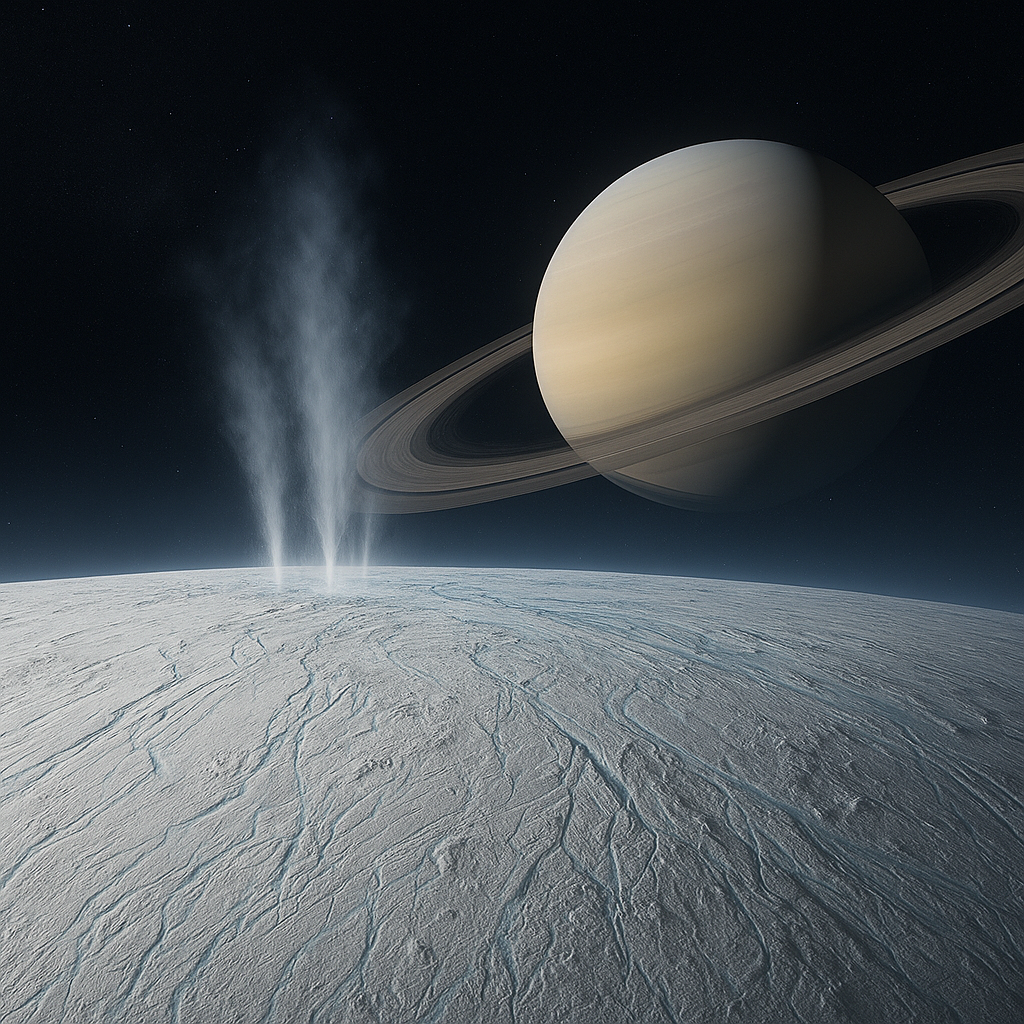
The icy moon of Enceladus has captivated scientists and space enthusiasts alike with its mysterious geysers and smooth, reflective surface. Orbiting Saturn at a relatively close distance, this small satellite offers surprising clues about its internal dynamics and the potential for life beyond Earth. Recent data collected by spacecraft suggest the presence of a global ocean hidden beneath a thick icy crust, making Enceladus one of the prime targets in the search for extraterrestrial habitability. As researchers delve deeper into its composition and structure, questions about astrobiology and the possibility of marine ecosystems on distant worlds come to the forefront.
Geological Features and Internal Structure
Enceladus spans just over 500 kilometers in diameter, yet its surface reveals a dynamic world sculpted by both impact craters and tectonic forces. The southern polar region, marked by a series of parallel fractures known as “tiger stripes,” emits jets of icy particles and vapor that extend thousands of kilometers into space. Analysis of gravity data and surface topography indicates that a layer of liquid water lies beneath the frozen shell, insulated by heat generated from tidal flexing as the moon orbits Saturn.
Key geological insights include:
- The thickness of the icy crust varies, with thinner regions near the poles allowing material exchange between the subsurface ocean and space.
- Heat flux anomalies concentrated under the tiger stripes point to localized warming, consistent with ongoing geological activity.
- Surface ridges and troughs record a history of stress and extension, suggesting that tectonism on Enceladus is a recent and continuing process.
Understanding the interplay between internal heating, crustal fracturing, and surface renewal helps scientists assess whether stable environments exist where organic molecules might concentrate and interact.
Evidence of a Hidden Ocean and Plumes
The discovery of massive plumes venting from the southern hemisphere in 2005 transformed our perception of Enceladus. These towering jets, composed of water vapor, ice grains, and trace organics, offer direct access to the moon’s hidden reservoirs, bypassing the need to drill through ice. Instruments aboard the Cassini spacecraft sampled plume particles and detected:
- Water vapor with salinity levels indicating a saltwater ocean in contact with rocky core material.
- Organic compounds, including simple hydrocarbons and nitrogen-bearing molecules, essential building blocks for life.
- Nanometer-scale silica particles formed at high temperatures, implying active hydrothermal vents on the seafloor.
These findings strengthen the hypothesis that Enceladus harbors a chemically rich environment similar to Earth’s deep-ocean vent systems, where ecosystems thrive without sunlight. The continuous eruption of plumes also replenishes the E-ring of Saturn, demonstrating the moon’s integral role in the broader planetary system.
Potential for Hydrothermal Activity
Hydrothermal vents on Earth support some of the most diverse and resilient communities, powered by chemical energy rather than solar radiation. If comparable vents exist on Enceladus, they could create microenvironments warm enough to sustain microbial life. Models of tidal dissipation within the rocky core predict heat production sufficient to maintain vent temperatures between 50°C and 150°C.
Critical aspects under investigation include:
- Composition of vent fluids: High concentrations of hydrogen, methane, and other reduced gases could fuel chemosynthetic metabolisms.
- Mineral interactions: Contact between seawater and basaltic rock may produce catalytic surfaces that facilitate organic synthesis.
- Stability and longevity: A sustained heat source is necessary to support ecosystems over geological timescales without freezing.
Laboratory simulations replicate vent conditions by mixing seawater analogs with finely ground rock at elevated pressures and temperatures. These experiments yield amino acids and complex organic polymers, highlighting pathways through which primitive biology might emerge or persist in Enceladus’s hidden ocean.
Implications for Astrobiology and Future Missions
The tantalizing evidence of habitability on Enceladus fuels enthusiasm for targeted exploration. Future missions aim to sample plume ejecta directly, seeking definitive bio-signatures such as lipid membranes, nucleic acid fragments, or isotopic anomalies. Proposed mission concepts include orbiters equipped with mass spectrometers, impactors that stir surface frost to release entrained molecules, and even landers capable of melting through the ice.
NASA and international partners are assessing priorities for the next decades, balancing cost, technical feasibility, and scientific return. Mission objectives often highlight:
- Enhanced plume analysis: High-resolution instruments to detect complex organics and chirality, indicating biological processes.
- Geophysical mapping: Gravity and magnetic field studies to refine models of the subsurface structure and heat flow.
- In situ experiments: Miniaturized laboratories to conduct electrochemical and biochemical assays on-site.
Beyond robotic probes, concepts for sample return missions are under preliminary study, envisioning the capture of plume grains in aerogel collectors. These samples could be delivered to Earth laboratories, where advanced analytical techniques would search for unmistakable evidence of life.
The quest to unveil Enceladus’s secrets underscores the broader drive for exploration within our Solar System. Discoveries here resonate across disciplines, from planetary science to the origins of biology, and inform our understanding of potentially habitable worlds orbiting other stars.