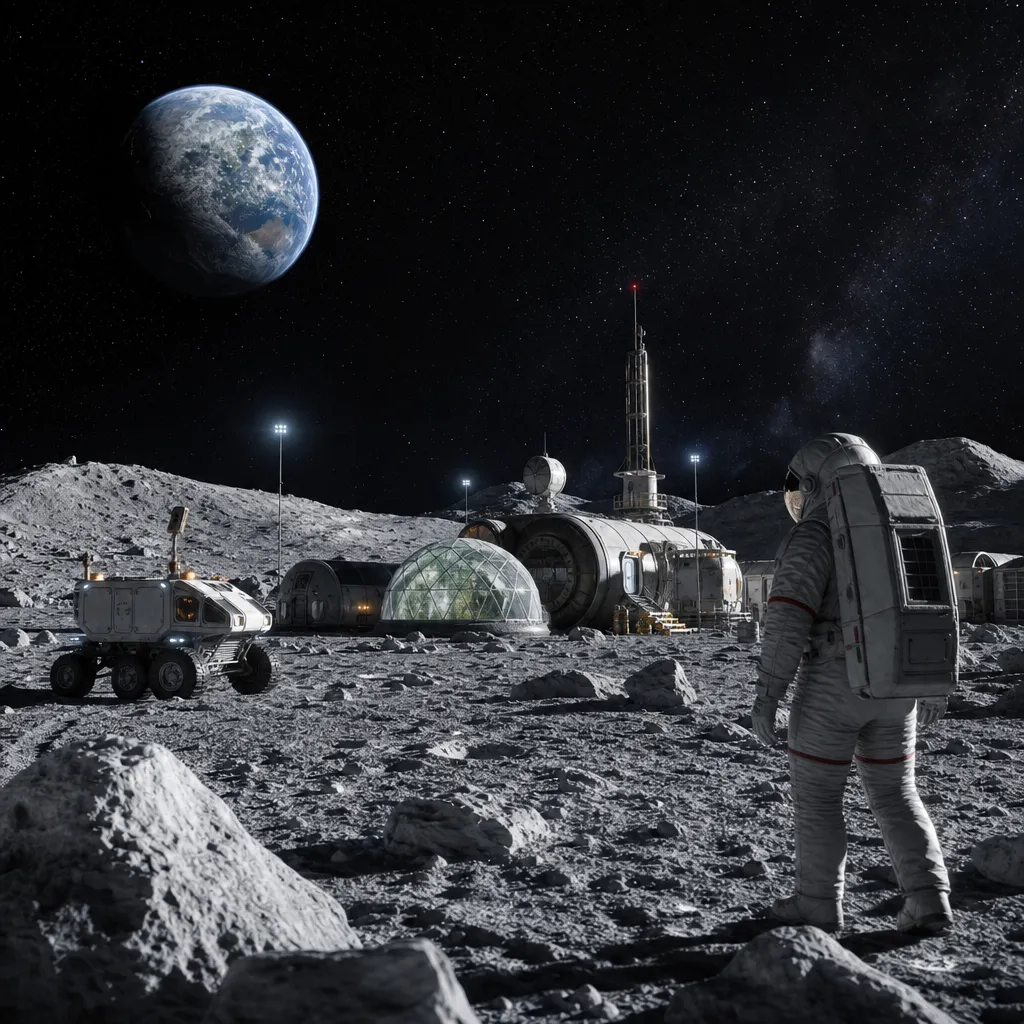
Yes, humans could live on the Moon, but not easily and not in the same way we live on Earth. Short stays have already happened during the Apollo missions, and longer-term residence is considered technically possible if people bring or produce air, water, food, power, shelter, and protection from radiation and dust. The Moon is close enough to Earth to make it the most realistic place beyond low Earth orbit for early human settlement experiments, yet its environment is harsh enough that every basic human need becomes an engineering problem. So the real answer is: possible in principle, difficult in practice, and still unproven at permanent scale.
The Moon matters because it is both a destination and a testbed. It offers scientists access to ancient planetary history, engineers a place to develop off-Earth infrastructure, and space agencies a stepping stone for future deep-space missions. But living there would require carefully designed habitats, reliable life-support systems, and ways to use local resources without assuming that the Moon is naturally hospitable.
What the Moon is like for humans
The Moon is Earth’s only natural satellite, orbiting at an average distance of about 384,400 kilometers. It has no breathable atmosphere, almost no surface pressure, and no liquid water flowing across its surface. A person standing unprotected on the lunar surface would face vacuum, large temperature swings, intense sunlight, dangerous radiation, and sharp dust.
Its gravity is about one-sixth of Earth’s. That is enough to keep people and equipment on the ground, but it is much weaker than what the human body evolved for. Scientists expect reduced gravity to affect muscles, bones, the cardiovascular system, balance, and possibly development and reproduction, though many of these effects remain uncertain because humans have never lived for long periods in lunar gravity.
The Moon also rotates slowly relative to the Sun. At most places on its surface, daylight lasts about two Earth weeks, followed by about two Earth weeks of night. That creates major power and thermal challenges, especially away from the poles.
What humans would need to survive there
Living on the Moon would depend on creating an artificial Earth-like environment inside protected habitats. The core requirements are not mysterious: air to breathe, water to drink, food to eat, safe pressure, manageable temperature, medical care, and reliable waste recycling. The challenge is that none of these are naturally available in a directly usable form at the surface.
A lunar base would likely begin with supplies launched from Earth. Over time, the goal would be to reduce dependence on resupply by reusing water and air, growing some food, and extracting useful materials from lunar soil and ice where possible. This idea is known as in-situ resource utilization, meaning the use of local resources rather than importing everything.
Power is another foundation. Solar energy is attractive because sunlight is abundant in many places, but the long lunar night complicates its use. Near the poles, some high areas receive sunlight for much of the year, which is one reason polar regions are considered promising sites. Nuclear power is also being studied as a possible steady energy source, especially for darkness and extreme cold.
| Basic need | Why it is difficult on the Moon | Possible solution |
|---|---|---|
| Breathable air | No oxygen-rich atmosphere | Closed life-support systems and oxygen production from water or lunar materials |
| Water | No stable surface liquid water | Recycling, imported supplies, and possible extraction of polar ice |
| Shelter | Vacuum, radiation, micrometeoroids, dust, thermal extremes | Pressurized habitats, buried structures, shielding with regolith |
| Food | No natural ecosystem for human diets | Imported food at first, later controlled-environment agriculture |
| Power | Long nights and harsh environmental cycling | Solar arrays with storage, or nuclear systems |
The biggest hazards: radiation, dust, and temperature
Radiation is one of the most serious concerns. Earth’s magnetic field and thick atmosphere shield us from much of the harmful radiation in space. The Moon lacks both. That means lunar residents would be exposed to galactic cosmic rays, solar energetic particles, and secondary radiation generated when energetic particles strike the ground or structures.
Some radiation risk can be reduced by shielding. Water, specialized materials, and especially thick layers of lunar soil, called regolith, could help. One widely discussed strategy is to place habitats partly underground or cover them with regolith. This is plausible, but the exact long-term protection level for a permanent settlement depends on habitat design, local geology, and the frequency of major solar storms.
Lunar dust is another major problem. Apollo astronauts found that it clung to suits and equipment, irritated eyes and airways, and damaged seals and surfaces. Lunar dust grains are extremely fine, abrasive, and electrostatically active. Because the Moon has no wind or water erosion, dust particles are not rounded the way many Earth grains are. For long-term living, dust control may be as important as food storage or plumbing.
Temperature is also challenging. In sunlight, the surface can become extremely hot; in darkness, extremely cold. Habitats would need thermal control systems to maintain safe internal conditions. A base is less like a house and more like a small spacecraft anchored to the ground.
Could the Moon provide useful resources?
Some local resources could make lunar life more practical. Water ice has been detected in permanently shadowed regions near the poles by multiple lines of evidence, including spacecraft observations. If that ice can be extracted efficiently, it could be used for drinking water, oxygen production, and hydrogen-oxygen rocket propellant.
Lunar regolith may also be useful. It can potentially provide building material, radiation shielding, and perhaps oxygen extracted from oxide-rich minerals. However, “could” is the key word. The chemistry is understood, but industrial-scale extraction on the Moon has not yet been demonstrated. Energy requirements, machine wear, dust contamination, and operational reliability remain open engineering questions.
Local construction is another active area of study. Concepts include using compacted regolith, sintered blocks, or 3D-printed structures. These ideas could reduce launch mass from Earth, but they remain developmental. No one has yet built and operated a human habitat on the Moon using local materials.
Where a lunar base would most likely be built
The lunar poles, especially the south polar region, are often considered the best candidates for early long-term missions. The reason is simple: they may offer two things that are unusually valuable on the Moon. First, some high terrain receives sunlight for long periods, which could improve solar power availability. Second, nearby permanently shadowed craters may contain water ice.
Equatorial sites are scientifically important and easier to compare with Apollo locations, but they suffer more from the full cycle of long day and long night. Polar regions are not easy, but they may be less difficult overall for sustained operations.
| Site type | Advantages | Challenges |
|---|---|---|
| Polar region | Potential access to ice, long periods of sunlight, scientific interest | Rugged terrain, deep shadows, difficult operations in cold traps |
| Equatorial region | Historically studied terrain, broad landing options in some areas | Two-week nights, no confirmed near-surface ice resources |
| Lava tube or subsurface site | Possible natural shielding from radiation and micrometeoroids | Accessibility and actual suitability remain uncertain |
How we know what life on the Moon would be like
Scientists are not guessing from imagination alone. Much of what we know comes from Apollo, robotic lunar missions, space-station research, laboratory experiments, and engineering analysis. Apollo astronauts directly experienced lunar gravity, dust, mobility challenges, and surface operations, though only for brief missions. They also returned rock and soil samples that transformed understanding of lunar geology and material properties.
Orbiters and landers from NASA, other space agencies, and international partnerships have mapped topography, mineral composition, temperatures, and likely water ice deposits. Instruments such as spectrometers, cameras, radar systems, neutron detectors, and laser altimeters allow scientists to infer surface and near-subsurface conditions. These are indirect methods, but they are powerful when multiple types of data agree.
Human health knowledge comes largely from low Earth orbit rather than the Moon itself. The International Space Station has taught researchers a great deal about how the body responds to microgravity, radiation exposure, isolation, and closed habitats. But lunar gravity is not the same as microgravity, so it is not yet known whether one-sixth gravity is enough to substantially protect long-term health. This is one of the most important unresolved questions.
What has already been done, and what comes next
Humans have already visited the Moon during NASA’s Apollo program between 1969 and 1972. Those missions proved that people can travel there, land, work on the surface, and return safely. What they did not prove is that humans can remain there for months or years with acceptable health, reliability, and cost.
Current plans for renewed lunar exploration are aimed partly at answering that bigger question. NASA’s Artemis program is designed to return astronauts to the Moon and support more sustained operations, with international and commercial participation. Robotic missions are also studying landing technologies, lunar environments, and potential resources. These efforts could clarify which habitat designs, power systems, and logistics strategies are realistic.
Still, a permanently occupied lunar base is not yet an established fact. It is a goal under active development. Many pieces exist separately, but they have not been integrated into a proven, self-sustaining settlement.
Why living on the Moon matters scientifically and practically
A lunar settlement would not just be symbolic. It could provide a platform for planetary science, astronomy, engineering, and human biology. The Moon preserves a long record of impacts and early Solar System history that Earth has largely erased through weathering and plate tectonics. A sustained human presence could support broader geological fieldwork and more complex sample return.
There are also practical reasons to test life-support, construction, power, and repair systems on the Moon before attempting long missions to Mars. The Moon is close enough that resupply and emergency return are far more feasible than from Mars. In that sense, it is a proving ground for deep-space habitation.
At the same time, not every argument for lunar settlement is equally strong. Some proposed economic uses remain speculative. Whether the Moon will become a large human outpost, a small scientific station, or mainly a robotic-industrial frontier is still unknown.
What remains uncertain
The central uncertainties are not about whether humans can survive briefly on the Moon. They can. The deeper questions are about duration, scale, health, reliability, and cost.
- Human health: The long-term effects of one-sixth gravity are not yet known.
- Radiation protection: Effective shielding is plausible, but operational designs must be tested.
- Resource extraction: Water and oxygen production may be possible, but performance at scale is unproven.
- Dust mitigation: This may become a major limiting factor for machinery and crew health.
- Economics and logistics: Sustained habitation depends on launch capacity, maintenance, and international commitment.
So the Moon is not an impossible place for human life, but it is also not a second Earth. Any real lunar home would be an engineered ecosystem operating in one of the toughest environments humans have ever tried to inhabit.
Could humans breathe on the Moon without a spacesuit?
No. The Moon has no breathable atmosphere and essentially no air pressure. Humans would need spacesuits outdoors and pressurized habitats indoors.
Would people be able to grow food on the Moon?
Possibly, but only inside controlled habitats. Plants would need water, light, nutrients, carbon dioxide, temperature control, and protection from radiation and dust. Early bases would likely rely mostly on food brought from Earth.
How do scientists know there is water on the Moon?
Evidence comes from several spacecraft observations, including spectral measurements, neutron data, radar studies, and impact experiments. These methods suggest water ice exists in some permanently shadowed polar regions, but the exact form, purity, and accessibility vary by location.
Is lunar gravity enough for human health?
Scientists do not yet know. Lunar gravity is stronger than microgravity but much weaker than Earth gravity. It may help reduce some health problems seen in orbit, but this has not been tested through long-duration human residence.
Would a lunar base need to be underground?
Not necessarily, but subsurface or shielded habitats are attractive because they could reduce radiation exposure, temperature stress, and micrometeoroid risk. Covering surface habitats with regolith is another leading idea.
Why is the Moon considered easier than Mars for early settlement?
The Moon is much closer to Earth, so travel times are shorter and resupply is more practical. Communications are also easier, and emergency options are better than for Mars. However, the Moon lacks a useful atmosphere and still presents major environmental hazards.
What missions are helping answer whether humans can live there?
Apollo provided the first direct human experience on the lunar surface. Current robotic missions and NASA’s Artemis program are intended to expand knowledge of lunar resources, landing systems, surface operations, and the requirements for sustained human presence.
Sources
- NASA, Artemis
- NASA Solar System Exploration, Earth’s Moon
- European Space Agency, Exploration of the Moon