
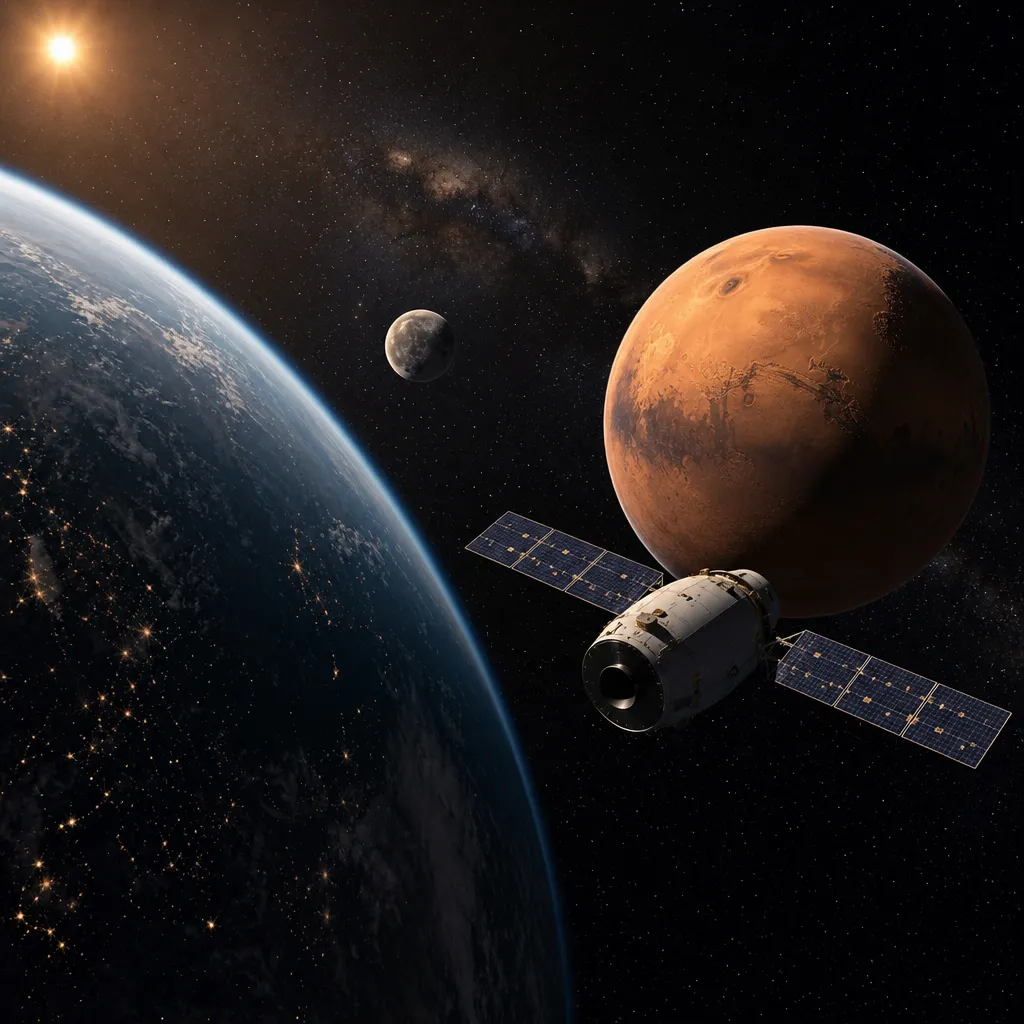
Mars is not a fixed distance from Earth. Because both planets move around the Sun on different orbits, the distance between them changes constantly, from about 54.6 million kilometers at the closest favorable approaches to more than 400 million kilometers when they are on opposite sides of the Sun. In round numbers, the average distance often quoted is about 225 million kilometers, but that single number hides the real orbital geometry. Understanding that changing distance matters for astronomy, spacecraft navigation, mission timing, and any future human journey to the Red Planet.
To answer “How far is Mars?” accurately, astronomers have to specify when they mean. The planet can appear bright and relatively nearby during one part of its cycle, then much farther away months later. That changing separation is not a complication added by scientists; it is the central fact.
Why the distance to Mars keeps changing
Earth and Mars both orbit the Sun, but they do so at different distances and different speeds. Earth completes one orbit in about 365 days, while Mars takes about 687 Earth days. Because Earth moves faster on an inner orbit, it regularly catches up to and passes Mars.
If planetary orbits were perfect circles centered on the Sun, the changing distance would already be significant. In reality, the orbits are ellipses. Mars has a noticeably more eccentric orbit than Earth, so its distance from the Sun varies more over the course of a Martian year. That means some close approaches are closer than others.
When Earth passes between Mars and the Sun, the planets are near opposition. That is when Mars is generally closest to Earth and also easiest to observe in the night sky. When Mars is on the far side of the Sun from Earth, the planets are near conjunction, and the distance becomes very large.
Typical distances: closest, average, and farthest
The most commonly cited numbers describe three different ideas: a minimum possible close approach, an average Sun-centered orbital distance, and the maximum separation when the planets are arranged unfavorably. Mixing these numbers can cause confusion.
| Distance description | Approximate value | What it means |
|---|---|---|
| Closest favorable approach | About 54.6 million km | Possible when Earth and Mars align near opposition under favorable orbital conditions |
| Commonly quoted average distance from the Sun | About 225 million km | Mars’s average distance from the Sun, not the Earth-Mars separation at any given moment |
| Maximum Earth-Mars separation | More than 400 million km | When Mars and Earth are on opposite sides of the Sun |
The exact value at a given moment depends on where each planet is in its orbit. That is why mission planners, observatories, and ephemeris services use precise calculations rather than a single textbook number.
What “close” means in astronomy
Even at its nearest, Mars is still extremely far away by human standards. Light, which travels at about 300,000 kilometers per second, takes several minutes to cross the gap between Earth and Mars. Depending on the planets’ positions, one-way radio signals can take roughly from about 3 minutes to more than 20 minutes.
That delay has practical consequences. Spacecraft at Mars cannot usually be flown like drones from Earth in real time. Landers, rovers, and orbiters need significant onboard autonomy because commands and responses do not move instantly.
The large distance also explains why Mars looks small through the naked eye despite being one of the brighter planets. Telescopes reveal surface markings, polar caps, and dust storms only because Mars comes comparatively close by planetary standards, not because it is actually nearby.
How scientists measure the distance to Mars
Today, the distance to Mars at any moment is known with very high precision through orbital mechanics, radar ranging, and spacecraft tracking. Scientists combine centuries of observation with modern physics and direct measurements of signal travel time.
One important method is radar ranging. Radio waves are transmitted toward Mars and reflected back, or sent to spacecraft near Mars and then returned. By measuring the travel time of the signal and using the known speed of light, scientists can calculate the distance very accurately.
Another method relies on celestial mechanics. Newton’s law of gravitation and later refinements in orbital modeling make it possible to predict planetary positions extremely well. Observations from telescopes, spacecraft, and tracking networks continually test and update these models.
Spacecraft missions have made planetary distance measurements much more precise. Orbiters around Mars provide ongoing tracking data, while NASA’s Deep Space Network and similar systems monitor signals exchanged with spacecraft across interplanetary space.
| Method | How it works | Why it is important |
|---|---|---|
| Telescopic observation | Measures Mars’s position against background stars over time | Built the historical foundation of planetary orbit calculations |
| Radar ranging | Measures round-trip travel time of radio waves | Gives direct distance measurements within the Solar System |
| Spacecraft tracking | Tracks radio signals to and from Mars missions | Provides very precise real-time geometry for navigation and science |
| Orbital models and ephemerides | Uses physics and many observations to predict locations | Allows mission design, launch planning, and accurate sky predictions |
How distance shapes missions to Mars
The distance to Mars is one of the main reasons missions are launched only during specific windows. These launch opportunities occur roughly every 26 months, when the orbital positions of Earth and Mars make the trip more efficient. A spacecraft does not usually fly straight at Mars. Instead, it follows a carefully designed path around the Sun, often a form of Hohmann transfer orbit.
Travel times vary depending on the mission design, propulsion system, and alignment of the planets, but robotic missions commonly take around six to nine months to arrive. Faster transfers are possible in principle, yet they generally require more energy, more capable propulsion, or different trade-offs in mass and mission architecture.
Distance also affects communications, power, and risk. A more distant Mars means longer signal delays and weaker radio signals at Earth. Spacecraft therefore need powerful antennas, careful timing, and robust fault protection. During solar conjunction, when the Sun lies between Earth and Mars, communications can become difficult because solar plasma interferes with radio signals.
Why the answer matters for human exploration
For human spaceflight, the changing distance to Mars is not just a navigation detail. It influences mission duration, radiation exposure, life-support needs, crew psychology, and emergency planning. A longer journey means more food, water recycling, spare parts, and medical capability must travel with the crew.
Radiation is a major concern because astronauts outside Earth’s magnetic field are exposed to galactic cosmic rays and solar energetic particles. The farther and longer they travel, the more important shielding, habitat design, and space weather forecasting become. Shortening travel time could help, but that usually requires advanced propulsion or larger energy budgets.
Return timing matters too. A crewed mission cannot simply land, stay briefly, and leave at any convenient moment. Mission planners must work within orbital windows, which may favor either shorter surface stays with higher-energy trajectories or longer stays waiting for the next efficient return opportunity.
How Mars appears from Earth at different distances
The apparent size and brightness of Mars change dramatically over its cycle. Near opposition, Mars becomes larger in telescopes and much brighter in the sky. During especially favorable oppositions, when Mars is also near perihelion in its orbit around the Sun, the planet can appear especially prominent.
At more distant times, Mars shrinks to a small disk even in amateur telescopes. Surface details become harder to resolve, and atmospheric turbulence over Earth can dominate what observers see. This changing appearance historically helped astronomers recognize that planets are not fixed points like stars.
Distance also affects scientific observing campaigns. Space telescopes, ground observatories, and radar instruments often time intensive studies around favorable geometries, when better spatial resolution and stronger signals are available.
What is firmly known, and what is not
The basic answer is settled science: Mars is tens to hundreds of millions of kilometers from Earth depending on orbital position, and those distances can be calculated and measured very accurately. There is no serious uncertainty about the large-scale geometry of the Earth-Mars system.
What remains less certain is not the distance itself but the best way to overcome it for exploration. Scientists and engineers continue to study how to reduce travel time, protect crews from radiation, maintain reliable communications, and design sustainable missions. Concepts involving nuclear thermal propulsion, nuclear electric propulsion, or other advanced systems are being studied, but they are not yet the standard operational method for sending humans to Mars.
In that sense, “How far is Mars?” is both a numerical question and an engineering challenge. Astronomy gives the measurement. Space exploration has to deal with the consequences.
FAQ
How far is Mars from Earth right now?
The exact distance changes from day to day and even hour to hour as both planets orbit the Sun. To know the current value, astronomers use ephemerides and mission tracking data rather than a fixed average number.
What is the closest Mars can get to Earth?
Under favorable orbital conditions, Mars can come to about 54.6 million kilometers from Earth. Not every opposition is equally close because Mars’s orbit is elliptical.
Why do people say Mars is about 225 million kilometers away?
That figure is commonly used as Mars’s average distance from the Sun, not the distance between Earth and Mars at a specific moment. It is a useful broad reference, but it does not answer the Earth-to-Mars distance precisely.
How long does it take light or a radio signal to reach Mars?
It depends on the current separation. One-way communication delays typically range from about 3 minutes to more than 20 minutes.
How long does it take a spacecraft to get to Mars?
Most robotic missions take roughly six to nine months, depending on trajectory and launch timing. Different propulsion systems and mission goals can change that travel time.
Can humans travel to Mars with current technology?
No human mission to Mars has yet flown, but current space technology could likely support such a mission if enough systems are developed and integrated. The main challenges are duration, radiation, life support, landing heavy payloads, and safe return.
How do scientists know the distance so accurately?
They combine precise orbital calculations with direct measurements such as radar ranging and spacecraft radio tracking. These methods are based on well-tested physics and continuously checked against observations.
Why does the distance to Mars matter scientifically?
It affects how well Mars can be observed, when missions can launch, how long signals take to travel, and how difficult human exploration will be. Distance is one of the central constraints in interplanetary science and engineering.
Sources
- NASA Solar System Exploration: Mars Overview
- NASA Jet Propulsion Laboratory: Mars in a Minute and Mars Exploration resources
- European Space Agency: Mars Express mission and Mars science resources