


Long before telescopes and **spacecraft** revolutionized our understanding of the cosmos, ancient societies looked to the sky with meticulous care. Civilizations across the world observed **celestial** patterns, developed sophisticated calendars, and constructed monuments precisely aligned with the **horizon**. Their achievements laid the groundwork for modern **astronomy** and our continuing quest to **predict** and explain the motions of the heavens.
Observations and Calendars of Antiquity
Ancient astronomers were keen observers of the daily and seasonal movements of the Sun, Moon, planets, and stars. Through generations of careful record-keeping, they identified cycles that allowed them to coordinate agricultural activities, religious festivals, and governance. These early calendars were among the most **valuable** scientific creations of their time.
Tracking the Sun and Seasonal Shifts
- In Mesopotamia, priest-astronomers noted the moment of the vernal and autumnal equinox when day and night were equal, establishing a basis for a 360-day year augmented by intercalary days.
- The ancient Egyptians aligned their civil calendar with the heliacal rising of Sirius, which heralded the annual flooding of the Nile and ensured agricultural success.
- Pre-Columbian peoples in Mesoamerica constructed precise solar markers, using gnomons and horizon towers to record **solstice** sunrise positions.
Lunar Cycles and Intercalation
Many Bronze Age cultures noticed that twelve lunar months (29–30 days each) fell short of a true solar year. To reconcile this difference, they employed intercalary days or entire intercalary months. The Babylonians, for example, inserted an extra month seven times in a 19-year Metonic cycle, enabling their lunar calendar to stay aligned with the seasons.
Monuments Aligned with the Sky
Some of the most **impressive** architectural feats of ancient times are megalithic sites, temples, and pyramids aligned with key astronomical events. These structures demonstrate not only remarkable engineering skill but also a deep understanding of celestial mechanics.
Stonehenge and Megalithic Europe
- Stonehenge in southern England is oriented toward the midsummer sunrise and midwinter sunset. The Heel Stone marks the rising point of the **sun**, allowing observers to track the year’s extremes.
- Throughout Brittany and the British Isles, rows of standing stones and passage tombs point to lunar standstill positions and solstitial alignments, revealing a pan-European tradition of horizon-based astronomy.
Teotihuacan and Maya Observatories
In central Mexico, the ancient city of Teotihuacan was laid out with surprising precision. The Avenue of the Dead is oriented 15.5 degrees east of north, possibly to align with the setting Pleiades star cluster on specific dates. Meanwhile, in the Yucatán Peninsula, the Maya built structures such as El Caracol at Chichén Itzá—sometimes called the “observatory”—with windows and stairways oriented toward Venus’ appearances and disappearances.
Pyramids of Giza and Egyptian Alignments
The three main pyramids at Giza reflect an alignment with Orion’s belt, linking their construction to Egyptian beliefs about the soul’s journey to the stars. The precise cardinal orientation of the Great Pyramid, off by mere minutes of arc, shows the Egyptians’ ability to determine true north using stellar observations.
Mythology and Cosmological Models
Astronomical observations were often woven into rich narratives that explained the creation of the world and the roles of gods and spirits. These mythologies codified **complex** astronomical data into enduring cultural traditions.
Babylonian Celestial Deities
- The Babylonians personified the planets as gods—Marduk for Jupiter, Ishtar for Venus—linking planetary cycles to omens and personal destiny.
- The Enuma Anu Enlil series recorded detailed celestial omens, associating the appearance of certain stars or eclipses with political and agricultural fortunes.
Māori and Polynesian Sky Lore
In the Pacific, Polynesian voyagers used star paths for navigation across vast oceans. Constellations like Te Waka o Tama Rereti (the Canoe of Tama Rereti) represented the Milky Way, guiding sailors toward islands by rising and setting points. The Maori held stars such as Matariki (Pleiades) central to new-year celebrations, signifying renewal and safe passage.
Chinese Celestial Hierarchy
Imperial China developed a cosmological model placing the Emperor at the center, mirrored by the Pole Star in the sky. Astronomers at the imperial court maintained extensive records of sunspots, comets, and nova appearances, believing these events to be heavenly signals of political change. Their meticulous annals later aided modern historians in dating celestial events accurately.
Instruments and Mathematical Techniques
To enhance their observational **precision**, ancient astronomers devised instruments and mathematical tools that anticipated later scientific breakthroughs. Their innovations demonstrate an early fusion of practical necessity and theoretical insight.
Early Sight-Lines and Gnomons
- The Egyptians used wooden sight-rods mounted on vertical posts to measure the sun’s shadow length at noon, creating rudimentary sundials and enabling foundational trigonometric calculations.
- The Greeks improved upon these methods with the gnomon—a vertical rod whose shadow provided data to calculate the Earth’s circumference. Eratosthenes famously used differences in shadow length between Syene and Alexandria to estimate Earth’s size within a few percent of modern values.
The Armillary Sphere and Celestial Globes
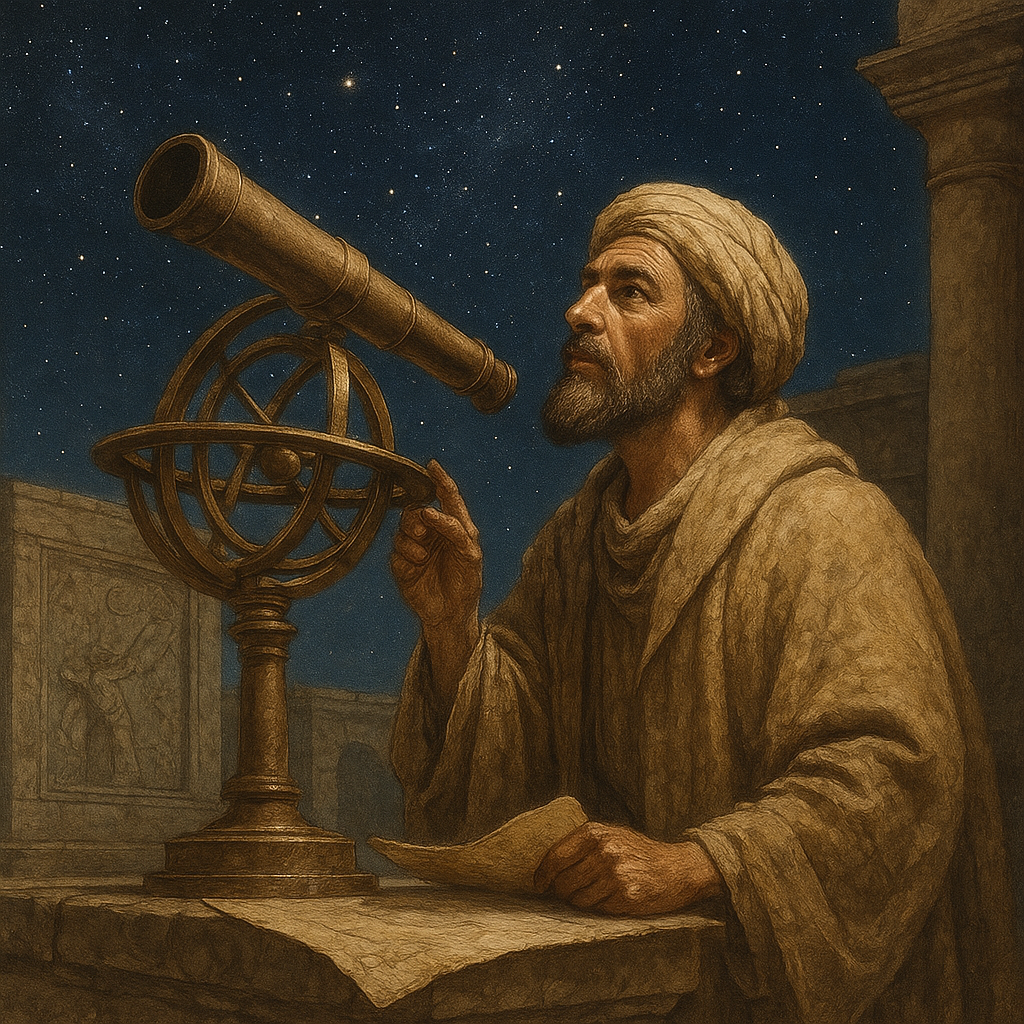
By the Hellenistic period, astronomers constructed armillary spheres—models of the celestial sphere composed of rings representing the equator, ecliptic, and meridians. These devices allowed them to visualize the motion of heavenly bodies and test spherical geometry theorems. Later, Chinese, Islamic, and European craftsmen refined these spheres, turning them into both teaching tools and status symbols.
Mathematics of Eclipse Prediction
In the first millennium BCE, the Babylonians discovered numerical cycles—like the Saros cycle—allowing them to predict eclipses of the Sun and Moon with remarkable reliability. Islamic astronomers inherited and enhanced these predictive tables, producing zij compilations that integrated Greek Ptolemaic models with Indian and Persian observations.
Star Catalogs and Coordinate Systems
Hipparchus, in the 2nd century BCE, compiled the first known star catalog, mapping over 850 stars and defining a coordinate grid based on celestial latitude and longitude. His work formed the basis for Ptolemy’s Almagest, which remained the authoritative astronomical text for over a millennium. Meanwhile, Chinese astronomers recorded hundreds of new stars and novae, some of which correspond to supernova remnants we observe today.
Legacy of Ancient Astronomical Wisdom
The achievements of antiquity continue to inspire modern researchers and amateur skywatchers alike. By studying ancient calendars, monuments, and texts, we gain insight into how our predecessors perceived their place in the cosmos. Their blend of **mythology**, **mathematics**, and architecture reminds us that the quest to understand the universe is a timeless human endeavor.