


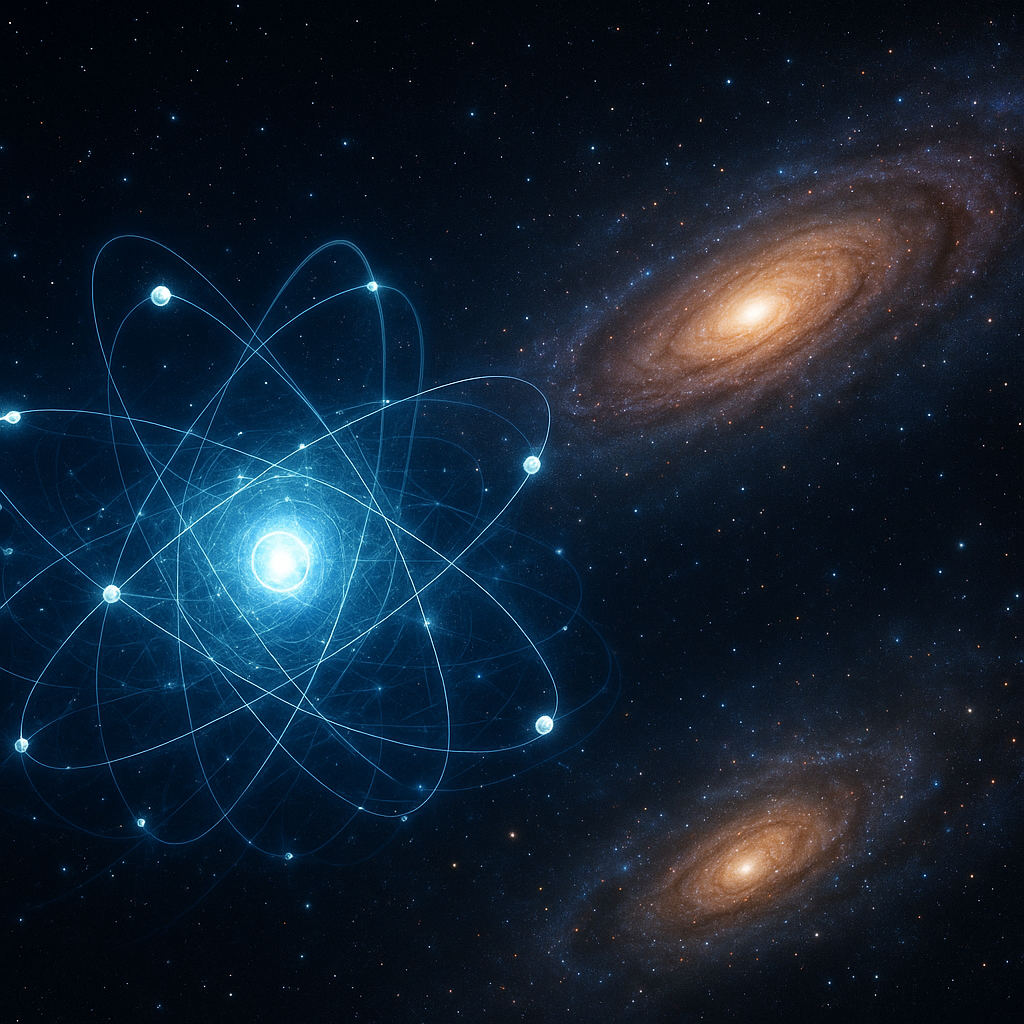
Exploring the interplay between quantum mechanics and cosmic evolution reveals surprising connections that reshape our perception of the universe. From the birth of spacetime to the large-scale distribution of galaxies, the invisible rules governing the subatomic realm weave themselves into the grand tapestry of the cosmos. This article delves into how the peculiar principles of quantum theory extend far beyond atoms and microscopes, leaving indelible marks on the structure and history of everything that surrounds us.
Quantum Foundations of the Universe
The first moments after the Big Bang present one of the most profound puzzles in physics. At energy scales trillions of times higher than those accessible in particle accelerators, gravity and quantum effects merge into a single, enigmatic regime. Standard cosmology relies on classical general relativity to describe the smooth expansion of spacetime, but close to the initial singularity, the uncertainty inherent in quantum mechanics must be taken into account. Physicists envision that the very fabric of spacetime arises from a network of quantum processes, often referred to as a quantum gravity foam.
In this view, spacetime is not a continuous stage but rather a patchwork of fluctuating geometries. These fluctuations give rise to minuscule pockets where distances and durations lose their classical meaning. The familiar notions of before and after break down, replaced by probabilistic amplitudes that only coalesce into definite outcomes once they interact with larger systems. Such a picture implies that the universe’s birth was not a single, sharply defined event, but a quantum transition out of a pre-spacetime state.
One key concept is superposition, the idea that a system can occupy multiple states simultaneously. In the cosmic context, entire universes might exist in superposed configurations of geometry and matter content. While most of these alternatives never become part of our reality, their fleeting influence may shape the distribution of energy and curvature that follows. Researchers aim to derive observable signatures of these primordial quantum phenomena, seeking traces in the cosmic microwave background or in subtle gravitational wave patterns.
Entanglement and Cosmic Structure
Entanglement stands as perhaps the strangest prediction of quantum physics: particles share properties instantaneously across vast distances. In the infant universe, entangled fluctuations in the quantum fields of space could link regions separated by billions of light-years. As the universe expanded and cooled, these quantum correlations stretched and froze into the seeds that would later grow into galaxies and clusters.
Though classical theories attribute structure formation to gravitational amplification of small density variations, the origin of those variations is fundamentally quantum. Tiny fluctuations in particle fields, amplified by the rapid expansion during inflation, acquire correlations that extend across space. When measured today, these correlations emerge as temperature anisotropies in the relic microwave radiation, providing a direct window into quantum processes at cosmic scales.
Key roles of entanglement in the cosmos:
- Linking distant regions through coherent fluctuations
- Imprinting nonlocal patterns in the cosmic microwave background
- Influencing the distribution of matter on the largest scales
Current experiments refine measurements of these anisotropies to test theoretical predictions. Even slight deviations from Gaussian statistics would signal exotic entanglement properties, hinting at new physics beyond the simplest inflationary models. Such discoveries could illuminate the nature of dark matter or the interactions of primordial fields that drove the universe’s initial burst of growth.
Vacuum Fluctuations and Inflationary Seeds
Perhaps the most spectacular application of quantum theory to cosmology lies in inflation, the hypothesized epoch of accelerated expansion that occurred fractions of a second after the Big Bang. During this phase, vacuum fluctuations—temporary changes in quantum fields even in empty space—were stretched to macroscopic scales. These fluctuations served as the initial perturbations from which galaxies and cosmic webs emerged.
Vacuum fluctuations arise from the uncertainty principle: a field’s energy cannot remain perfectly constant over arbitrarily short times. Pairs of virtual particles constantly pop into and out of existence, creating a frothy quantum vacuum. Inflation takes advantage of this froth, freezing fluctuations into lasting distortions of spacetime geometry. When expansion ends, these distortions become density variations in the primordial plasma.
Mathematically, inflationary models predict a nearly scale-invariant spectrum of fluctuations—equal strength across different length scales. Observations confirm this remarkable feature with high precision. Yet subtle departures from perfect scale invariance could hint at the detailed physics of the inflationary field, such as its self-interaction strength or coupling to other quantum fields.
Seeds of Cosmic Structure
As the universe cools further, these seeds undergo gravitational collapse. Regions slightly denser than average attract surrounding matter, eventually forming stars, galaxies, and clusters. Without quantum vacuum fluctuations, the universe would have remained too smooth to give rise to complex structures. The mere existence of planets and life itself hinges on these minute primordial wrinkles, born in the quantum realm.
Testing Inflationary Quantum Effects
Ongoing and planned missions aim to detect primordial gravitational waves—ripples in spacetime produced by the dynamics of inflation. These waves would carry signatures of the inflationary vacuum, offering a direct confirmation of quantum physics at the largest scales. A detection of B-mode polarization patterns in the cosmic microwave background would constitute one of the most significant breakthroughs in modern cosmology.
Observational Implications of Quantum Cosmology
The marriage of quantum mechanics and cosmology bridges the very small with the very large, transforming abstract principles into observable phenomena. As telescopes and detectors push the boundaries of sensitivity, they reveal the quantum fingerprints on cosmic history. By analyzing the distribution of galaxies, gravitational lensing effects, and the fine structure of background radiation, scientists extract clues about vacuum processes, entanglement, and the nature of dark components.
Dark matter and dark energy remain two of the deepest mysteries. While both are introduced phenomenologically in cosmological models, quantum field theory offers frameworks to describe them. Dark energy may correspond to the energy density of the vacuum itself, while dark matter candidates include novel quantum particles such as axions or sterile neutrinos. Laboratory searches and astrophysical observations work in tandem to validate or rule out these proposals.
Future experiments will harness techniques like 21-centimeter tomography, mapping hydrogen distribution across cosmic time, and advanced interferometers probing primordial gravitational waves. Together, these efforts will sharpen our understanding of how quantum fluctuations influenced every stage of cosmic evolution, from the Planck era to galaxy formation.
- Mapping residual quantum correlations in the cosmic web
- Identifying particle candidates for dark matter via quantum detectors
- Probing vacuum energy contributions with high-precision cosmography
By integrating quantum principles into our cosmological toolbox, researchers aim to construct a unified narrative of the universe’s origin, composition, and ultimate fate. As observations converge with theoretical breakthroughs, the boundary between the microscopic quantum world and the macroscopic cosmos continues to blur, revealing a reality more interconnected and wondrous than ever imagined.