





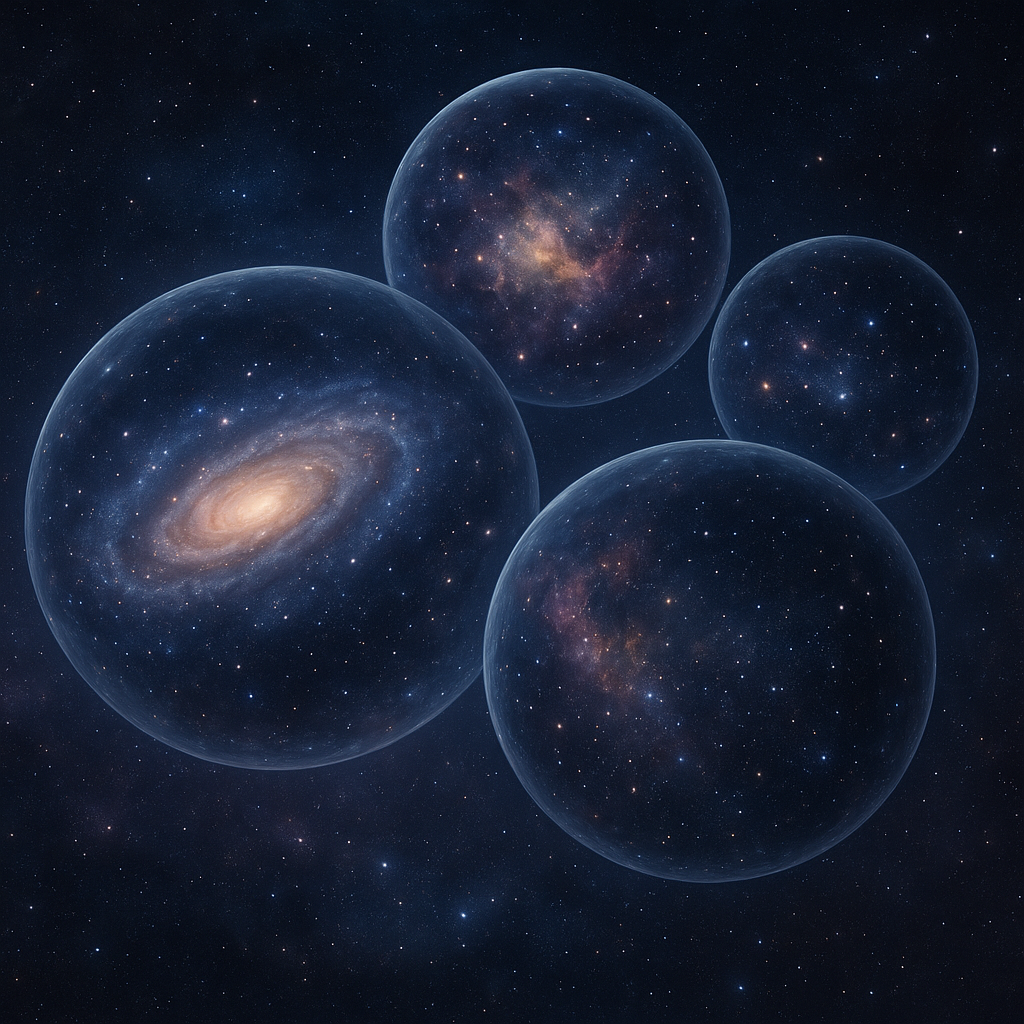
The concept of a multiverse suggests that our cosmos might be just one of countless parallel realities, each with its own unique laws and properties. Far from mere speculation, this idea has gained traction among physicists, cosmologists, and philosophers alike. By exploring the origins, scientific underpinnings, and far-reaching consequences of the multiverse hypothesis, we can better appreciate how it challenges our understanding of reality and the very fabric of existence.
Origins of Multiverse Concepts
The seeds of the multiverse notion first appeared in philosophical debates about infinity and the nature of existence. Ancient thinkers pondered whether a finite cosmos could truly encompass all possibilities. However, it was the advent of modern cosmology and breakthroughs in mathematics that transformed these musings into a testable framework.
Historical Precedents
- Ancient Greece: Philosophers such as Anaximander speculated about infinite worlds beyond the observable sky, planting early seeds for cosmic plurality.
- Johannes Kepler: In the early 17th century, his ideas on planetary systems hinted that stars could host their own solar systems, paving the way for a broader cosmic vista.
- 18th and 19th Centuries: Enlightenment thinkers and Romantic poets embraced the idea of a vast universe teeming with unknown worlds, blending science with imagination.
Philosophical Impetus
Beyond historical speculation, the multiverse concept grew from philosophical challenges to the uniqueness of our laws of physics. If certain fundamental constants seem finely tuned for life, why assume these values persist everywhere? Could an ensemble of diverse universes explain this fine-tuning without invoking special creation or design?
Scientific Foundations
Today’s interest in a multiverse is grounded in rigorous theoretical frameworks and emerging observational cues. Rather than idle conjecture, this field intersects with cutting-edge research in quantum mechanics, string theory, and cosmic inflation.
Inflationary Cosmology
The theory of inflation proposes that the universe underwent an exponential expansion in its first fleeting moments. Intriguingly, variations in how inflation proceeds can generate “bubble universes,” each budding off with its own physical constants. These bubbles form an enormous cosmic foam—an eternal stream of diverse domains, collectively forming a multiverse.
Quantum Mechanics and the Many-Worlds Interpretation
Quantum theory’s Many-Worlds Interpretation (MWI) takes a bold stance: every quantum decision branches reality into separate, noncommunicating worlds. Every time a particle’s wavefunction collapses, the universe splits, spawning a new branch where each possible outcome unfolds. Although debate continues over whether MWI can be empirically verified, it remains one of the most compelling quantum multiverse models.
String Theory’s Landscape
String theory posits that the fundamental components of matter are one-dimensional strings whose vibrations produce particles and forces. Yet this theory allows for an enormous “landscape” of possible solutions—some estimates count more than 10^500 distinct vacuum states. Each state translates into a different universe with unique physical laws and particle interactions.
Observational Hints
- Cosmic Microwave Background (CMB) anomalies: Slight temperature irregularities might be fingerprints of bubble collisions in a greater multiverse.
- Dark flow: Unexplained large-scale motions of galaxy clusters may hint at gravitational pull from regions outside our observable universe.
- Fine-tuning and anthropic reasoning: The surprising suitability of fundamental constants for life invites the idea that we inhabit a hospitable pocket among an ensemble of less accommodating realms.
Implications and Debates
Embracing the multiverse carries deep philosophical and scientific consequences. From the nature of reality to the limits of empirical science, this idea reshapes core assumptions about our place in the cosmos.
Philosophical and Existential Impact
If countless universes exist, the notion of a unique, privileged world dissolves. Questions of purpose, destiny, and meaning take on new dimensions. Are human experiences special or just one random outcome in a vast cosmic lottery? The multiverse challenges anthropocentrism, urging a more humble perspective on humanity’s significance.
Challenges to Scientific Methodology
- Testability: Critics argue that unobservable universes lie beyond the scope of empirical science, rendering the idea speculative.
- Falsifiability: If any outcome occurs somewhere, does the multiverse hypothesis lose its predictive power?
- Occam’s Razor: Introducing an infinite ensemble of realities may violate the principle of simplicity in scientific theory-building.
Potential Pathways to Evidence
Despite these hurdles, scientists propose ingenious tests. Advanced CMB surveys could reveal collision signatures, while high-precision measurements of fundamental constants might detect subtle regional variations. In quantum experiments, refined interferometry or entanglement studies could shed light on branching realities predicted by the Many-Worlds Interpretation.
Future Directions
As observational techniques advance and new theoretical insights emerge, the multiverse concept remains a vibrant frontier. Collaborative efforts between cosmologists, quantum physicists, and philosophers aim to refine definitions, propose testable models, and confront the deep questions raised by a cosmos potentially teeming with infinite universes. Whether the multiverse proves real or fades as an elegant myth, its exploration enriches our quest to understand the ultimate nature of everything.